Bulgaria Just Got Its First Fully Online Prepaid eSIM — and the Timing Makes Sense
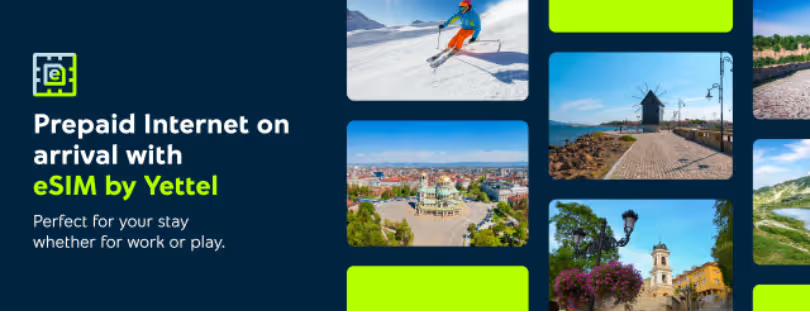
For anyone who’s landed in Sofia and spent 20 minutes hunting for a SIM card kiosk that’s either closed, cash-only, or buried in a mall basement — Yettel’s new prepaid eSIM service is going to feel quietly revolutionary. Yettel Bulgaria prepaid eSIM
Bulgaria‘s leading telecom has become the first local operator in the country to offer a fully online prepaid eSIM for mobile data. No store. No physical card. No ID. You buy it before you board, activate it on arrival, and you’re connected. It’s the kind of frictionless experience that travelers have come to expect from MVNOs like Airalo or Yesim – except this time it’s coming from the incumbent, with local network infrastructure backing it up.
Two Plans, One Clear Logic
The launch lineup keeps things simple. Yettel is offering two plans:
Yettel 25 GB — €10.23 (BGN 20), valid for 30 days, with unlimited data for the first 5 days followed by a 25 GB pool for the remainder. Built for short trips, city breaks, or the kind of visit where you need to stay connected but won’t be burning through data on 4K uploads.
Yettel 100 GB — €40.90 (BGN 80), valid for 60 days, with 20 days of unlimited data upfront, then a 100 GB allowance. This one’s clearly aimed at longer stays — digital nomads doing a Balkans run, extended family visits, or slow travelers who actually need the bandwidth.
The “unlimited days first” structure is worth noting. It’s a smart UX choice: it eliminates the anxiety of data monitoring during the most intensive phase of any trip, when you’re navigating, booking, translating, and mapping everything at once. After that initial buffer, you’re on a metered pool — which, frankly, 25 GB or 100 GB is more than enough for most travelers.
Buying It Doesn’t Require a Tutorial
The purchase flow is five steps: pick a plan, enter your email, verify, pay, and confirm. That’s it. After purchase, you get a QR code, activation instructions for both iOS and Android, and an optional PDF invoice if you need it for expenses.
No account creation. No passport scan. No waiting at a counter. The absence of mandatory ID verification is worth flagging explicitly — it’s not a loophole, it’s by design. Data-only prepaid SIMs in the EU don’t carry the same registration obligations as voice services, which means Yettel can offer a genuinely anonymous, friction-free product here.

One More Thing: Vignettes
Somewhat unexpectedly, Yettel has bundled its vignette (road toll pass) sales into the same digital ecosystem. Anyone driving in Bulgaria needs one — it’s mandatory on national roads — and Yettel’s platform covers all durations: daily, weekend, weekly, monthly, quarterly, and annual. It’s a small but clever touch. You’re not just selling connectivity; you’re positioning yourself as the first stop for anyone arriving in Bulgaria and trying to get organized quickly.
What This Actually Means for the Market
Here’s the bigger picture: local telecoms entering the prepaid eSIM space directly is a trend worth watching. For years, the eSIM travel market has been dominated by MVNO-style aggregators — Airalo, Holafly, Nomad, Ubigi, Yesim — who buy wholesale capacity from operators like Yettel and resell it with a margin. They’re good at UX, brand-building, and reaching travelers digitally. But they’re not the network.
When operators launch their own consumer-facing eSIM products, they compress the supply chain. Yettel’s €10.23 price point for 25 GB over 30 days is competitive — roughly in the range of what you’d pay on Airalo for Bulgarian coverage, without the MVNO middleman. The quality argument is even simpler: you’re on Yettel’s own network, not a roaming agreement that may or may not prioritize your traffic.
This mirrors what’s happening elsewhere. Operators across Central and Eastern Europe are slowly waking up to the fact that the eSIM travel segment is real revenue walking out the door to aggregators. Orange, A1, and Deutsche Telekom affiliates have made similar moves in their respective markets. Yettel’s Bulgaria launch adds another data point to that pattern.
The question is whether operators can actually compete on distribution and discovery, which is where the aggregators have a structural advantage. A traveler searching “Bulgaria eSIM” is far more likely to land on Airalo or Holafly than Yettel’s website. That’s a marketing and SEO problem, not a product one. According to GSMA Intelligence, eSIM-capable device penetration continues to accelerate across Europe, and the prepaid travel segment is among the fastest-growing use cases. The operators who build direct digital channels now will be better positioned as that growth compounds.
Yettel‘s move is straightforward, well-executed, and a signal of where the regional telecom market is heading. Whether it captures meaningful market share depends less on the product — which is solid — and more on whether travelers ever find out it exists.