For a long time, business mobile connectivity was treated as something boring, contractual, and slightly painful. A company signed a deal with a mobile operator, handed employees physical SIM cards, accepted roaming as a cost of doing business, and hoped nobody came back from Singapore, Dubai, or New York with a bill that made finance angry.
Company eSIM, or business eSIM, is becoming one of the more interesting corners of the wider eSIM market because it solves a very specific problem: companies no longer work in neat geographic boxes. Teams travel, devices move, contractors join projects quickly, and employees expect their phone or laptop to connect as smoothly abroad as it does at home. The physical SIM card was never designed for that world.
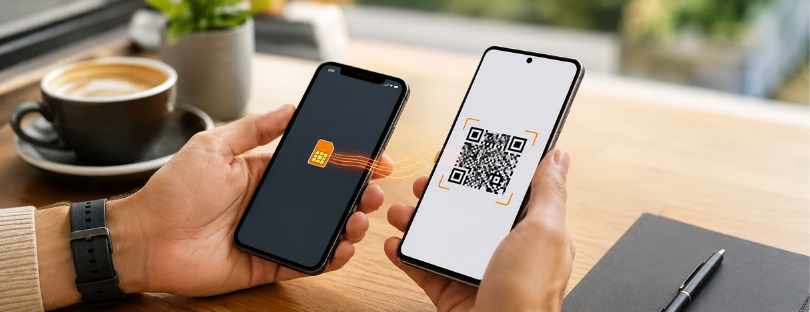
The GSMA defines eSIM as a global specification that allows remote SIM provisioning, meaning a mobile subscription can be downloaded and managed digitally rather than tied to a removable plastic SIM card. That sounds technical, but the business implication is simple: companies can activate, change, or manage connectivity without physically touching the device.
Why businesses care now
The timing matters. eSIM adoption in consumer travel has made people more comfortable with buying connectivity digitally. A traveller who has used Airalo, Holafly, Yesim, Ubigi, Nomad eSIM, or GigSky on holiday is less likely to accept old corporate roaming logic at work. Once people see how easy mobile data can be, the corporate process suddenly feels unnecessarily slow.
But company eSIM is not just “travel eSIM with an invoice.” That is where the market often gets lazy.
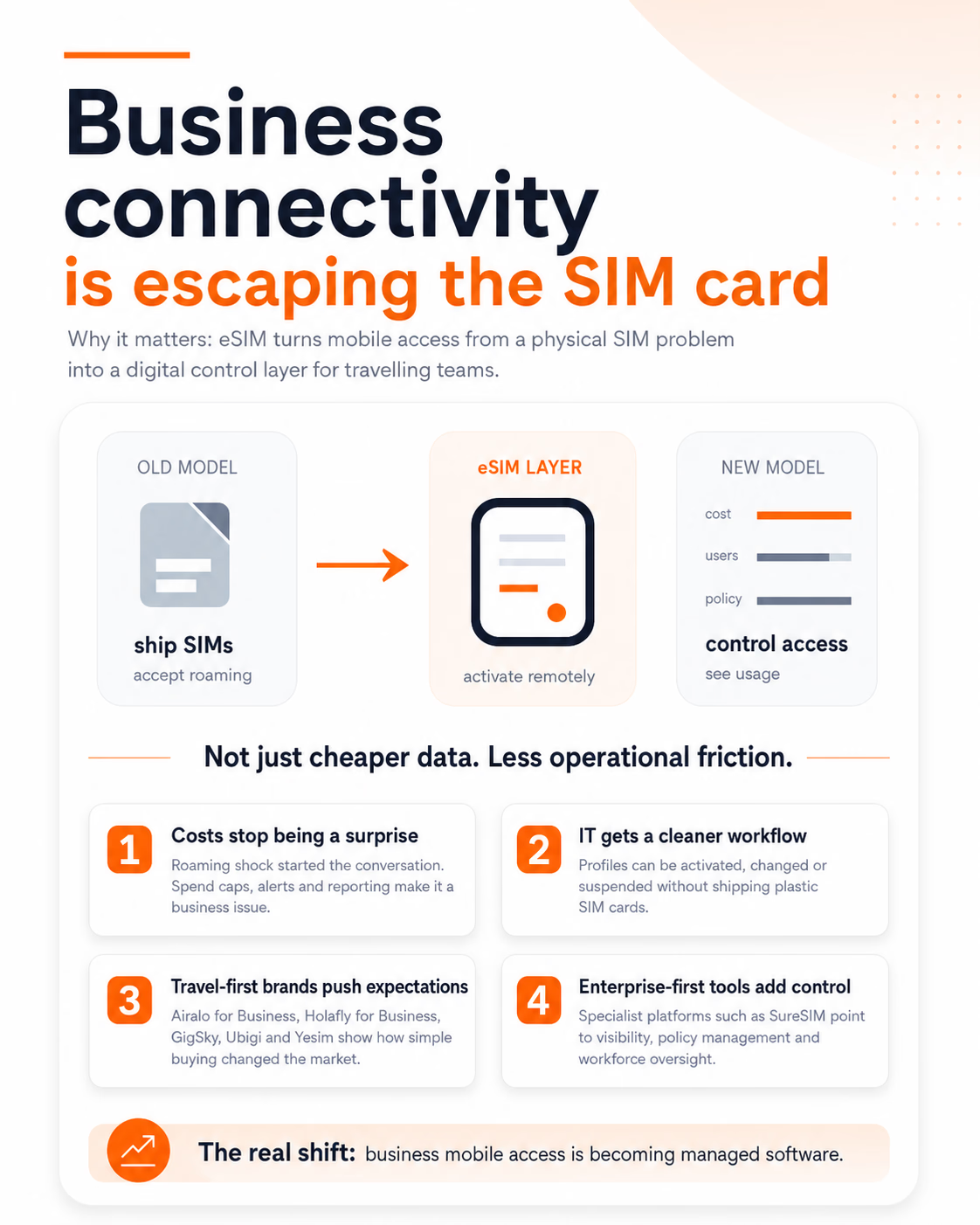
A business does not only need cheap data. It needs control. Who is using data? In which country? On which network? What happens when usage spikes? Can a company cap spend? Can IT deploy connectivity to a new employee without shipping a SIM card? Can policies differ for executives, field workers, contractors, and frequent travellers?
That is the real shift. eSIM is moving from a consumer convenience product into a management layer.
More on Alertify
Follow the latest enterprise eSIM news
Enterprise connectivity, workforce mobility, roaming control and business eSIM market moves in one place.
Explore news →
Beyond roaming savings
Roaming cost is still the hook, of course. Nobody enjoys paying legacy roaming rates when travel eSIMs have trained the market to expect flexible, destination-based pricing. Juniper Research has projected strong growth in travel eSIM revenues, with reports pointing to rapid expansion as more operators and digital providers compete for international data demand.
Still, the more interesting story is operational. Physical SIM management creates hidden costs: procurement, shipping, replacement, lost SIMs, manual setup, support tickets, and employees using personal hotspots because the company solution is too slow. In a large organisation, those small frictions become expensive.
Company eSIM removes some of that mess. A business can provision profiles remotely, onboard users faster, and reduce dependence on local SIM purchases or reimbursement claims. For international teams, that can be more valuable than saving a few euros per gigabyte.
Thales, for example, positions eSIM solutions around remote activation, subscription management, and connectivity for operators, enterprises, and IoT providers. Its enterprise messaging reflects where the market is heading: eSIM is not just about the SIM itself, but about managing connectivity as a digital service.
The market is splitting
There are now several types of players circling the businesses’ eSIM opportunity.
Traditional mobile operators still have the strongest enterprise relationships. Vodafone Business, Orange Business, Deutsche Telekom, AT&T, and others already sit inside procurement departments. Their advantage is trust, contracts, SLAs, and bundled services. Their weakness is often flexibility. The corporate telco model can still feel heavy, especially for companies that want fast deployment across multiple countries.
Then there are enterprise mobility specialists and global connectivity platforms. Players such as 1GLOBAL, BICS, iBASIS, Transatel, Gigs, eSIM Go, and similar infrastructure or enablement companies are closer to the plumbing. They help brands, platforms, and enterprises build connectivity into products or manage it across markets.
Finally, travel-first eSIM brands are moving toward business users. Airalo for Business, Holafly Connect, GigSky, Ubigi, Yesim’s B2B propositions, and other providers are trying to capture SMEs, travel-heavy teams, and companies that do not want a full enterprise telecom contract. Their strength is simplicity. Their challenge is proving they can handle governance, support, reporting, and predictable performance at a business scale.
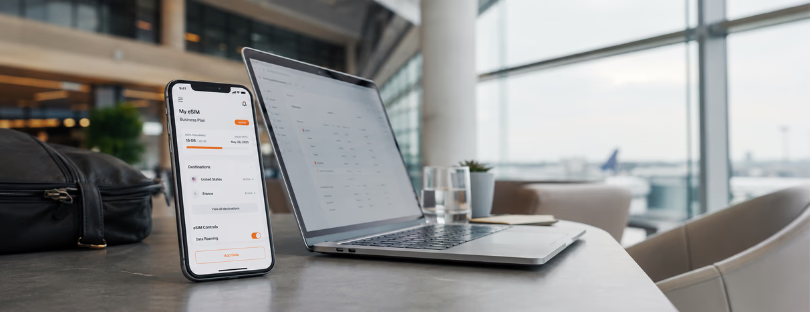
Then there is a more specialised category emerging between traditional telcos and travel eSIM apps: enterprise-first eSIM management. SureSIM fits here. It is not trying to look like a holiday eSIM app with a corporate login added on top. Its role is closer to workforce connectivity control, giving companies visibility over usage, spend, active networks, SIM status, and policy management across traveling employees and business devices. That matters because enterprise buyers are not only asking, “Can my team get online abroad?” They are asking, “Can we control the cost, see what is happening, and manage connectivity without creating another operational headache?”
This is where the business eSIM market becomes more serious. Travel-first brands are useful when a business wants speed and simplicity. Traditional operators still matter when procurement wants scale, contracts, and familiar accountability. But enterprise-first platforms such as SureSIM show where the category is heading: not just cheaper roaming, but managed, policy-led connectivity built around how companies actually operate.
What buyers should check
The best enterprise eSIM offers will not be judged only by coverage maps. Coverage is easy to advertise and harder to experience consistently.
A serious buyer should ask about network access, fallback options, throttling rules, hotspot support, usage visibility, spend controls, refund handling, admin roles, security, and support response times. They should also ask whether the provider is a reseller, an MVNO, a platform, an operator partner, or a deeper infrastructure player. The answer affects performance, pricing flexibility, and accountability.
This is where the market still has some growing up to do. Too many eSIM pages talk about “global connectivity” as if all countries, networks, and usage cases are equal. They are not. A sales director using Teams from an airport lounge, a construction worker uploading site photos, and a consultant crossing three countries in one week do not need the same product.
The real business case
Company eSIM will win when it stops being presented as a cheaper roaming trick and starts being treated as workforce infrastructure.
The companies most likely to benefit first are not only huge multinationals. SMEs with travelling sales teams, event companies, logistics firms, consulting agencies, remote-first startups, media crews, and hospitality groups can all use eSIM to simplify connectivity without rebuilding their entire telecom setup.
For larger enterprises, the question is different. They will not replace traditional telcos overnight. More likely, they will add eSIM as a flexible layer next to existing contracts, especially for international travel, temporary teams, secondary devices, and markets where the main operator deal performs poorly.
Conclusion
Company eSIM is not going to kill corporate telecom. That is too simplistic. What it will do is expose where corporate telecom has become too rigid.
Traditional operators still matter because businesses trust them with contracts, compliance, and scale. Travel eSIM brands matter because they changed user expectations. Infrastructure players matter because they make programmable connectivity possible behind the scenes. The winners will be those who combine all three ideas: operator-grade reliability, travel eSIM simplicity, and software-style control.
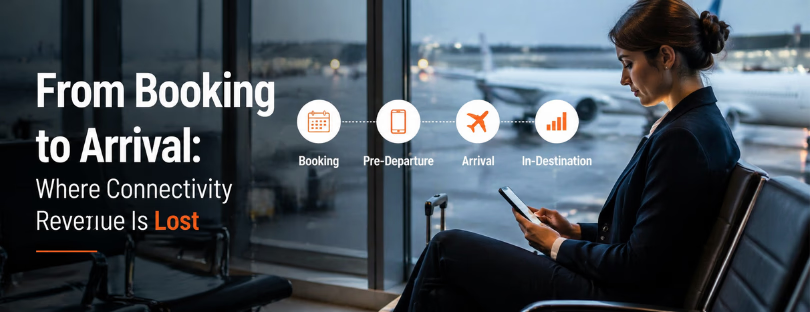
That is the real trend. Business connectivity is becoming less about owning a SIM card and more about managing access. The company that understands this will not ask, “Which SIM should we give employees?” It will ask, “How do we make connectivity invisible, controlled, and ready before the employee even lands?”
Driven by wanderlust and a passion for tech, Sandra is the creative force behind Alertify. Love for exploration and discovery is what sparked the idea for Alertify, a product that likely combines Sandra’s technological expertise with the desire to simplify or enhance travel experiences in some way.