Best eSIM approaches for frequent and business travellers
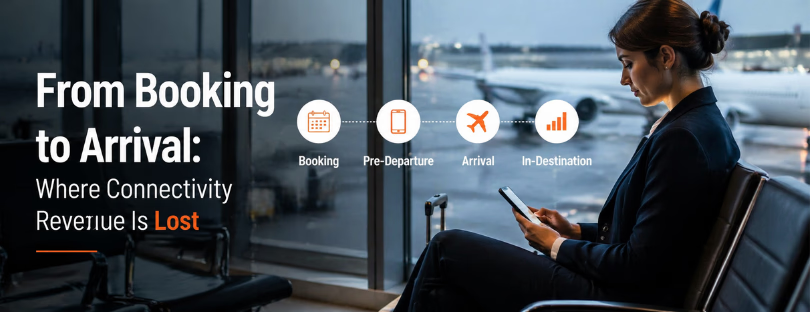
If you travel a lot for work, you already know the moment when connectivity stops being “a travel detail” and becomes an operational dependency. The ride-share at arrivals. The QR code for the hotel self-check-in. The “can you jump on a quick call” that always happens five minutes after landing.
And yet most people still treat mobile data like a last-minute purchase, not part of the travel system.
The good news is that the eSIM market has matured fast. The confusing part is that it matured in multiple directions at once. Consumer travel eSIM brands, airline and telco roaming passes, corporate wallets, voucher programs, managed mobility, multi-profile devices. If you are a frequent or business traveller, the “best eSIM” is not a single product. It is an approach.
So let’s talk about the approaches that actually work, what they optimize for, and what usually breaks in real life.
Approach 1: The “single wallet” model (one provider, many trips)
This is the approach most frequent travellers end up loving once they find a provider they trust: you keep one eSIM installed, top up as needed, and reuse it trip after trip. In practice, it feels like a travel connectivity subscription, even when it is technically prepaid.
Why it works:
- You stop doing the airport connectivity dance.
- You build muscle memory: same app, same activation flow, same receipts.
- You get predictable billing and fewer “surprise settings” moments.
Where it fails:
- Coverage quality varies by country because most travel eSIMs ride on partner networks.
- Some providers are great for data, weaker for voice, SMS, or support.
- “Unlimited” is often a marketing word, not an engineering promise.
If you are flying twice a month, the wallet approach wins because it reduces decision-making fatigue. You are not searching for the best plan every time. You are buying back your attention.
Approach 2: The “two-line system” (separate work line, separate travel data)
Business travellers who cannot afford downtime often run two lines on a dual SIM phone: one stable line that never changes (for authentication, bank SMS, work systems), and one travel eSIM line for data.
Think of it as risk separation.
Why it works:
- Your identity line stays stable: 2FA codes, WhatsApp, iMessage, banking, corporate accounts.
- Your travel data line can change based on region, price, or performance.
- If something goes wrong with the travel plan, your core line still lives.
Where it fails:
- Some people forget which line is used for what and end up burning roaming on the wrong SIM.
- Corporate security policies can complicate multi line setups.
- Not every phone handles dual SIM elegantly, especially with voice routing.
If you do client travel, conferences, or multi-country trips, this is one of the most resilient setups you can run.
Approach 3: Regional eSIMs for predictable routes (EU, APAC, North America)
If you travel the same corridors repeatedly, a regional eSIM usually beats buying a new country plan each time. The bigger win is not just price. It is operational simplicity: fewer activations, fewer profiles, fewer receipts.
Why it works:
- One plan covers your predictable geography.
- It reduces admin overhead for expense claims.
- It is easier to standardize across a team.
Where it fails:
- Regional coverage can hide weak spots (a country included, but only via one partner network).
- Some regional plans have uneven speeds depending on roaming agreements.
- Not ideal if your routes include fringe destinations.
This approach is “boring by design,” which is exactly what frequent travellers should be optimizing for.

Approach 4: Corporate eSIM provisioning (the managed approach)
This is where eSIM stops being a consumer purchase and becomes an enterprise control. Instead of employees choosing plans ad hoc, the company issues connectivity via a platform: profiles, policies, spend controls, reporting, support. It aligns closely with the broader enterprise mobility and telecom expense management universe.
Why it works:
- Spend becomes a policy line item, not a travel surprise.
- IT and finance can see usage patterns and control risk.
- Support gets centralized, which matters when someone lands and has no service.
Where it fails:
- Rollout friction: devices vary, user behaviour varies, travel patterns vary.
- Overly strict policies create workarounds (people buy their own plans).
- Some programs focus on cost but ignore performance, which is a false economy.
If you manage frequent travel across a team, this is the approach that scales. It also fits the direction the industry is moving in: more centralized provisioning models, especially as standards evolve and bulk management becomes normal in the broader eSIM ecosystem.
Approach 5: Voucher and co-branded eSIM distribution (the travel industry play)
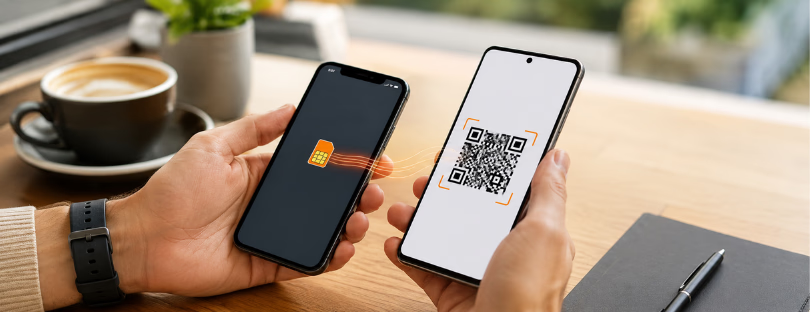
This approach is less about the traveller choosing an eSIM and more about travel brands embedding connectivity into the trip: agencies, airlines, hotels, event organizers. You receive a voucher code, activate in one minute, and move on.
Why it works:
- It is frictionless at the moment it matters, usually right before departure.
- It shifts connectivity from “extra task” to “included utility.”
- It is easy to standardize for groups, delegations, and corporate travel programs.
Where it fails:
- If support is unclear, travellers get stuck between the travel brand and the eSIM provider.
- Vouchers can be misconfigured (wrong region, wrong validity).
- Some travelers still want choice, especially power users.
This is one of the biggest market trends you should watch because it changes distribution. The travel industry does not want to sell “data.” It wants to sell peace of mind.

Approach 6: Backup-first planning (the underrated pro move)
Here is the most honest thing I can say after years of watching business travel behaviour: the best eSIM setup is the one that includes a backup plan before you need it.
Not a backup you “could buy.” A backup that already exists.
Practical backup patterns that work
- Keep a small global eSIM with a little data always installed.
- Keep a second provider ready for your most common destination.
- Keep roaming disabled by default, then enable only if absolutely necessary.
- Save airport Wi-Fi sign-in steps and VPN settings before travel.
This approach matters because travel risk management frameworks explicitly emphasize communication and the ability to keep employees informed and connected. Connectivity is not just convenience. It is part of operational safety and duty of care thinking.
So what is “best” right now
If you are a solo frequent traveller, the best approach is usually a hybrid:
- A trusted single wallet provider for most trips
- Plus a small always-on backup eSIM
- Plus a stable identity line for your work and banking life
If you run travel for a team, the best approach is standardization:
- A managed corporate eSIM program for the majority
- A regional plan strategy for repeat corridors
- Clear backup rules for edge cases, not heroic improvisation
And across both worlds, the real differentiator is no longer “can I buy data.” It is: can I stay connected without thinking about it.
Conclusion about the best eSIM for business travellers
The eSIM market is heading toward two different endgames, and frequent travellers sit right in the middle.
On the consumer side, eSIM adoption keeps accelerating, and the travel use case remains a major on-ramp. GSMA Intelligence has forecast eSIM smartphone connections reaching billions by 2030 and becoming the majority of smartphone connections. That means more competition, more pricing games, and more “unlimited” plans that are actually built on fair-use logic. Your advantage as a frequent traveller is learning to evaluate approaches, not slogans.
On the enterprise side, the story is control and scale. The industry is moving from individual, manual provisioning toward more centralized models, reinforced by newer standards work in the GSMA ecosystem and broader eSIM platform evolution. In plain terms: companies are increasingly treating connectivity like they treat laptops and identity, as something you issue, manage, and audit.
So the “best eSIM approach” is going to look more polarized over time:
- For individuals: fewer decisions, more reliability, smarter backups
- For companies: centralized provisioning, policy, reporting, and duty of care alignment
The travellers who win are the ones who stop shopping for plans and start designing a system. When your connectivity becomes boring, predictable, and almost invisible, that is not a small convenience. That is a professional advantage.