Beeline Russia Roaming: What Travellers Should Know
Beeline Russia is trying to make international roaming feel less like a trap and more like a managed travel feature. That is the real story behind its current roaming offer, not only the headline price.
On its Moscow roaming page, Beeline says it applies the same basic roaming conditions across 198 countries, covering the destinations where “99%” of its customers travel. The operator frames the offer around predictability: no extra setup country by country, no surprise switching, and the ability to choose how many gigabytes or minutes the traveller actually needs.
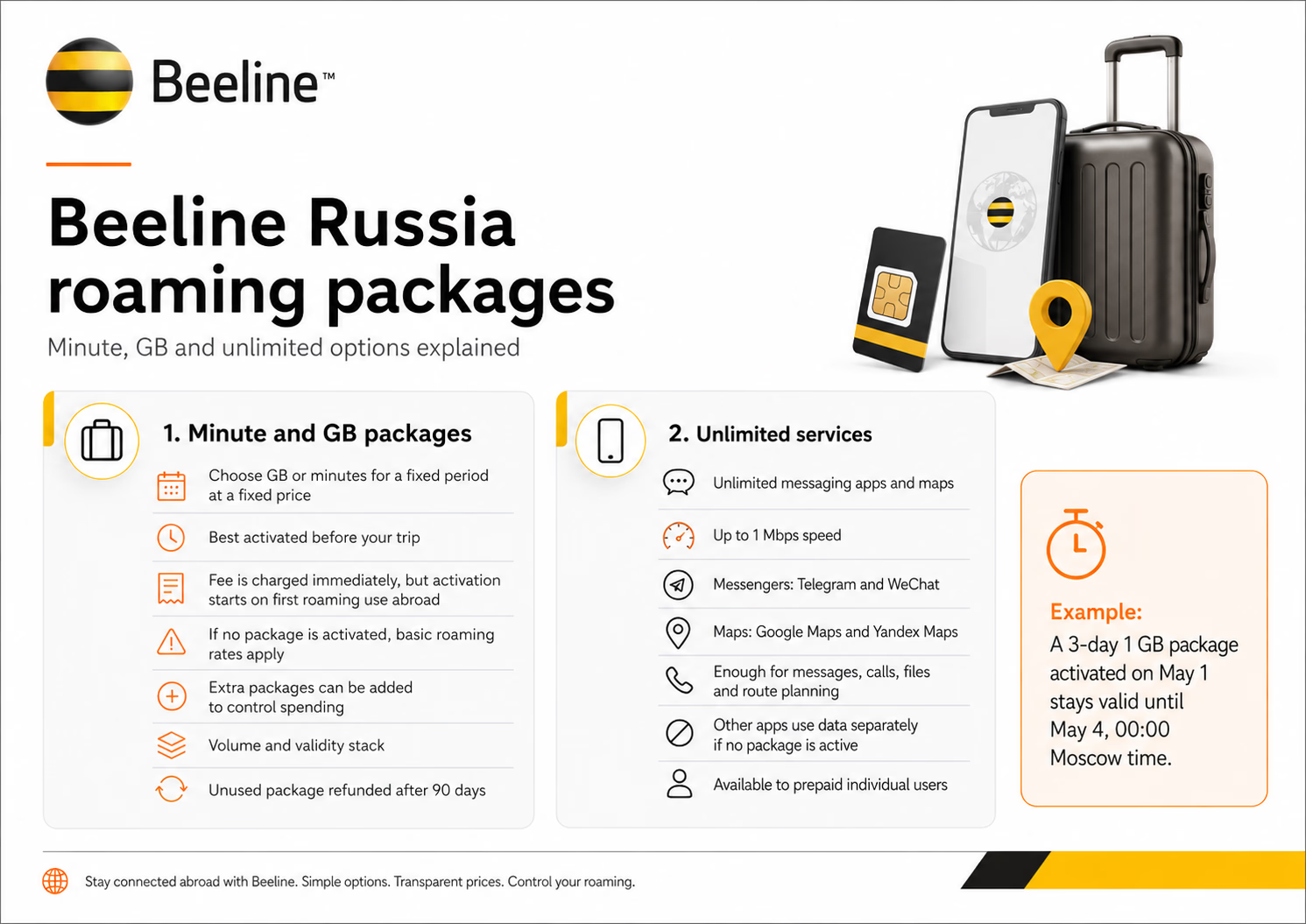
The basic condition is straightforward: 1GB for 500 ₽, updated every 24 hours. Calls are priced at 50 ₽ per minute for incoming and outgoing calls, incoming SMS are free, and outgoing SMS cost 45 ₽. On top of that, Beeline promotes lower-cost add-ons, with internet packages from 327 ₽, calls from 22 ₽ per minute, and unlimited maps and messengers from 100 ₽. For a traditional mobile operator, that positioning is quite telling. Beeline is not only selling roaming. It is selling control.
The app becomes the roaming dashboard
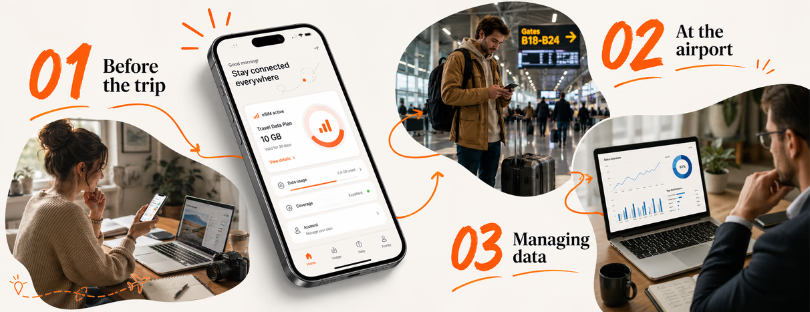
The Beeline app sits at the centre of the offer. The company tells users to install it before travelling, log in by phone number, and use it to manage roaming without consuming internet traffic abroad. It also says roaming can be enabled through the app even if the customer’s balance is negative. That is a smart operational detail, because roaming problems rarely happen at a convenient time. They happen at airports, hotel lobbies, train stations, or exactly when someone is trying to open a banking app.
There is also a practical travel checklist: turn on data roaming, disable automatic app updates, switch off cloud syncing, and activate a package before leaving to avoid accidental usage charges. These are not glamorous features, but they matter. The most common roaming pain is not always the price itself. It is the feeling that the phone is silently spending money in the background.
Beeline’s messaging is clearly built around that anxiety.
Why Beeline still defends roaming against local SIMs
One of the more interesting parts of Beeline’s FAQ is how directly it compares roaming with local SIM cards. The company argues that roaming keeps access to familiar Russian services, including banking apps and Gosuslugi, while avoiding some local restrictions in markets such as the UAE or China. It also says roaming can use available local partner networks and allows tethering.
That is a strong operator argument, and it is not wrong. Local SIMs can be cheaper, but they can also create friction: passport registration, local payment issues, language barriers, app restrictions, and the annoying problem of losing access to your home number for authentication. For Russian travellers in particular, that home-number continuity can be more important than saving a few euros.
This is where traditional roaming still has a case. Not because it is always the cheapest option, but because it preserves identity, banking access, SMS reception, support, and the customer’s normal mobile environment.
The eSIM pressure is obvious
Still, Beeline Russia is operating in a very different market than it was five years ago. Travel eSIM providers have trained users to expect instant activation, visible pricing, short-term data packages, and app-based control. GSMA Intelligence reported in March 2026 that, across 11 major surveyed countries, 12% of consumers who took international trips in the previous year used eSIM while travelling abroad.
That figure explains why operators are moving fast to make roaming more transparent. The competitor is no longer only another domestic mobile operator. It is Airalo, Holafly, Ubigi, Nomad eSIM, GigSky, Saily, Yesim, and dozens of regional eSIM brands selling simple travel connectivity before the traveller even reaches the airport.
Beeline’s answer is not to copy the travel eSIM model completely. It is to make roaming behave more like a digital product: app-first, package-based, visible, refundable in some cases, and easier to control.
Russia adds its own complications
Russia is also not a typical roaming market. Travellers leaving Russia may care deeply about keeping Russian digital services reachable. Travellers entering Russia face a market where local connectivity, payments, apps, and platform access can be more complex than in most European destinations.
Beeline also includes special domestic roaming-style notes for Russia, including conditions for Norilsk and the Taimyr Dolgan-Nenets area, as well as travel in the Win Mobile network, where speed can drop after daily usage thresholds. That detail matters because Russia is not one uniform connectivity environment. Large geography, regional network differences, and local operator arrangements still shape the user experience.
Final take
Beeline’s roaming offer is not trying to win the global travel eSIM price war. That would be difficult, especially when eSIM providers can package data-only access with leaner structures and aggressive destination pricing.
Its stronger position is different: trust, continuity, and control for existing Beeline customers. For a traveller who wants Russian banking access, SMS continuity, familiar support, and fewer setup steps, Beeline roaming can make sense. For a tourist who only wants cheap data abroad, a travel eSIM may still be a better value.
That is the wider trend Alertify readers should watch. The future of roaming is not simply “operators versus eSIM providers.” It is about who removes more friction at the exact moment the traveller needs connectivity. Beeline’s latest roaming positioning shows that traditional operators understand the threat. They are no longer just defending old roaming margins. They are trying to redesign roaming into something that feels predictable enough to survive the eSIM era.