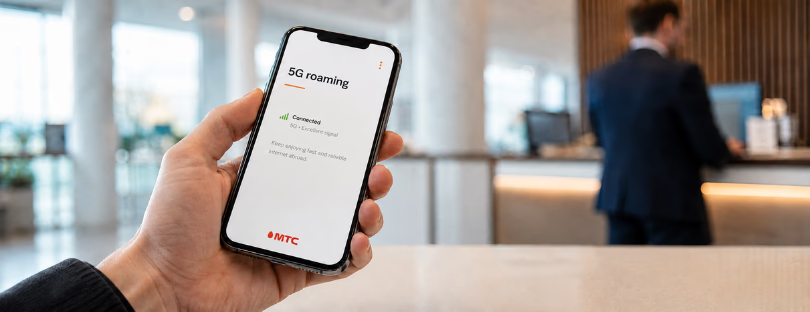
T2 Expands VoLTE Roaming Across 48 Markets
Russian mobile operator T2, formerly Tele2, is preparing a bigger international push for VoLTE roaming, with plans to expand the service to 48 countries and territories by the end of 2026.
For travelers, that sounds like a technical network update. In reality, it is more practical than it looks. VoLTE roaming lets customers make voice calls over 4G LTE instead of falling back to older 2G or 3G networks. The benefit is simple: faster call setup, clearer voice quality and fewer of those awkward seconds when a call feels like it may not connect at all.
T2 says its VoLTE roaming service is currently available to subscribers in 23 countries across 30 foreign networks. Around 70,000 customers reportedly use the feature abroad every day, which suggests this is no longer just a quiet engineering project sitting behind the scenes.
Why this matters now
The timing is important. Around the world, operators are gradually retiring older 2G and 3G networks, or at least reducing their importance. That creates a roaming problem: voice calls cannot simply depend forever on legacy fallback. If an operator wants customers to travel and still make normal calls, VoLTE roaming becomes part of the basic service promise.
This is exactly why GSMA has been pushing the industry to solve VoLTE roaming and 2G/3G sunset issues more seriously. LTE and 5G are now normal for mobile data, but voice roaming has been slower to modernize because it requires international agreements, interconnection testing, device compatibility and IMS support across networks.
That is the unglamorous part of roaming. A travel eSIM can often solve mobile data quickly. Voice is different. It depends on the home operator, the visited network, the device, the tariff and the commercial roaming relationship. When it works well, nobody thinks about it. When it fails, travelers notice immediately.
 T2’s expansion path
 T2’s expansion path
T2’s international VoLTE development accelerated in 2025, when the company integrated 18 foreign networks into the service within one year. Current destinations include major travel and business markets such as the United States, Australia, China, Japan, Spain and Germany.
The next phase is more ambitious: another 25 countries and territories are expected to be added by the end of 2026. If delivered, that would almost double T2’s footprint and move the service from a useful add-on into something closer to a standard travel connectivity feature.
There is also a competitive angle here. Operators are under pressure from two sides. On one side, global travel eSIM providers have made roaming data feel easier and more transparent. On the other hand, large telecom groups still want to defend the full-service relationship with customers, including voice, SMS, billing, number identity and roaming support. VoLTE roaming sits right in the middle of that fight.
The catch for travelers
This does not mean every T2 customer abroad will automatically get the same experience everywhere. VoLTE roaming can depend on handset support, software settings, destination network compatibility and whether the customer’s plan supports roaming voice in that country. That is still a weak point for the industry: operators often announce coverage, but the real user experience can vary by phone model and partner network.
For data-first travelers who only need WhatsApp, maps, ride-hailing and email, an eSIM data plan may still be simpler, especially for short trips. But for people who need their regular number abroad, such as business travelers, banking users, families, or anyone who still receives important voice calls, VoLTE roaming has real value.
T2’s move also shows something broader: roaming is not disappearing. It is being rebuilt. The old roaming model was about expensive minutes and megabytes. The new model is about reliability, continuity and whether your mobile identity still works when you cross a border.
Final take
T2 is not leading the global VoLTE roaming race yet. Some European operators already have wider VoLTE roaming footprints, and large international groups can lean on broader partner networks. But T2’s plan is still meaningful because it points to where the market is going.
Travel connectivity is becoming split into layers. eSIM providers are winning on fast, flexible data. Traditional operators are trying to win back trust by making roaming feel invisible again. VoLTE roaming is one of the clearest examples of that shift.
The real test for T2 will not be the number of countries in the press release. It will be consistency: does the call connect quickly, does the voice quality hold up, and does the customer understand where it works before they travel? If T2 gets that right, this expansion becomes more than a coverage milestone. It becomes a stronger reason for customers to keep their home operator relevant abroad.