Why Summer Heat Drains Smartphone Batteries Faster
Summer travel used to mean checking sunscreen, passports and roaming settings. Now there is another anxiety in the stack: will the phone stay alive long enough for maps, boarding passes, hotel check-in, payments, WhatsApp, eSIM activation and 4K video?
This is not paranoia. Apple says iPhone and iPad are designed for ambient temperatures between 0°C and 35°C, and that very hot conditions can permanently shorten battery life. Samsung gives Galaxy devices the same optimal range and warns that use or charging in extreme temperatures can accelerate battery deterioration. Google’s Pixel guidance also points to 0°C to 35°C and says exposure above 45°C, such as on a dashboard, can damage the phone or overheat the battery.
That matters because a European summer city, a beach club table or a rental car mount can push a phone past its comfort zone fast.
Why Heat Hurts
Lithium-ion batteries do not like three things together: high charge, high workload and high temperature. Summer gives them all three.
Think about a traveler landing in Barcelona at 2 p.m. The phone is at 92%, pulling 5G, running Google Maps, brightness is maxed, the camera is open, and the device is clipped to a windshield mount. The battery is not just draining. It is working hot.
Battery University’s lithium-ion guidance shows the direction clearly: after one year of storage at 40°C, a Li-ion cell held at 40% charge is estimated to retain about 85% capacity; held at 100%, it falls to about 65%. At 25°C, the equivalent figures are about 96% and 80%. A phone is more complex than a lab cell, but heat plus full charge is still a nasty little partnership.
The phone usually tries to protect itself before anything dramatic happens. Apple lists common symptoms: charging slows or stops, the display dims, cellular radios may reduce power, camera features can be disabled and performance can drop. Google similarly notes that gaming, video recording, flashlight use and AR/VR can generate extra heat and may trigger reduced-power mode.

The New Buying Criterion
Battery life used to be marketed as endurance. Now it is edging toward resilience.
The EU has made that shift visible. Since June 2025, smartphones and tablets placed on the EU market must display energy efficiency, battery lifespan, dust/water/drop resistance and a repairability score. EU consumer guidance also says new labelled devices must retain at least 80% of declared battery capacity after 800 charging cycles and include an optional feature to stop charging at 80%.
READ MORE: Managing Your Smartphone’s Heat at the Beach: Essential Tips
For travelers, the best phone is not only the one that wins a clean indoor battery test. It is the one that still behaves well after heat, fast charging, constant navigation and two years of real travel abuse.
Safer Bets For Hot Travel Days
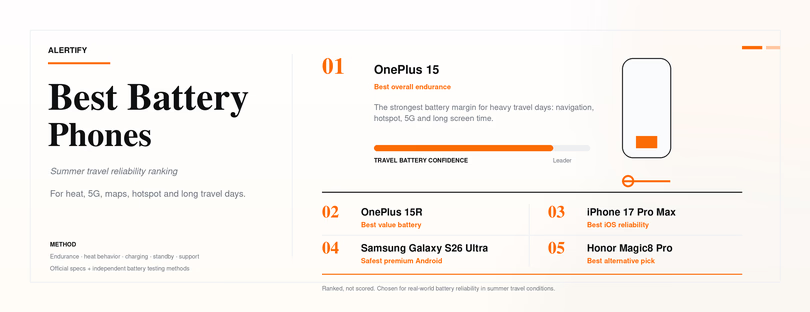
If I were buying mainly for summer travel reliability, I would start with large batteries, proven efficiency, sensible thermal behavior, long software support and repair options. No phone is magic in direct sun, but some give you more margin.
The OnePlus 13 is the endurance pick. It uses a 6,000mAh battery, confirmed in OnePlus’ own specifications, and Tom’s Guide measured 19 hours 45 minutes in its 5G web-surfing battery test. That is excellent for people who roam all day, use a hotspot occasionally and hate battery anxiety. The caution: very fast charging is only your friend when the phone is cool.
The iPhone 17 Pro Max is the safe iOS bet. Tom’s Guide measured 17 hours 54 minutes, calling it the longest-lasting iPhone it had tested. Apple’s thermal protections can feel conservative, but that is part of the point. It is overkill for someone who only needs messaging and maps, but strong for heavy camera, Wallet and connectivity use.
The Samsung Galaxy S25 Ultra remains a strong Android travel phone. In Tom’s Guide testing, it reached 17 hours 14 minutes, behind OnePlus and iPhone but still in serious endurance territory. Samsung could improve charging speed and battery size; it has stayed conservative here. But conservative can be useful when reliability matters more than spec theatre.
For a different kind of reliability, Fairphone deserves a mention. It will not beat the big flagships on raw performance, but its EU product sheet lists a user-replaceable battery and A repairability class. For sustainability-minded travelers, NGOs, field teams or anyone keeping phones for years, that matters more than another half-hour in a benchmark.
Practical Rules
Do not charge at 100% in direct sun. Do not leave a phone on a dashboard. Take the case off during hot charging. Use wired charging instead of wireless when the device is already warm. Download offline maps before leaving the hotel. Turn off the hotspot when you stop using it. If the phone is hot, airplane mode plus shade beats angrily closing every app.
READ MORE: How to Extend Your Smartphone’s Battery Life on Long Trips
Also, treat eSIM setup as a pre-trip task. Activating a plan while standing outside arrivals, under a glass roof, with a low battery and weak Wi-Fi is exactly the kind of small operational mess that turns heat into a bigger problem.
Conclusion
Summer exposes the difference between battery life on paper and battery reliability in motion. OnePlus is pushing capacity and fast charging. Apple is leaning on efficiency and tight thermal control. Samsung offers a balanced flagship experience. Fairphone points to a more repairable future.
The wider trend is clear: phones are becoming travel infrastructure. They hold our identity, maps, money, connectivity and emergency contacts. So the next “best travel phone” conversation should not only ask how long it lasts in a lab. It should ask how gracefully it behaves when the airport queue is long, the car is hot, the brightness is maxed and the boarding pass is still somewhere in the app.