Airalo eSIM USA: Real Performance & Hidden Trade-Offs
If you’ve traveled to the US in the last two years, you’ve probably noticed one thing: roaming is no longer the default problem. Choosing the right eSIM is.
And that’s exactly where Airalo sits in the conversation.
It’s one of the most recognizable names in the travel eSIM space. Not because it promises the most data. Not because it’s the cheapest. But because it sits right in the middle of convenience, pricing, and global scale.
So what does Airalo actually look like when you use it in the United States?
Let’s break it down the way travelers experience it, not the way providers market it.
What Airalo Offers in the USA
Airalo’s USA eSIM is a classic example of how the travel eSIM market has evolved: simple, modular, and fully digital.
You’re not buying a SIM card. You’re buying a data layer.
Plans typically range from 1GB to Unlimited, with pricing roughly between €3.5 and €70 depending on duration and data size. Validity spans from a few days up to 30 days, which makes it flexible for both short trips and longer stays.
There’s no subscription. No contract. No commitment.
Just pick a plan, install the eSIM, and you’re connected the moment you land.
And that’s the key value proposition here: instant connectivity without friction.
Airalo operates across 200+ destinations globally, and the US is one of its strongest markets simply because infrastructure is reliable and partnerships with major networks are already optimized.
Some of the Airalo USA eSIM plans:
Plan type
|
Data Displays all data only eSIMs for the location when selected. |
Data / Calls / Texts Displays all eSIMs with data, calls, and texts for the location when selected. |
Standard Displays eSIMs with a fixed amount of data for the location when selected. |
Unlimited Displays all unlimited data eSIMs for the location when selected. |
|
Airalo USA Unlimited plansChoose your package
|
Airalo USA Standard plansChoose your package
|
Setup and First Experience
This is where Airalo consistently wins.
Installation is either via QR code or directly through the app. Most users go from purchase to activation in under 5 minutes. Even first-time users rarely struggle.
That’s not a small thing.
Because in the eSIM market, the real barrier isn’t price. It’s confidence.
And Airalo has built a reputation around making the first experience feel safe.
Reviews consistently highlight:
- Smooth setup process
- Clear instructions
- No physical SIM swapping
- Immediate activation on arrival
For travelers landing in cities like New York, Los Angeles, or Miami, the transition is almost invisible. You turn on data, and it just works.


Real-World Performance Across the US
Now here’s where things get interesting.
Airalo doesn’t own infrastructure. It aggregates it.
Technically, it operates as a mobile network aggregator, leveraging multiple carrier agreements to deliver connectivity.
In practice, that means:
- Strong coverage in cities and highways
- Reliable speeds on major networks
- Occasional drops in remote areas (but that’s a network issue, not an Airalo issue)
Real-world testing across US routes, including national parks and rural zones, shows that coverage is generally “good to very good”, with failures typically linked to lack of signal in the area itself .
So if you lose signal in the Grand Canyon, it’s not your eSIM.
It’s geography.
Pricing Logic: Where Airalo Wins (and Where It Doesn’t)
Airalo’s pricing is one of its strongest advantages.
Compared to traditional roaming, it’s significantly cheaper. Many travelers still pay €5–€10 per day for roaming bundles, while Airalo offers full trip coverage at a fraction of that cost .
Example:
- ~10GB / 30 days ≈ $20–$25
- Entry plans from ~$5
That positions Airalo as a value-for-money provider, not a premium one.
But here’s the catch:
All plans are limited data.
No “true unlimited” option like Holafly. No flexible scaling like Fairplay. No enterprise-level control like SureSIM.
You’re managing your usage.
For light to moderate users, that’s perfect.
For heavy users, it becomes a mental calculation.
The Biggest Trade-Off: No Real “Unlimited” Experience
This is where the market is clearly splitting.
Airalo represents the first-generation eSIM model:
- Prepaid
- Fixed data
- Predictable pricing
But newer players are shifting toward:
- Unlimited data (Holafly, Yesim)
- Usage-based scaling (Fairplay)
- Subscription-style connectivity
Airalo doesn’t compete on that layer.
Instead, it competes on simplicity.
And for many travelers, that’s enough.
What Users Actually Say
User sentiment around Airalo is generally positive, but not perfect.
Common highlights:
- Easy to use
- Reliable in most destinations
- Competitive pricing
Many reviews emphasize that Airalo “keeps rising to the top” because of coverage, reputation, and price balance .
But there are also recurring criticisms:
- Customer support can be slow
- No unlimited plans
- Occasional patchy coverage depending on region
Even aggregated ratings reflect this balance, with scores around 3.7–3.9/5 in recent testing .
That tells you everything: it’s dependable, but not perfect.
Where Airalo Fits in the US eSIM Landscape
If you zoom out, Airalo is not trying to dominate every category.
It owns a very specific position:
The “default safe choice” for travelers.
Compared to competitors:
- Holafly → best for unlimited data, higher price
- Nomad → often cheaper, similar structure
- Yesim → hybrid with unlimited and business layers
- Ubigi → strong on long-term and automotive use
Airalo sits right in the middle.
That’s why it consistently appears in “top eSIM for USA” lists. Not because it’s the best in one category, but because it performs well across all of them .
The Bigger Picture: What Airalo Tells Us About the Market
Airalo is more than just a provider. It’s a signal of where the market started.
It represents Phase 1 of travel eSIM:
- Replace roaming
- Simplify connectivity
- Offer global access
But the market is already moving into Phase 2:
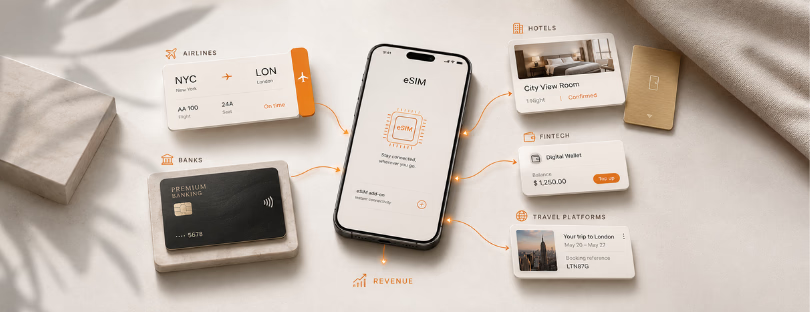
- Embedded connectivity (airlines, banks, apps)
- Subscription models
- API-driven telecom infrastructure
- Dynamic pricing based on usage
And this is where things get interesting.
Because Airalo’s model is efficient, but not deeply differentiated anymore.
Conclusion
Airalo’s USA eSIM does exactly what it promises. It gives you a reliable, affordable, and frictionless way to stay connected the moment you land.
But that’s no longer enough to define the category.
The real shift happening right now is not about connectivity. It’s about how connectivity is packaged and monetized.
Airalo still plays the strongest role in on-demand, prepaid travel data. And for millions of travelers, that’s still the easiest decision.
But the market is clearly moving toward something else.
Unlimited plans are becoming the new baseline expectation. Subscription logic is replacing one-time purchases. And distribution, not pricing, is becoming the real battleground.
Airalo built its position by making connectivity simple.
The next wave of providers is trying to make it invisible.
And that’s where the next competition will happen.