GO UP
esim background

Airalo eSIM Plans: What You Actually Get (And What You Don’t)

If you’ve searched for an eSIM even once, you’ve seen Airalo.

It’s everywhere. Airport lounges. TikTok travel hacks. Reddit threads. Google rankings. And increasingly, inside the apps and platforms you already use.

But here’s the thing most people don’t fully understand:

Airalo isn’t just another eSIM provider. It’s a marketplace model that quietly reshaped how global connectivity is sold.

And its plans reflect that.

Let’s break it down properly.

What Airalo Actually Sells

At its core, Airalo sells prepaid eSIM data plans that you download instantly and use abroad. No SIM cards. No contracts. No roaming agreements with your home operator.

Everything is digital.

The key detail many miss:

These are data-first plans, not traditional telecom packages.

That means:

  • You usually don’t get a phone number
  • Calls and SMS are often missing (unless you use VoIP apps or specific plans)
  • Everything is optimized for mobile data usage

Airalo gives you access to 200+ countries and regions, with three core plan types:

  • Local (single country)
  • Regional (multi-country, like Europe or Asia)
  • Global (cross-continent travel)

This structure is simple on the surface. But strategically, it’s powerful.

The Plan Structure (And Why It Works)

Airalo plans follow a very predictable format:

  • Fixed data (e.g. 1GB, 3GB, 10GB)
  • Fixed validity (e.g. 7, 15, 30 days)
  • Prepaid only

You pay upfront, install the eSIM, and start using data when you land.

No billing surprises. No roaming shock.

That’s the core appeal.

And it works.

For example, typical pricing might look like:

  • 1GB for ~7 days starting around $5
  • 10GB for ~30 days around $20–$40 depending on region

Compared to traditional roaming at ~$15/day, the difference is massive.

But here’s the more interesting part:

Airalo’s plans are not designed to be perfect.

They’re designed to be “good enough for most travelers, most of the time.”

The Real Strength: Coverage, Not Features

Airalo’s biggest advantage is not price.

It’s coverage.

You can land almost anywhere and get data within minutes. No local SIM hunt. No language barrier. No registration.

That’s because Airalo operates as a global aggregator, working with local telecom networks behind the scenes.

Technically, it behaves more like a connectivity layer than a traditional telco.

And that’s why it scaled to 20+ million users globally.

This is also why:

  • It works in niche destinations where others struggle
  • Regional plans (like Europe) cover dozens of countries seamlessly
  • You can stack multiple eSIMs for different trips

From a travel experience perspective, it removes friction.

From a telecom perspective, it abstracts the entire network layer.

Where Airalo Plans Start Showing Limits

Now let’s be honest.

Airalo is not perfect. And its plan structure reveals that.

The biggest limitation?

You are always guessing your usage.

Buy too little data → you run out mid-trip
Buy too much → you overpay

There is no dynamic scaling.

There is no real-time pricing adjustment.

There is no subscription logic.

Even their “unlimited” plans are typically:

  • Limited high-speed data
  • Then throttled after a threshold

This is where the market is starting to move away from Airalo’s original model.

How Travelers Actually Use Airalo

If you look at real-world usage patterns, Airalo fits best into very specific scenarios:

Short trips

Landing in a country for 3–7 days

You need quick, reliable data

You don’t care about long-term optimization

Perfect use case.

Multi-country travel

Europe trips, Asia hopping, remote work travel

Regional eSIMs remove constant switching

Huge advantage here.

Backup connectivity

Many frequent travelers use Airalo as a secondary SIM

Primary SIM handles calls

Airalo handles data

This hybrid usage is more common than people admit.

Airalo vs The New Wave of eSIM Players

Here’s where things get interesting.

The eSIM market has evolved.

Airalo represents the first phase:

  • Marketplace
  • Prepaid data bundles
  • Broad coverage

But newer players are pushing different models:

  • Holafly → unlimited data positioning (higher price, less thinking)
  • Nomad / Saily → pricing optimization and UX improvements
  • Ubigi → long-term plans and automotive/device ecosystem
  • Yesim / Airhub / 1GLOBAL → API-driven, platform-level connectivity

And then you have emerging models like:

  • Subscription-based eSIMs
  • Usage-based pricing
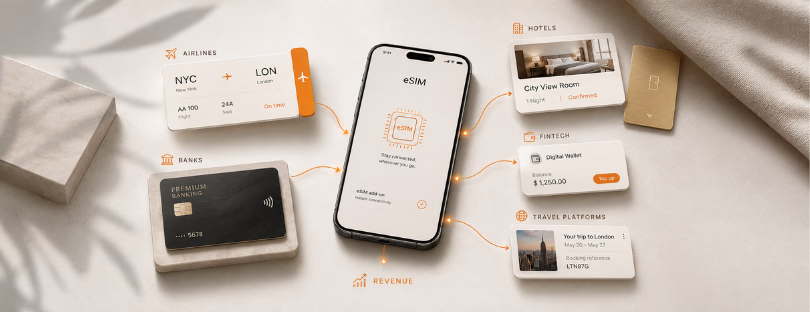
  • Embedded connectivity inside travel platforms

Even TechRadar’s 2026 comparison reflects this shift:
Airalo is still “best overall” for coverage and simplicity, but no longer the most advanced model.

The Bigger Picture: What Airalo Really Represents

Airalo isn’t just selling data.

It normalized a completely new behavior:

Buying connectivity like a travel product.

Before

You bought a SIM from your telecom operator

Now

You buy data like you book a hotel or flight

That shift is massive.

And it unlocked:

  • Affiliate-driven distribution
  • App-based onboarding
  • Instant global scalability

Airalo proved the demand.

Now the rest of the industry is optimizing the model.

What This Means for You (And the Market)

If you’re a traveler:

Airalo is still one of the easiest, safest entry points into eSIM.

It works. It’s predictable. It’s widely supported.

But if you travel frequently, you’ll start noticing its limitations:

  • Static plans
  • No real personalization
  • Limited control over usage vs cost

If you’re watching the market:

Airalo is no longer the endgame.

It’s the baseline.

Conclusion

Airalo did something the telecom industry failed to do for years. It simplified international connectivity into a product anyone could understand, buy, and use in minutes.

That alone made it a category leader.

But the market has moved on.

What Airalo offers today is clarity and accessibility. What newer players are building is flexibility and control.

And that difference matters.

Because the next phase of travel connectivity will not be about buying data packages. It will be about adaptive connectivity that follows your behavior, not your prediction.

Airalo still wins when you want something that just works.

But the real competition is no longer about coverage or price.

It’s about who solves the fundamental problem better:

Not “how much data do you need?”
But “why are you still being asked to guess?”

Driven by wanderlust and a passion for tech, Sandra is the creative force behind Alertify. Love for exploration and discovery is what sparked the idea for Alertify, a product that likely combines Sandra’s technological expertise with the desire to simplify or enhance travel experiences in some way.