Vodafone eSIM
For years, eSIM was treated like a convenience feature. Nice to have. Slightly futuristic. Mostly useful if you lost your SIM ejector tool or wanted to avoid waiting for a plastic card in the post.
That phase is over.
Vodafone’s eSIM strategy shows something much bigger happening in the market: traditional mobile operators are no longer just reacting to travel eSIM brands. They are starting to use eSIM as a digital distribution channel, a customer acquisition tool, a roaming alternative, and a way to stay relevant in a world where connectivity is increasingly bought inside apps, travel platforms, device settings, and partner ecosystems.
Vodafone UK describes eSIM in the simplest possible way: a digital SIM built into a phone, tablet, or smartwatch, allowing users to download a mobile plan directly to the device instead of inserting a physical SIM card. It also notes that compatible devices can store more than one eSIM profile, each with its own number and data plan, which users can switch between.
That sounds basic. But strategically, it is not basic at all.
Vodafone’s practical eSIM play
Vodafone’s consumer eSIM offer is still very operator-like. In the UK, Vodafone says all its SIM-only plans are available as eSIM, and users simply choose eSIM at checkout. That includes pay monthly plans and Pay As You Go Plus options.
The user benefit is obvious: faster setup, no physical SIM delivery, less plastic, and easier dual-SIM use. Vodafone also points to security as a benefit, since an eSIM is built into the device and cannot be physically removed in the same way as a plastic SIM.
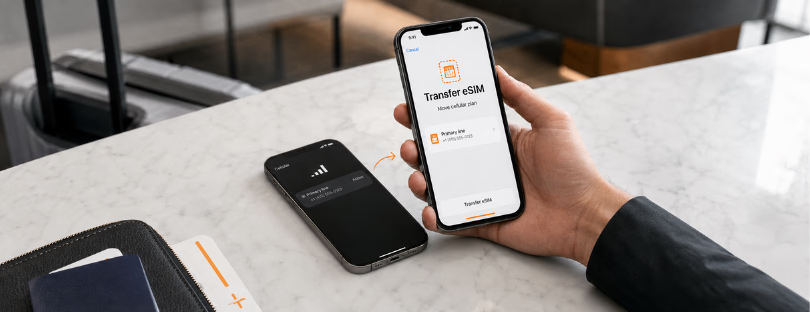
But the more interesting part is the behaviour change. eSIM makes switching, testing, transferring, and managing connectivity feel more like software. Vodafone explains that setup usually happens through a QR code sent by email, manual details if needed, or through device flows such as Apple Quick Transfer for compatible iPhones.
This is where operators have had a difficult balancing act. They want eSIM to feel simple enough for mainstream users, but they also need to preserve account security, number ownership, KYC flows, device compatibility checks, and customer support processes. Travel eSIM brands often look faster because they sell data-only products with lighter account complexity. Operators have to handle the full mobile relationship.
That is also why Vodafone eSIM is not just about activation. It sits inside a larger operator system: phone numbers, contracts, PAYG, device financing, roaming, customer apps, support channels, and network trials.
The travel eSIM angle
Vodafone has also moved into the travel eSIM space through Vodafone Travel eSIM, offering data plans for destinations and regions including Germany, Spain, the UK, and Europe. Its travel eSIM pages position the product around instant activation, reliable connectivity, 5G access where available, and avoiding roaming surprises.
This matters because it puts Vodafone in a slightly awkward but powerful position. On one side, Vodafone is a traditional mobile network operator with domestic subscribers. On the other, it is increasingly acting like the very travel eSIM brands that built their growth by selling simple, data-only connectivity to travellers.
The difference is trust.
For many travellers, a known operator name still carries weight. Vodafone is not a random marketplace brand or a lightweight reseller with unclear network arrangements. The Vodafone Group describes itself as one of the largest telecommunications companies in Europe and Africa, operating in 15 countries with more than 40 partner markets.
That scale gives Vodafone a brand advantage. But scale also creates friction. Travel eSIM-native players are often quicker with UX, clearer with bundles, and more aggressive with destination landing pages. Vodafone’s opportunity is to combine operator credibility with the simplicity of a digital travel product. That is harder than it sounds.

Where Vodafone is strong
Vodafone eSIM is strongest for users who already trust operator-grade connectivity and want a more “official” setup. This includes domestic users moving from a physical SIM to eSIM, customers using dual SIM for work and personal numbers, smartwatch and tablet users, and travellers who prefer buying from a known telecom brand rather than an unfamiliar eSIM marketplace.
The practical benefits are real. Vodafone says eSIM can be available instantly when choosing a plan, while a physical SIM must be delivered or collected. It also says users can download a new eSIM profile when changing networks, rather than ordering a new physical SIM.
That sounds small until you think about the modern user journey. People switch phones more often. They travel more frequently. They use one number for banking, another for work, and sometimes a temporary data plan abroad. In that world, plastic SIM logistics feel increasingly outdated.
Vodafone is also using eSIM as a trial mechanism. Its UK eSIM help page includes guidance for installing a trial eSIM, setting the original SIM as the default for calls and texts, and using Vodafone eSIM for mobile data during the trial.
That is clever. eSIM lowers the barrier to testing a network without asking the user to switch numbers, visit a store, or wait for a SIM card. For operators, this may become one of the most important eSIM use cases: not only selling plans, but proving network quality before asking for commitment.
Where Vodafone still faces pressure
The challenge for Vodafone is not whether it supports eSIM. It clearly does. The challenge is whether it can make eSIM feel as effortless as users now expect.
Travel eSIM brands such as Airalo, Holafly, Nomad, Ubigi, and Yesim have trained consumers to expect quick purchase flows, destination-specific pages, clear data packages, simple installation, and immediate use. They may not always have operator-level depth, but they often win on simplicity.
Vodafone has the opposite advantage. It has network credibility, a large telecom footprint, customer support infrastructure, and a familiar brand. But operators often carry more complexity into the purchase journey: contracts, eligibility, account login, app flows, device rules, number transfer logic, and support layers.
This is the wider industry tension. GSMA defines eSIM as a global specification enabling remote SIM provisioning across devices, and GSMA Intelligence’s 2026 consumer eSIM checkpoint highlights several market accelerators, including eSIM-only devices, China’s eSIM launch, travel eSIM development, emerging device categories, bundling, and connectivity experiences in sport.
In other words, eSIM is no longer one feature. It is becoming a distribution layer.
That is exactly why Vodafone’s moves matter. When a major operator offers standard eSIM, travel eSIM, trial eSIM, and device-integrated setup, it signals that the operator world is slowly adapting to the app-based connectivity economy.
What travellers should know?
For everyday users, Vodafone eSIM is best understood in three categories.
 A more serious operator play
 A more serious operator play
Vodafone eSIM is not the flashiest eSIM story in the market. It is not built like a startup landing page. It does not always feel as clean as the best travel eSIM apps. But that is exactly why it is interesting.
Vodafone represents the operator side of the eSIM transition. The company is not trying to be only a travel eSIM marketplace. It is trying to digitize the core mobile relationship while also defending its place in travel connectivity.
That is a different game from Airalo or Holafly. Those companies are fighting for the traveller’s purchase moment. Vodafone is fighting for something broader: the account relationship, the network experience, the device setup flow, and the right to stay visible as connectivity becomes more embedded and less physical.
The real question is not whether Vodafone supports eSIM. It does. The real question is whether operators like Vodafone can make eSIM feel as simple as the app-native players while using their scale, trust, and network depth as an advantage.
If they can, the eSIM market will stop being divided into “operators” and “travel eSIM brands.” It will become a much more interesting fight over who owns the customer moment: the network, the device, the travel platform, or the app that gets there first.