Mint Mobile eSIM: Everything You Need To Know
Mint Mobile eSIM is not trying to look futuristic anymore. That may be the most interesting thing about it.
A few years ago, eSIM still felt like a technical option hidden somewhere between phone settings and carrier support pages. Today, Mint presents it as the normal way to join: check your phone, buy a plan, activate digitally, and skip the plastic SIM card entirely. For a prepaid brand built around price, simplicity and online sign-up, that matters.
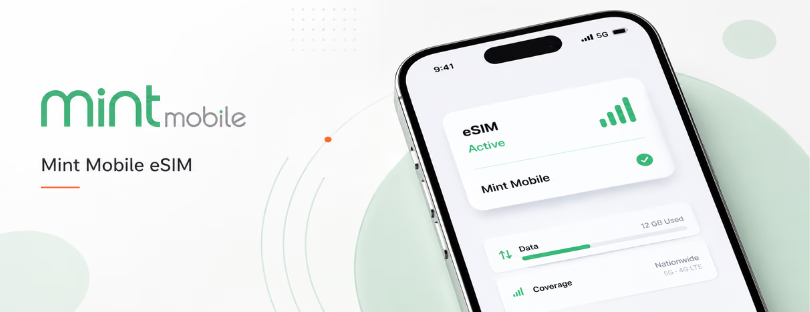
Mint’s own eSIM page frames the offer around speed and convenience, with premium wireless from $15 per month as long as the customer has an unlocked, compatible phone. The message is very Mint: no store visit, no waiting for a SIM envelope, no dramatic setup ritual. Just a digital SIM profile.
Why the pitch works
The strongest part of Mint Mobile eSIM is the match between product and business model.
Mint is a prepaid carrier, now part of the T-Mobile family, and it has always leaned into online-first buying. Customers choose a plan, usually commit to several months, and trade some traditional carrier hand-holding for lower pricing. eSIM fits that perfectly. If someone is comfortable ordering mobile service online, they are probably also comfortable activating through an app or website.
For new customers, Mint says eSIM can be selected at checkout if the phone is unlocked and eSIM-compatible. Existing customers can also move from physical SIM to eSIM through Mint’s support flow. That removes one of the old friction points of switching: waiting for hardware.
For travelers, second-phone users, and people testing a cheaper U.S. plan, that has real value. You can keep a physical SIM slot free, use dual SIM on supported phones, or separate personal and work numbers without carrying two devices. The FCC also points to dual-number use as one of the practical benefits of eSIM.
The catch is predictable but worth saying clearly: eSIM makes activation easier only when the phone, account and network setup cooperate. A locked phone, an old device, weak Wi-Fi during setup, or confusion around number transfer can still turn a “minutes” experience into a support session.
The prepaid angle
Mint’s biggest advantage is still price. The eSIM is not the headline by itself. It is the delivery method for a low-cost plan.
That is where Mint differs from premium carrier eSIM pages from Verizon, AT&T or T-Mobile. Those brands often use eSIM to support device flexibility inside a larger service ecosystem. Mint uses it to make switching feel lighter, even if the plan structure asks customers to pay in multi-month blocks.
In the U.S., prepaid is no longer just the “cheap phone plan” corner of the market. It is where practical customers go when they are tired of big bills, confusing promos, and plan bundles they never use.
But it is not for everyone. Heavy users who need top-priority data at all times may still prefer a postpaid plan from one of the major carriers. Families who want retail support, device financing, international roaming bundles, or in-store problem-solving may also feel more comfortable elsewhere.
What could be clearer
The main area Mint could improve is not the idea of eSIM. It is the confidence layer around it.
Consumers still worry about compatibility, number transfer, locked phones, and what happens if activation fails. Mint does provide support articles for getting an eSIM, converting from physical SIM, and troubleshooting activation. Still, the experience would be stronger if every eSIM step felt clear before purchase, not only after someone gets stuck.
The best eSIM experience is not just “digital.” It is reassuring. It tells the customer exactly what they need before checkout, what will happen during activation, and what to do if their old number does not move instantly.
Alternatives worth watching
Mint Mobile eSIM sits in a crowded but interesting lane.
Visible is the closest comparison for many U.S. shoppers because it also sells a digital-first, budget-friendly experience, but on Verizon’s network. T-Mobile Prepaid can appeal to users who want the same network family with a more direct carrier relationship. Google Fi remains attractive for certain international users, especially those who move between countries and want more travel-friendly account behavior.
Travel eSIM providers such as Airalo, Holafly, Yesim, Ubigi, Nomad eSIM and GigSky are not direct replacements for Mint. Most people use them for temporary data abroad, not as a main U.S. mobile number. But they have changed expectations. People now expect connectivity to be bought quickly, activated digitally, and understood before landing or switching.


Final take on Mint Mobile eSIM
Mint Mobile eSIM is not revolutionary in the technical sense. What makes Mint interesting is how naturally eSIM fits its value proposition.
Mint does not need eSIM to look premium. It needs eSIM to make cheaper wireless feel easier to try. That is a stronger commercial story than it first appears. In a market where big carriers are trying to simplify, prepaid brands are trying to look more trustworthy, and travel eSIM players are teaching consumers to expect instant connectivity, Mint is sitting in the right part of the curve.
The real test is not whether Mint can activate an eSIM quickly. It is whether it can make the whole switch feel low-risk. If it does that well, eSIM becomes one of the quiet reasons people finally leave an expensive plan they have been complaining about for years.