SPC Discovery 3 Pro: Affordable eSIM smartphone
Affordable smartphones with eSIM used to be a contradiction. If you wanted eSIM, you bought an iPhone. Or a flagship Samsung. Or maybe a Google Pixel. End of story. affordable eSIM smartphone SPC DIscovery
As we move deeper into 2026, the real shift isn’t that flagships support eSIM. It’s that €150 devices do.
The eSIM conversation is slowly moving away from premium-only territory. And devices like the SPC Discovery 3 Pro are a signal that something bigger is happening: eSIM is no longer a luxury feature. It’s becoming infrastructure.
Let’s talk about what that means.
eSIM Is No Longer Just for Apple and Samsung
For years, eSIM adoption was driven by brands like Apple, Samsung, and Google. They made eSIM mainstream by integrating it into flagship devices and, in Apple’s case, even removing the physical SIM tray in the US.
But that created a pricing barrier.
If you wanted the flexibility of digital SIM provisioning for travel, remote work, or dual profiles, you were often forced into a €800 to €1200 device. That excluded a massive part of the market, especially younger travelers, digital nomads on tighter budgets, and emerging markets.
Now, brands outside the usual big three are integrating eSIM into devices under €200. That changes the accessibility equation completely.
And this is where SPC enters the picture.
Display and Performance That Don’t Feel “Budget”
At €157.83, the SPC Discovery 3 Pro does not read like a compromise device.
The 6.7-inch 120Hz InCell IPS display immediately stands out. At this price point, 120Hz is still not guaranteed. The difference is noticeable. Every scroll feels smoother. Animations feel more natural. Gaming and streaming benefit from that fluidity.
It is not just about numbers on a spec sheet. A higher refresh rate genuinely improves day-to-day usability. And for many mid-range users, that’s often more important than extreme benchmark performance.
Under the hood, you get a MediaTek Helio G81 octa-core processor paired with 8GB of RAM. That is not entry-level memory anymore. 8GB has quietly become the sweet spot for multitasking, switching between apps, and running heavier social or productivity apps without stutter.
Add 256GB of internal storage, expandable to 512GB via microSD, and you are looking at storage capacity that rivals far more expensive devices.
For €157.83, that is not normal. That is aggressive positioning.

Camera: AI Without the Marketing Noise
The 50MP AI triple camera setup sounds familiar. Most brands now lead with megapixels.
But what matters is balance.
A 50MP main sensor combined with AI processing can deliver solid daylight photography, detailed shots, and respectable dynamic range in this category. The 32MP selfie camera is another strong inclusion for content creators, video calls, and social-first users.
The ability to record in 2K adds another layer of value. Many affordable phones still cap video at 1080p.
Is it competing with a €1000 flagship camera system? No. But that’s not the point. The point is that mid-range devices are closing the experience gap.
And for most users, especially travelers documenting their journeys, it’s more than enough.
eSIM, NFC and Biometric Security
Now the real conversation.
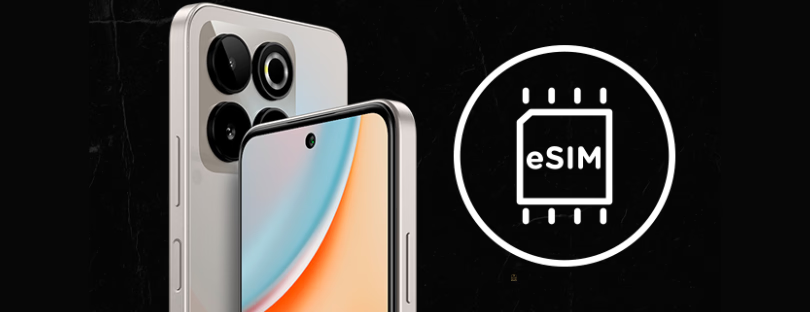
The SPC Discovery 3 Pro includes eSIM support, NFC, side fingerprint unlock, and face recognition.
That combination matters.
From a travel connectivity perspective, eSIM removes friction. You no longer need to search for a physical SIM at the airport. You don’t need to carry ejector pins. You don’t need to swap tiny plastic cards in hotel lobbies.
If your primary operator lacks coverage in a country, you can add a digital profile in minutes. Download. Activate. Connect.
For Alertify readers, this is not just convenience. It’s strategic mobility.
NFC adds mobile payments. Biometric security ensures quick, secure access. These features used to define premium tiers. Now they are standard in a sub-€200 device.
That shift is not cosmetic. It reflects a deeper market change.

Battery and Real-World Endurance
A 5000mAh battery is now the benchmark for reliable endurance. Combined with a power-efficient processor, this translates into full-day usage without anxiety.
And 33W fast charging bringing the device from 0 to 100 percent in roughly an hour is a practical advantage. Reverse charging adds an unexpected bonus. In travel scenarios, being able to top up earbuds or another phone from your own device can be surprisingly useful.
This is not just a spec checklist. It’s lifestyle alignment.
The Bigger Market Shift
According to GSMA data, global eSIM adoption continues to accelerate, especially as travel rebounds and operators expand remote provisioning. Counterpoint Research has also highlighted growing demand for affordable 5G and eSIM-capable smartphones in emerging markets.
What’s interesting is not that premium devices support eSIM. That’s old news.
What’s interesting is that smaller brands and so-called “no name” manufacturers are integrating it early in the product cycle.
Affordable hardware. Modern features. Connectivity flexibility.
And this is happening across the market. More mid-range and entry devices are quietly adding eSIM alongside traditional dual SIM configurations.
This is where things get strategic.

Why This Matters for Travel Connectivity
For years, the eSIM ecosystem depended on high-end smartphone penetration.
If your audience owned iPhones and Galaxy S devices, your travel eSIM product could scale. If they didn’t, adoption stalled.
Now the hardware barrier is lowering.
A €157 device with eSIM means the travel connectivity conversation becomes mass-market. Students. Seasonal workers. Budget travelers. Families.
The implication is simple: eSIM providers must prepare for volume, not just premium users.
And brands like SPC are indirectly accelerating that shift.
Conclusion
Affordable eSIM smartphones are not a niche experiment anymore. They are the next phase of market expansion.
The SPC Discovery 3 Pro is not competing with flagship giants on prestige. It is competing on access. And that might be more powerful in the long run.
When a sub-€200 device delivers 120Hz display fluidity, 8GB RAM, 256GB storage, 50MP camera, 5000mAh battery, NFC, biometrics, Android 14, and eSIM support, the narrative changes.
The real story is not that this phone exists. The real story is that the premium eSIM wall is collapsing.
As GSMA Intelligence and Counterpoint continue to report rising eSIM-capable device penetration, the ecosystem will shift from early adopters to mainstream behavior. Travel eSIM brands, operators, and connectivity platforms must adapt to this broader, price-sensitive audience.
Because once eSIM becomes standard in affordable hardware, it stops being a feature.
It becomes an expectation.
And when expectations change, markets follow.