Social Media Platforms: Who Really Controls Attention?
If you step back and look at social media today, one thing becomes obvious: this is no longer a “platform” story. It’s an infrastructure story.
There are now over 5.6 billion social media user identities globally — which basically means most of the connected world is inside these systems. The average person spends more than 2 hours a day scrolling, watching, messaging, reacting . And crucially, they’re not doing it in one place. The average user now actively uses 6–7 platforms per month .
That fragmentation is where things get interesting.
Because social media platforms aren’t competing for users anymore. They’re competing for attention slices within the same user.
The big platforms still dominate — but for different reasons
It’s easy to assume that the biggest platforms win everything. They don’t. They’ve just carved out different roles in people’s lives.
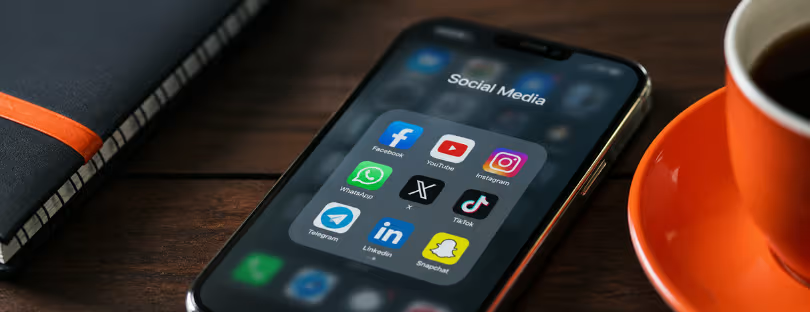
- Facebook still leads with over 3 billion users, but it’s increasingly a utility layer — groups, events, older demographics
- YouTube is the default video engine, not really “social” in the traditional sense anymore
- Instagram sits somewhere between lifestyle media and commerce engine
- TikTok is pure attention — arguably the most efficient discovery machine on the internet
- WhatsApp and messaging apps quietly dominate daily communication globally
This isn’t a hierarchy. It’s a stack.
And each layer solves a different human behavior: staying informed, being entertained, staying connected, expressing identity.
Short video changed everything — but not in the way people think
Everyone talks about TikTok. Fair. It crossed 1.6–1.7 billion users and dominates time spent per user.
But the real shift wasn’t TikTok itself. It was what TikTok proved.
READ MORE: Australia draws a hard line: no social media for under-16s
That distribution beats following.
Before, platforms were built around who you followed. Now they’re built around what the algorithm thinks you should see. That flipped the entire power structure:
- Creators don’t need audiences to go viral
- Brands don’t need followers to get reach
- Platforms don’t need loyalty to retain users
This is why Instagram pushed Reels. Why YouTube pushed Shorts. Why every platform suddenly looks… the same.
Because the winning format isn’t “social.” It’s feed-driven entertainment with social features layered on top.

Social media is quietly becoming the internet’s news layer
Here’s where it gets more uncomfortable.
For younger audiences, social platforms are no longer just where you hang out. They’re where you learn what’s happening in the world.
Recent data shows platforms like TikTok have become a leading source of news among younger users, surpassing traditional channels in some segments.
That shift has consequences:
- News becomes personality-driven
- Credibility becomes harder to assess
- Speed beats verification
And yet, it works. Because it’s native to how people consume content today.
Not headlines. Stories. Faces. Opinions.
The regulatory pressure is real — and growing fast
At the same time, governments are starting to push back.
The EU, for example, is currently investigating whether Meta platforms like Facebook and Instagram are doing enough to protect minors, with potential fines reaching up to 6% of global revenue.
And it’s not just Europe. Countries globally are exploring or implementing restrictions on younger users, driven by concerns around addiction, safety, and mental health.
This matters because it signals a shift:
Social media platforms are no longer just tech companies. They’re being treated like infrastructure with societal responsibility.
And infrastructure always gets regulated eventually.
Fragmentation is the real trend nobody talks about enough
If you talk to marketers, they’ll tell you social is harder than ever.
Not because it’s saturated. But because it’s fragmented.
Users are spreading their time across:
- TikTok for discovery
- Instagram for identity
- WhatsApp for communication
- LinkedIn for professional signaling
- Reddit for niche communities
Even X (formerly Twitter) is losing ground in some regions, while platforms like Reddit and TikTok gain traction .
There is no “main platform” anymore.
And that breaks the old playbook completely.
You can’t just “be on social media.” You have to decide which behavior you want to own.
Messaging is quietly becoming the most important layer
One of the more overlooked trends is the rise of private and semi-private communication.
Usage of messaging features across platforms is growing significantly, even on apps that started as public feeds.
This is important because:
- Public content builds awareness
- Private messaging drives decisions
For businesses, that changes everything.
The real conversion doesn’t happen in the feed. It happens in DMs, groups, or private conversations.
Social media is no longer just about broadcasting. It’s about facilitating interaction.

Platforms are turning into ecosystems, not channels
Look at what’s happening structurally:
- Instagram is adding shopping, subscriptions, and messaging layers
- TikTok is pushing into search, e-commerce, and even longer content
- LinkedIn is becoming a content platform, not just a CV
- WhatsApp is evolving into a business communication tool
Each platform is trying to become a closed ecosystem where users never leave.
This mirrors what we’ve seen in other industries. Super apps. Embedded services. Everything in one place.
And it’s not accidental.
The more time users spend inside one platform, the more valuable that platform becomes — not just for ads, but for data, commerce, and partnerships.
Where this is heading (and what most people miss)
The mistake most people make is thinking social media is about content.
It’s not.
It’s about distribution control.
Who controls how content is discovered, ranked, and delivered controls the market.
Right now:
- TikTok controls discovery
- Meta controls scale and ad infrastructure
- YouTube controls long-form video dominance
- Messaging apps control direct communication
And new players aren’t trying to beat them head-on. They’re finding gaps. Communities. Formats. Behaviors.
That’s why the space keeps evolving instead of consolidating.
Conclusion: the next phase isn’t about platforms — it’s about positioning
Here’s the uncomfortable truth.
Social media platforms aren’t going anywhere. But the idea of “winning social media” is becoming irrelevant.
Because there is no single platform to win anymore.
Compared to a few years ago, the landscape is more fragmented, more regulated, and more behavior-driven. TikTok may dominate attention, Meta still dominates scale, and YouTube remains unmatched in video depth — but none of them fully control the user journey.
Reliable industry datasets like DataReportal and Hootsuite consistently point to the same direction: growth is still happening, but usage is spreading across multiple platforms rather than concentrating in one .
So the real question isn’t “Which platform matters most?”
It’s:
Where in the user’s behavior do you actually fit?
Because the platforms that win long-term won’t be the ones with the most users.
They’ll be the ones that own a specific, repeatable behavior — and become impossible to replace in that moment.
Everything else is just noise.