Skyscanner Launches Package Holiday Comparison in UK
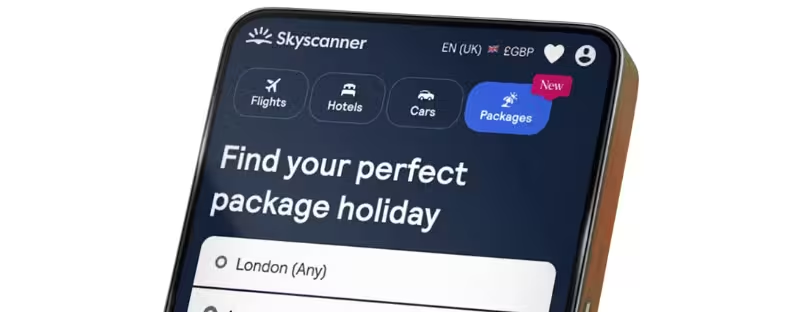
The metasearch giant Skyscanner has quietly but decisively stepped into one of travel’s most competitive arenas. With the launch of Packages, a new package holiday comparison product, Skyscanner is no longer just the place where trips begin. It wants to be where complex travel decisions are actually made.
Rolled out first in the UK, with further markets planned later this year, Packages signals a strategic expansion that feels less like a feature update and more like a repositioning. Flights, hotels, and car hire were already part of Skyscanner’s DNA. Adding package holidays completes the loop and puts the platform squarely in the same consideration set as online travel agencies and tour operators.
Why Skyscanner is moving into packages now
Package holidays never really went away, but they have evolved. Today’s traveller is price-aware, flexibility-hungry, and increasingly impatient with fragmented booking journeys. Searching separately for flights and accommodation often looks cheaper at first, but once baggage, transfers, and protection are added, the maths can change quickly.
Skyscanner is leaning into that reality. According to the company, demand for package holidays at the start of the year is already up 113 percent, a telling figure given January’s importance in the UK booking calendar. This surge aligns with broader industry data from sources like ABTA and Phocuswright, which have consistently highlighted a post-pandemic preference for bundled travel products that offer both value and reassurance.
Packages is designed to capitalise on that shift, without asking users to change how they already search.
How Packages works inside the Skyscanner ecosystem
Rather than becoming a package holiday seller itself, Skyscanner stays true to its metasearch roots. Packages compares offers from a carefully selected pool of providers, all ATOL protected, and sends users directly to the provider to complete the booking.
The initial UK launch includes major tour operators, airlines, and OTAs such as TUI, Jet2, Expedia, On the Beach, easyJet holidays, lastminute.com, and Loveholidays.
Behind the scenes, Skyscanner says it scans around 25 million package options every day. That scale matters. It allows travellers to compare flight plus hotel combinations across brands that would normally sit behind separate walled gardens.
From a user perspective, Packages feels familiar. Filters, price comparisons, and flexibility tools mirror what travellers already expect from Skyscanner’s flight search. The difference is that complexity is abstracted away. One price, one comparison, fewer tabs.

January, timing, and the psychology of booking
Cat King, global VP of commercial at Skyscanner, framed the launch around behaviour rather than technology. January remains the single most important booking month for UK travellers, driven by a mix of post-holiday optimism and aggressive pricing.
Her point that finding a good deal should not feel like another chore is more than marketing language. Travel search fatigue is real, and it is something platforms like Google Travel, Booking Holdings, and Expedia Group are all trying to solve in different ways.
Skyscanner’s advantage lies in trust. For many users, it is already the neutral referee, the place to sanity-check prices before committing. Extending that trust into packages is a logical next step, especially when travellers are already comparing flight plus hotel combinations manually.
What this means for package providers
For tour operators and OTAs, Skyscanner Packages is both an opportunity and a warning.
On one hand, it offers access to highly engaged travellers at the exact moment of decision-making. Users arriving on Skyscanner are not browsing for inspiration. They are actively comparing dates, destinations, and prices. Visibility at that stage is powerful.
On the other hand, transparency increases competition. When package prices sit side by side, differentiation becomes harder. Brand loyalty matters less, and value propositions need to be clearer. Extras, flexibility, cancellation terms, and protection will play a bigger role in conversion.
This mirrors what happened years ago in flight metasearch, where airlines initially feared price commoditisation but ultimately adapted by refining ancillaries and fare structures.
Packages versus existing players
Skyscanner is entering a crowded space, but it is not trying to replicate what others do.
Platforms like Booking.com and Expedia have long offered dynamic packaging, allowing users to bundle flights and hotels within a single ecosystem. Tour operators such as TUI and Jet2holidays focus on end-to-end control, from inventory to customer service.
Skyscanner sits above all of them. It does not own inventory, does not handle customer service, and does not control the booking experience beyond the click-out. Its role is comparison at scale.
This makes Packages closer in spirit to Google’s evolving travel products, but with a more travel-native interface and less dependency on advertising-driven rankings. Skyscanner’s claim of applying unrivalled pricing data is credible, given its historical strength in fare analysis and demand signals.

A broader trend towards simplified travel planning
The launch of Packages reflects a wider trend in travel tech: reducing friction by collapsing multiple decisions into one.
Travellers are increasingly comfortable with bundles, as long as transparency remains high. Flexible dates, alternative airports, and clear inclusions are now expected, not optional. At the same time, economic uncertainty keeps price sensitivity front and centre.
Industry research from Skift and McKinsey has repeatedly pointed to a bifurcation in travel demand. Premium travellers seek bespoke experiences, while mass-market travellers want clarity, protection, and value. Packages squarely target the latter, without alienating the former.
By integrating packages into its existing search flow, Skyscanner avoids forcing users into a new mindset. It simply offers another option when it makes sense.
Conclusion: a calculated but meaningful shift
Skyscanner’s move into package holiday comparison is not a radical reinvention, but it is a strategically important evolution.
In a market where OTAs, tour operators, and even airlines are racing to own the entire customer journey, Skyscanner is doubling down on what it does best: comparison, neutrality, and scale. Packages strengthens its position as a decision-making platform rather than just a discovery tool.
Compared to vertically integrated players like TUI or Expedia, Skyscanner offers less control but more choice. Compared to newer inspiration-led platforms, it offers less storytelling but more substance. That balance is likely to resonate, especially in markets like the UK where package holidays remain deeply embedded in travel culture.
If adoption continues at the pace suggested by early demand figures, Packages could quietly reshape how millions of travellers book their holidays. Not by replacing tour operators or OTAs, but by forcing the entire ecosystem to compete more transparently, at the exact moment travellers care most about value.
For the travel industry, that is not disruption for disruption’s sake. It is metasearch doing what it has always done, just one step closer to the final booking decision.