SIM card – The tiny chip that quietly runs your entire mobile life
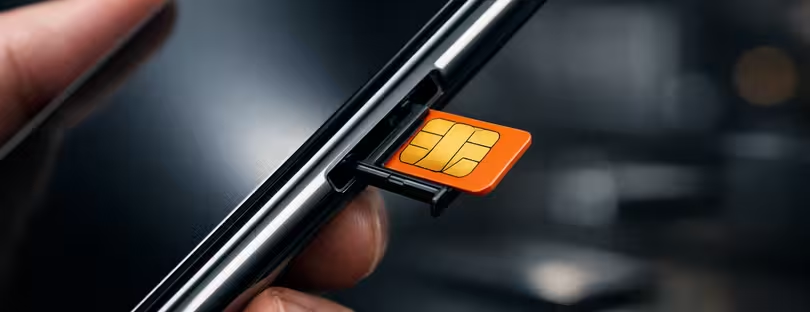
You probably don’t think about your SIM card much. It sits in your phone, invisible, silent, doing its job. But the moment something goes wrong, no signal, no data, no calls, you suddenly realize how critical that tiny piece of plastic really is.
SIM stands for Subscriber Identity Module. Sounds technical, but in reality, it is your identity on a mobile network. Not your phone. Not your app. You.
Every time you connect to a network, send a message, or load a webpage, your SIM is the thing that tells the network: “Yes, this user belongs here.”
And yet, for something so essential, most people have no idea how it actually works or why it still matters so much in 2026.
Let’s break it down.
What a SIM actually does behind the scenes
Think of your SIM as your digital passport for mobile connectivity.
Inside that tiny chip is a unique identifier tied to your mobile subscription. When your phone connects to a network, the SIM authenticates you. It tells the network who you are, what plan you have, and what you’re allowed to do.
That includes:
- Access to voice calls
- SMS messaging
- Mobile data
- Roaming permissions
- Network priority in some cases
Without a SIM, your phone is basically just a WiFi device.
This is also why you can move your SIM from one phone to another and instantly keep your number, your data plan, and your connectivity. The identity travels with the SIM, not the device.
That simple idea shaped the entire mobile industry for decades.
Why SIM cards were revolutionary
Before SIM cards, mobile devices were tied directly to networks. Changing phones or carriers was complicated and often required manual intervention from operators.
SIM cards changed that.
They introduced portability.
Suddenly, users could:
- Switch phones without losing their number
- Change operators by swapping a card
- Travel internationally and use local networks
This flexibility fueled massive growth in mobile adoption globally. It made telecom scalable.
And for years, the physical SIM card became the standard.
Mini SIM, micro SIM, nano SIM. Same idea, just smaller plastic.
But the core concept never changed.

The hidden limitations nobody talks about
Here’s the part most telecom companies don’t highlight.
Physical SIM cards are not built for the way we travel and connect today.
They come with friction.
You lose them. You break them. You need a pin to eject them. You have to go to a store to replace them. Activation can take time. Switching providers is not always seamless.
And when you travel, it gets worse.
You land in a new country and suddenly you’re:
- Searching for a local SIM vendor
- Comparing confusing prepaid plans
- Physically swapping cards
- Risking losing your primary SIM
It’s a process that feels outdated in a world where everything else is instant.
This is exactly why the industry started shifting.
The rise of eSIM and why it changes everything
Enter eSIM.
Instead of a physical card, the SIM becomes embedded inside your device. You download profiles digitally, like installing an app.
No plastic. No swapping. No store visits.
It sounds like a small change, but it completely reshapes how connectivity works.
With eSIM, you can:
- Activate a plan in minutes
- Store multiple profiles on one device
- Switch networks without touching hardware
- Manage everything from your phone
For travelers, this is huge.
You can land in a country and be connected before you even leave the airport. No hunting for SIM cards. No language barriers. No guesswork.
But here’s the interesting part.
Even though eSIM is growing fast, the traditional SIM is not going away overnight.
Why physical SIM still matters in 2026
Despite all the innovation, physical SIM cards still dominate in many parts of the world.
There are a few reasons for that.
Infrastructure inertia is one. Telecom operators have spent decades building systems around physical SIM distribution.
Regulation is another. Some countries still require physical identity checks tied to SIM registration.
Device compatibility also plays a role. Not every phone supports eSIM yet, especially in lower-cost segments.
And then there is user behavior. People are used to SIM cards. They trust what they can physically hold.
So for now, we are living in a hybrid world.
Physical SIM and eSIM coexist.
But the direction is clear.

SIM as a product is disappearing
Here’s a bigger shift that most people miss.
The SIM itself is slowly becoming irrelevant as a product.
What matters is connectivity, not the format.
Users don’t care if it’s a plastic card or a digital profile. They care about:
- Price
- Coverage
- Speed
- Reliability
- Simplicity
And this is where things get interesting for the industry.
Telecom is moving from hardware to software.
From distribution to experience.
From selling SIM cards to selling connectivity solutions.
This is why you see new players entering the space, not just traditional operators, but travel platforms, fintech apps, airlines, and even startups building connectivity directly into their services.
The SIM is no longer the star of the show. It’s just the enabler.
The real problem users still face
Even with all this progress, one problem remains unsolved.
Fragmentation.
Users still deal with:
- Multiple providers
- Different pricing models
- Confusing data limits
- Expiry rules that make no sense
- Lack of transparency
You might buy a SIM or eSIM thinking you have “unlimited data,” only to hit speed throttling after a few gigabytes.
Or you lose your data not because you used it, but because your plan expired at midnight.
The technology has improved, but the experience is still messy.
And that is where the real opportunity is.
Where SIM is heading next
The future of SIM is not about smaller cards or faster activation.
It’s about invisible connectivity.
You won’t think about SIMs at all.
Your device will just connect to the best available network automatically. Pricing will be dynamic. Plans will adapt to your usage. Connectivity will follow you across borders without friction.
We are already seeing early signs of this with:
- Multi-network profiles
- Global plans
- Subscription-based connectivity
- API-driven telecom services
In this world, the concept of “buying a SIM” starts to feel outdated.
Instead, you subscribe to connectivity as a service.
Always on. Always optimized.
What this means for you as a user
If you are still buying a new SIM every time you travel, you are playing by old rules.
The smarter approach today is to think in terms of flexibility and control.
Look for solutions that:
- Let you switch networks easily
- Avoid time-based expiry traps
- Offer transparent pricing
- Work across multiple countries
- Give you control through an app
Because the real value is not in the SIM itself.
It’s in how easily you can stay connected without thinking about it.
Conclusion: The SIM is fading, but its impact is bigger than ever
The SIM card started as a simple piece of plastic that identified you on a network.
It enabled the mobile revolution.
Now, it’s evolving into something you don’t even see.
And that’s the paradox.
As SIM becomes less visible, its importance actually grows.
Because everything depends on seamless connectivity.
The winners in this space will not be the ones selling SIM cards.
They will be the ones who remove the need to think about them at all.
That’s where the industry is going.
And honestly, it’s long overdue.