If you have ever landed in China and tried to get online, you already know the story. Your apps don’t load, your VPN is hit or miss, and even basic things like Google Maps or WhatsApp suddenly feel… fragile.
This is exactly where travel eSIMs have started to quietly outperform traditional roaming. And lately, one name that keeps showing up in that conversation is Nomad eSIM.
Their China offering is not new, but it is getting more attention. Not because it is flashy, but because it solves a very specific problem: staying reliably connected in one of the most restricted telecom environments in the world.
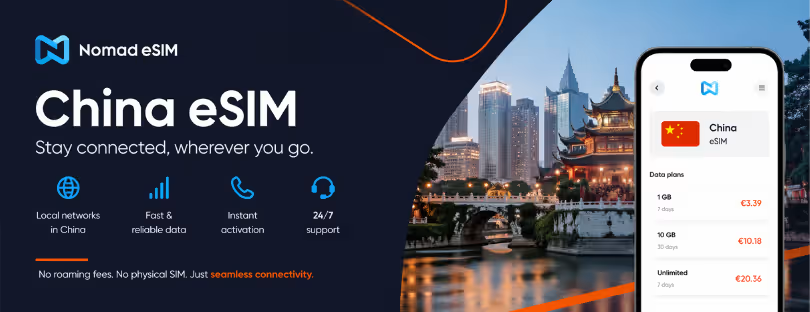
What Nomad is actually offering for China
Let’s skip the marketing language and look at the structure.
Nomad’s China plans are straightforward, almost aggressively simple:
NORMAL PLANS
1 GB
7 days
€3.39
3 GB
30 days
€5.94
5 GB
30 days
€8.48
10 GB
€18.66
30 days
€10.18
20 GB
€25.45
30 days
€16.97
50 GB
45 days
€29.69
UNLIMITED
Unlimited
3 days
€10.18
Unlimited
5 days
€15.27
Unlimited
7 days
€20.36
Unlimited
10 days
€28.00
At first glance, nothing groundbreaking. But the structure tells you a lot about how Nomad is positioning itself.
This is not trying to be the cheapest option. It is trying to be predictable and usable in China specifically.
That distinction matters more than most travelers realize.
The China factor: it’s not just about data
China is not just another destination in the roaming map. It is a completely different connectivity environment.
Local SIM cards and many international roaming connections route traffic through Chinese networks. That means restricted access to services like Google, WhatsApp, Instagram, or even some cloud tools.
What Nomad and similar providers are doing differently is routing traffic through international gateways. In practice, that often means:
No need for a VPN for basic access
Stable access to Western apps
Less friction when switching between networks
This is the real value proposition. Not the gigabytes. The routing.
And this is where a lot of cheaper options quietly fail.
Where Nomad actually performs well
From a practical perspective, Nomad’s China eSIM works best in three scenarios:
Short business trips
You land, you need Slack, Gmail, maybe Zoom. You don’t have time to debug a VPN.
The unlimited 3 or 5-day plans make sense here. They remove friction. You pay slightly more, but you avoid surprises.
Digital nomads passing through
China is often not a long-term base, but a stop. A few weeks in Shanghai or Shenzhen.
The 10 GB or 20 GB plans hit a sweet spot. Enough data, reasonable pricing, and more importantly, stable access to global tools.
First-time travelers
If you have never dealt with Chinese telecom restrictions, simplicity matters more than optimization.
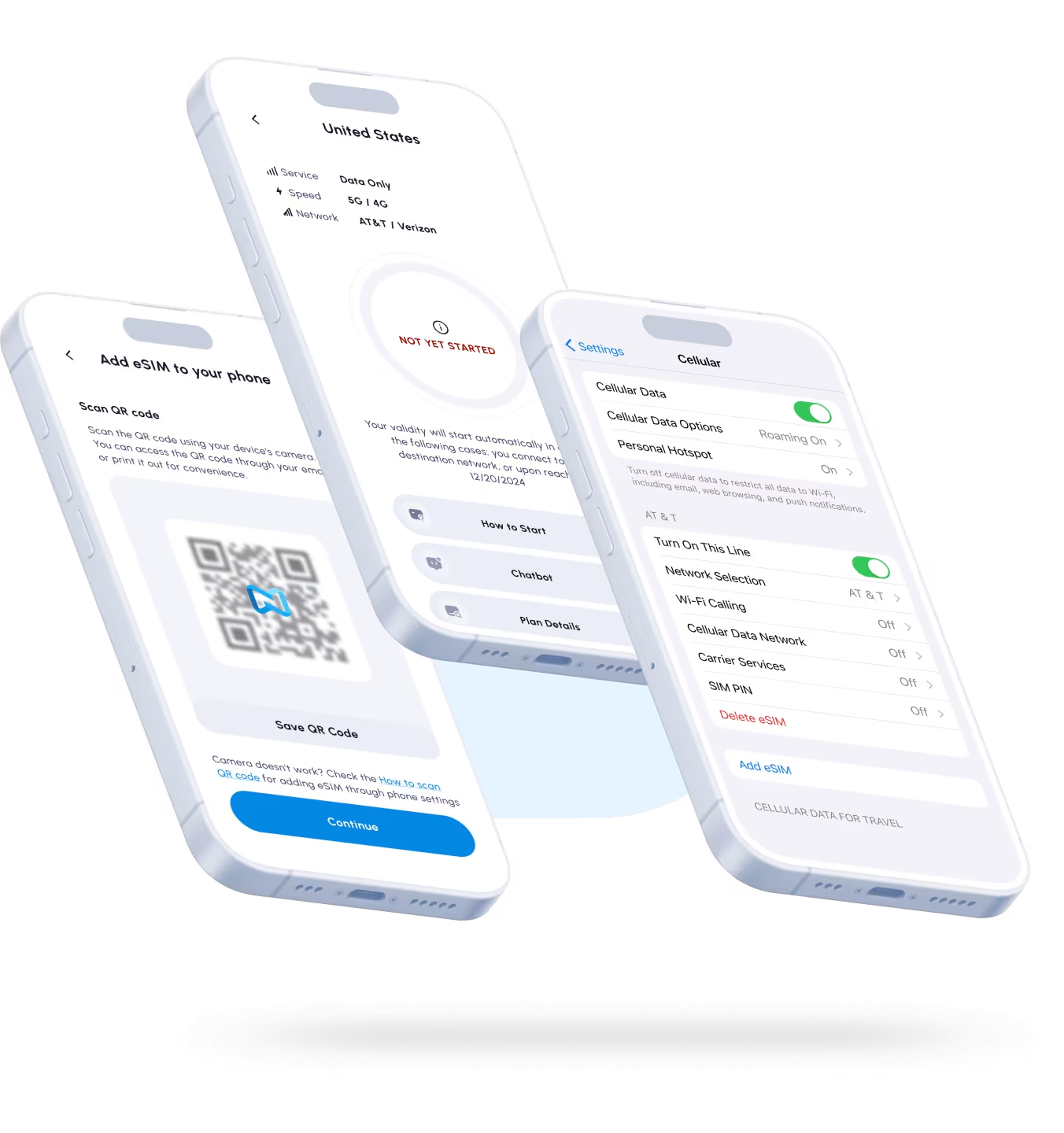
Nomad’s plans are easy to install, activate, and forget about. That alone is a selling point.
Where it’s not perfect
Let’s be honest. No China eSIM is perfect.
Nomad has two trade-offs:
Unlimited plans are almost always subject to fair usage policies. Speeds can drop after a certain threshold
Pricing is not the lowest on the market, especially for high data users
And if you are a heavy data consumer, streaming, tethering, or running constant video calls, you will feel those limits.
This is where other players try to differentiate.
How it compares to the market
China is one of the few markets where the differences between eSIM providers actually matter.
Take Airalo. It is often cheaper for low data plans, but users sometimes report more variability in routing and speeds depending on the partner network.
Holafly pushes unlimited plans aggressively. But those “unlimited” offers are frequently speed-throttled, especially in high-demand regions like China.
Yesim is interesting because of its unlimited day model, where you only consume a day when you actually connect. That flexibility can work well for China trips with irregular usage.
What Nomad does differently is stay in the middle:
Not the cheapest
Not the most aggressive “unlimited” marketing
But relatively stable in performance
And in China, stability tends to win over price.
The quiet trend: routing is the real product
If you zoom out, something bigger is happening in the travel eSIM space.
We are moving away from “data bundles” as the core product.
Instead, the real differentiation is:
Network routing
Latency and reliability
Access to restricted services
This shift is already visible in how providers position themselves. Some talk about “global coverage.” The more serious ones talk about network infrastructure and traffic handling.
China is just the most obvious example of this trend.
According to industry insights from the GSMA, international eSIM adoption is growing fastest in regions where traditional roaming fails to meet user expectations. China fits that pattern perfectly.
And reports from platforms like Statista consistently show that travelers now prioritize reliability over price when it comes to connectivity.
That is a subtle but important shift.
What this means for travelers
If you are heading to China, the decision is not really about gigabytes.
It is about risk.
Do you want the cheapest plan and hope it works smoothly?
Or do you want something that just works, even if it costs slightly more?
Nomad is clearly targeting the second group.
And honestly, for China, that is a reasonable strategy.
Conclusion: China exposes the truth behind eSIMs
The China market has a way of exposing weak products.
In Europe or the US, almost any eSIM works fine. Networks are open, infrastructure is mature, and differences are minimal.
China is different. It forces providers to prove their technical setup.
Nomad does not reinvent the category. But it does something more valuable. It delivers a relatively stable, low-friction experience in a market where that is genuinely hard.
Compared to competitors, it sits in a pragmatic middle ground. Less marketing hype than unlimited-first players like Holafly, more consistent performance than budget-first options, and less flexibility than programmable models like Yesim.
And that positioning actually aligns with where the industry is heading.
Because the next phase of travel connectivity is not about who sells the cheapest data.
It is about who controls the experience behind it.
China just happens to be the place where that difference becomes impossible to ignore.
Driven by wanderlust and a passion for tech, Sandra is the creative force behind Alertify. Love for exploration and discovery is what sparked the idea for Alertify, a product that likely combines Sandra’s technological expertise with the desire to simplify or enhance travel experiences in some way.