T-Mobile and Infobip Push Network APIs Into Security
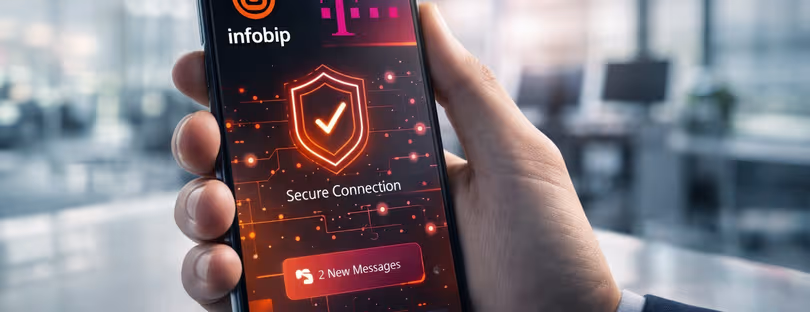
Something important is shifting in telecom, and it has less to do with speed and more to do with trust. Infobip is partnering with T-Mobile to integrate network APIs directly into its platform, giving enterprises a new way to verify users and reduce fraud. On paper, this looks like a technical upgrade. In reality, it signals a bigger change in how telecom networks are being used inside digital services.
Telecom is no longer just connectivity. It is becoming part of the security stack.
Why fraud is forcing telecom back into the spotlight
Mobile channels have quietly become one of the most targeted environments for fraud. SIM swap attacks, OTP interception, and identity spoofing are no longer niche threats. They are operational risks for any business that relies on mobile verification.
At the same time, user trust has been weakening. People still use SMS and app-based authentication, but confidence in those methods is declining.
This is where network APIs change the equation.
Instead of relying only on what an app can verify, network APIs allow developers to check signals directly from telecom infrastructure. That includes confirming SIM status, verifying device possession, and validating user identity at the network level.
It shifts authentication from assumption to verification.
Fixing the fragmentation problem
One of the biggest barriers to using telecom capabilities has always been fragmentation.
Each operator had its own APIs, making global integration slow and expensive. Enterprises had to build custom connections market by market, which limited adoption.
This is exactly what CAMARA and the GSMA Open Gateway initiative are addressing. By standardizing APIs across operators, they make telecom capabilities accessible in a consistent way.
Infobip’s integration with T-Mobile builds on this standardization. Instead of managing multiple operator relationships, enterprises can access these capabilities through a single platform.
What this enables
- Network-level user verification without relying only on OTPs
- Stronger authentication embedded into apps
- Reduced fraud across onboarding and transactions
- Faster deployment without custom integrations
This is not just a security upgrade. It is a usability breakthrough.

What the key players are saying
Dirk Mosa, SVP, Spectrum, Wholesale & Roaming at T-Mobile:
“Staying ahead of the increasingly complex and evolving cybercrime landscape has long been a priority as one of the largest telecom providers, We are committed to empowering businesses with Network APIs that mitigate mobile fraud and keep digital experiences secure, meeting the expectations of today’s digitally savvy consumers.”
Henry Calvert, Head of Networks at GSMA:
“T-Mobile is strengthening its business offering for partners and end customers by partnering with a GSMA Open Gateway-certified company, Infobip, to offer network APIs through a reliable and safe platform, Network APIs can play a crucial role in helping enterprises increase security and reduce fraudulent activity. So, the GSMA is proud to see these leading organizations unify their efforts and capabilities to tackle these challenges together from North America to the rest of the world.”
Marcelo Frizzo, VP of Strategic Accounts in North America at Infobip:
“The influx of fraudulent activity carried over mobile networks is heightening the need for businesses and their networks to fortify their security capabilities, from authentication processes to verifying user accounts, As more complex fraudulent activity over mobile networks exacerbates growing mistrust from audiences, businesses must be proactive in assuring protection for their customers. This is exactly what we’re doing with T-Mobile and our global carrier partners – helping enterprises keep their customers safe through carrier-grade network capabilities amid rising consumer prioritization of reinforced security in our digital ecosystem.”
Where this fits in the market
This move reflects a broader shift across telecom.
Operators like Vodafone, Orange, and Telefónica are pushing similar strategies through GSMA Open Gateway. At the same time, CPaaS players like Twilio and Vonage are expanding beyond messaging into identity and security.
But there is a clear distinction emerging.
Most CPaaS platforms operate at the application layer. They enable communication. Infobip’s approach, especially through direct operator integrations, goes deeper by bringing network intelligence into those interactions.
That changes the role of the platform.
It moves from enabling communication to enabling trust.
Why enterprises should pay attention now
For enterprises, especially in fintech, travel, and digital platforms, fraud is no longer just a cost issue. It directly impacts growth.
If onboarding is not secure, risk increases. If authentication is too complex, users drop off.
Network APIs offer a way to improve both security and user experience at the same time. Verification becomes stronger, but also more seamless.
That balance is critical.
And importantly, it aligns with what users expect. Security without friction.

The bigger picture: telecom as infrastructure again
This is part of a larger transformation.
Telecom is moving back into the core of digital services, not as visible infrastructure, but as an embedded capability. Network APIs are the interface that makes that possible.
As GSMA Open Gateway expands, these capabilities will become more standardized and more widely available. The expectation is that network-level verification will become a default layer across apps and platforms.
In that context, partnerships like Infobip and T-Mobile are early indicators of where the market is heading.
Conclusion: the shift from messaging to trust
This is not just another API integration.
Compared to traditional CPaaS players, which focus on communication channels, this approach brings telecom into the core of identity and security. Compared to standalone operator APIs, it simplifies access and scale.
That combination is what makes it significant.
The market is moving toward platforms that do more than connect users. They validate them.
And in a landscape where fraud is growing faster than user acquisition, that distinction matters.
The next phase of telecom will not be defined by coverage or speed. It will be defined by how effectively it can act as a trust layer inside digital ecosystems.
Infobip’s move with T-Mobile is a clear step in that direction.