MEP eSIM: Why Multiple Profiles Matter Now
MEP, or Multiple Enabled Profiles, sounds like one of those deeply technical telecom acronyms that only testing labs and standards people should care about.
But this one matters.
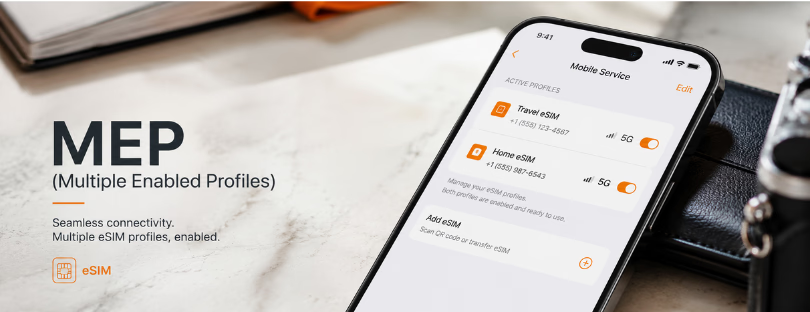
At its simplest, MEP allows more than one eSIM profile to be enabled and used at the same time on a compatible device. In plain English: a single eSIM chip can support dual active connectivity without needing two separate SIM slots or a physical SIM as the second line. Android’s own documentation describes MEP as a feature that lets devices running Android 13 or higher support dual SIM using a single eSIM chip, with multiple SIM profiles connecting to different carriers at the same time.
That may sound like a small hardware efficiency improvement. It is not. It changes how device makers design phones, how operators think about profile management, and how eSIM providers position themselves in a market that still sells too many products as if all eSIMs were basically the same.
From storing profiles to using them
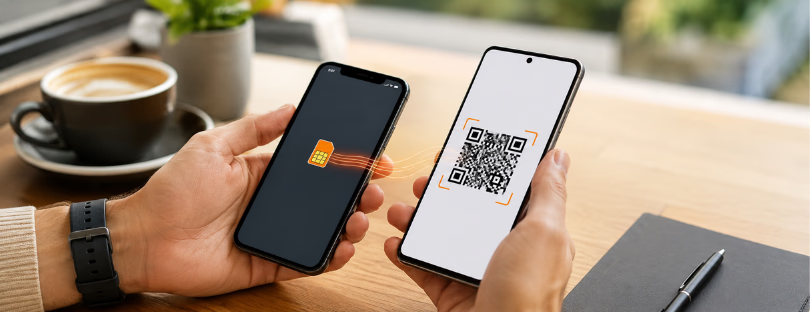
Most travellers already understand the basic eSIM promise: download a profile, activate it, connect abroad, avoid shocking roaming bills. Many modern phones can store several eSIM profiles, which is useful, but storage is not the same as simultaneous use.
Before MEP, the practical experience often depended on the device setup. A user might run one physical SIM and one eSIM, or switch between stored eSIM profiles manually. That is fine for simple travel, but it starts to feel clumsy when people want work and personal lines active, a home number reachable, and a travel data plan running in the background.
MEP pushes the industry closer to the experience users actually expect: one device, several identities, less fiddling. The traveller should not need to understand the architecture behind the scenes. They just want their bank SMS, WhatsApp, airline app, work line, roaming fallback, and local data to behave.
That is where MEP becomes interesting. It turns eSIM from a “downloadable SIM replacement” into a more flexible connectivity layer.
Why GSMA and testing matter
The source shared by GSMA and COMPRION frames MEP as more than another eSIM extension, because it depends on correct implementation, interoperability and validation across devices, profiles and networks. COMPRION has also announced GSMA SGP.23-2 MEP tests for consumer devices, based on GSMA SGP.22 v3, to support simultaneous eSIM profile use.
That testing angle is important. In consumer marketing, eSIM is often sold as a neat app experience: scan, install, go. In reality, the stack is much deeper. The device, chipset, eUICC, operating system, LPA, profile, operator systems and remote SIM provisioning architecture all need to behave properly.
READ MORE: How to switch between eSIM profiles?
This is why MEP will not become meaningful just because a standard exists. It becomes meaningful when OEMs, chipset vendors, SIM technology providers, operators and eSIM platforms all implement it cleanly enough that users never have to think about it.
And that is usually where the real industry split appears. Some companies sell eSIM access. Others understand the full lifecycle.

The travel angle
For travel eSIM providers, MEP is both an opportunity and a warning.
The opportunity is obvious. A traveller could keep their primary home profile active while using a travel eSIM for data. Business travellers could maintain a corporate profile and a personal travel profile. Frequent travellers could move between operator profiles more smoothly, especially on devices where physical SIM slots are disappearing or already gone in certain markets.
But the warning is sharper. If device-native eSIM management improves, and if phones make multiple active profiles easier to handle, the value shifts away from “we sell a QR code” toward orchestration, reliability, profile quality, support and intelligent plan logic.
That matters for providers competing only on gigabytes and price. MEP does not automatically make a weak travel eSIM better. It simply gives better platforms more room to show why they are better.
Beyond phones
MEP also sits inside a wider eSIM standards story. Consumer eSIM has largely been shaped by GSMA SGP.22, while IoT is moving toward SGP.32, a newer architecture designed for remote profile management in devices that may not have screens, QR scanning or user interaction. Industry explainers from companies such as Telenor IoT and emnify describe SGP.32 as purpose-built for IoT fleet management, while SGP.22 remains focused on consumer devices.
That distinction matters because the future of eSIM is not one market. It is several overlapping markets.
A smartphone traveller wants convenience.
An enterprise wants policy, control and auditability.
An IoT fleet manager wants remote provisioning at scale.
An operator wants compliance and lifecycle control.
A device maker wants fewer hardware constraints.
MEP is most visible in phones, but its logic points to the bigger direction: connectivity is becoming software-defined, multi-profile and more dynamic.
 Who benefits first
 Who benefits first
The first obvious winners are device makers. If one eSIM chip can support multiple active profiles, the hardware design becomes cleaner. There is less pressure to preserve old SIM slot logic just to support dual SIM behaviour.
Operators can benefit too, but only if they treat MEP as a way to improve customer experience rather than protect old activation models. For MVNOs and travel eSIM brands, the benefit depends on execution. Providers with stronger provisioning systems, better app flows, clearer customer education and reliable network partnerships will look more credible. Providers relying on cheap data bundles and vague “global coverage” claims may find the market less forgiving.
READ MORE: The Future of eSIM Is One Unified Connectivity Layer
Testing specialists such as COMPRION also become more important, not less. As eSIM becomes more capable, validation becomes a competitive necessity. A broken single-profile setup is annoying. A broken multi-profile setup can affect two lines, two operators and a user who has no patience for telecom excuses.
Conclusion
MEP is not the headline feature travellers will ask for by name. Most people will never say, “I need a Multiple Enabled Profiles compatible eSIM setup.” They will simply expect their phone to manage several connectivity needs at once without drama.
That is exactly why MEP matters.
It quietly moves eSIM competition away from the old SIM replacement story and toward a more layered market. Apple, Android device makers, Samsung, Google, operators, test companies, eSIM enablers and travel eSIM brands are all playing in the same space, but not at the same level. The consumer sees a toggle. The industry sees control points.
For Alertify readers, the takeaway is simple: MEP is another sign that eSIM is maturing beyond “buy data before you fly.” The next phase is about simultaneous profiles, device-native experiences, lifecycle management and smarter orchestration. The brands that understand that will talk less about QR codes and more about reliability, control and real user scenarios.
That is where eSIM is heading. Not more profiles for the sake of more profiles, but better connectivity architecture hidden behind a much simpler travel experience.