Because once you step outside Europe or parts of Asia, internet pricing becomes something else entirely. Not just higher. In some places, it crosses into what feels like a luxury product rather than a basic utility.
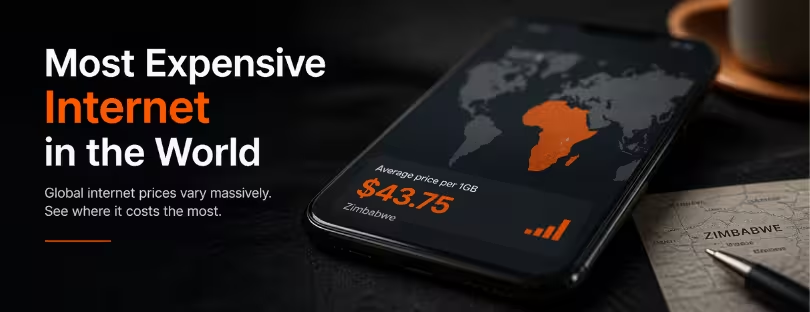
Take Zimbabwe. It consistently ranks as the most expensive mobile data market in the world, with prices around $40+ per GB. That means a few hours of video calls or remote work can cost more than a week of groceries.
Put that next to Italy or Israel, where 1GB can cost less than $0.10, and the contrast becomes almost absurd.
Same internet. Same technology. Completely different reality depending on where you are.
Fixed vs mobile
There’s an important distinction that often gets lost.
“Most expensive internet” can refer to two very different things. Fixed broadband and mobile data.
Fixed broadband is what you pay for at home, usually priced per Mbps. Mobile data is what you actually use when you travel, priced per GB.
And the rankings are not the same.
For fixed broadband, the United Arab Emirates regularly shows up as one of the most expensive markets globally. High-quality infrastructure, strong performance, but limited competition keep pricing elevated.
For mobile data, the list shifts toward smaller economies, remote regions, and structurally constrained markets.
For travelers, mobile pricing is the one that actually matters.
Highest-cost countries
Once you look at the data, the pattern is very clear.
The most expensive internet markets tend to share similar traits.
Zimbabwe
Falkland Islands
Saint Helena
South Sudan
Yemen
These are not high-density, highly competitive telecom environments. They are often remote, economically constrained, or dependent on limited infrastructure.
That combination pushes costs up dramatically.
Even markets like the United States and Canada, which don’t top the list, still sit noticeably higher than Europe, often around $5 to $6 per GB.
So, high income does not automatically translate into cheap internet.
Why prices rise
It’s easy to assume high pricing is simply about operators charging more. In reality, it’s structural.
Infrastructure is the first driver. Building and maintaining telecom networks is expensive, especially in regions with low population density. Fewer users means a higher cost per user.
Competition is the second. Markets dominated by one or two operators almost always show higher prices. There’s less pressure to reduce them.
Regulation also plays a role. Spectrum costs, licensing frameworks, and national telecom strategies directly influence pricing models.
And then there’s affordability. A market might look cheap on paper, but if incomes are low, access is still limited.
Price alone never tells the full story.
Geography matters
If you map global pricing, geography becomes one of the strongest predictors.
Sub-Saharan Africa appears repeatedly among the most expensive regions. Small island economies show the same pattern.
Meanwhile, Eastern Europe stands out for the opposite reason. Countries like Romania offer some of the cheapest internet globally, driven by aggressive ISP competition and early fiber rollout.
This isn’t accidental.
When multiple providers compete for the same users, prices collapse. When they don’t, prices hold or rise.
The widening gap
One of the more uncomfortable realities is that the gap isn’t closing.
It’s widening.
The difference between the cheapest and most expensive data globally can exceed 100 times.
That’s not just a pricing issue. It’s a structural divide.
It affects who can work remotely, who can access digital services, and who can fully participate in the global economy.
Connectivity becomes access. Or exclusion.
Travelers feel it
For travelers, this gap is immediate.
You land in Italy and data feels almost free. You land in the United States and it suddenly feels expensive. You land in a high-cost market and the difference becomes impossible to ignore.
This is exactly where eSIM solutions gained momentum.
Not because they’re new, but because they smooth these extremes. They sit on top of multiple networks and pricing agreements, then present something predictable.
And predictability, in a fragmented system, is a powerful product.
Market distortion
There’s a dynamic here that rarely gets discussed.
The markets with the most expensive internet are often the least competitive and the least innovative.
Breaking that loop requires either regulatory intervention or new players that fundamentally change the pricing model.
What is changing
Shifts are happening, but they’re uneven.
Mobile data prices are generally declining globally, but not at the same pace everywhere. Fiber rollout is improving fixed broadband in many regions, but it takes time.
Satellite internet is entering the conversation, but it’s still not a universal solution due to pricing and scalability challenges.
Technology is evolving. Market structures are slower to change.
Conclusion
The most expensive internet in the world is not really about price.
It’s about how telecom markets are structured.
In competitive environments like Italy or Romania, pricing collapses because operators are forced to compete.
In controlled markets like the United Arab Emirates, prices remain high despite strong infrastructure.
In constrained markets like Zimbabwe, pricing reflects deeper economic and infrastructural limitations.
What’s changing is not the existence of these gaps, but how they are being navigated.
eSIM providers and global connectivity platforms are not fixing the underlying system. They are building on top of it. They aggregate access, normalize pricing, and create consistency where none existed.
That’s fundamentally different from traditional telecom.
Roaming still relies on bilateral agreements and legacy pricing logic. eSIM platforms behave more like marketplaces, optimizing across multiple networks.
And marketplaces tend to win.
The real takeaway is not that some countries have expensive internet.
It’s that global connectivity is still fragmented.
And that fragmentation is exactly where the next generation of telecom players is building its advantage.
Driven by wanderlust and a passion for tech, Sandra is the creative force behind Alertify. Love for exploration and discovery is what sparked the idea for Alertify, a product that likely combines Sandra’s technological expertise with the desire to simplify or enhance travel experiences in some way.


 Why prices rise