Luxury Hotel Parent Brands in China: The Real Battle Is Above the Door
For years, international hotel groups treated China as one of the great luxury growth stories. Open a Ritz-Carlton, a Waldorf Astoria, a Park Hyatt, a Regent, or a St. Regis in the right city, attach the right loyalty engine, and the market would do the rest.
That story is no longer so simple.
China is still enormous. It still matters. But the luxury hotel game there is becoming more strategic, more local, and much less forgiving. The old assumption that a famous global name automatically wins the high-end traveller is starting to look tired. Today, the more interesting question is not only which luxury hotel brand is opening in China. It is which parent company has the strongest system behind it.
Because in China, luxury is not just a logo above the entrance. It is distribution, loyalty, owner trust, digital convenience, cultural fluency, and the ability to make a property feel international without feeling copy-pasted.
The parent brand matters more now
Marriott International remains one of the most powerful players because its luxury architecture is deep. The Ritz-Carlton, St. Regis, W Hotels, EDITION, JW Marriott and The Luxury Collection give Marriott several ways to speak to different luxury travellers, from old-school service expectations to lifestyle-led city stays. Marriott also said its Greater China expansion accelerated in 2025, with more than 200 deals signed and over 36,000 rooms added to its regional pipeline. That tells us something important: even with softer market conditions, the big groups are still placing long-term bets.
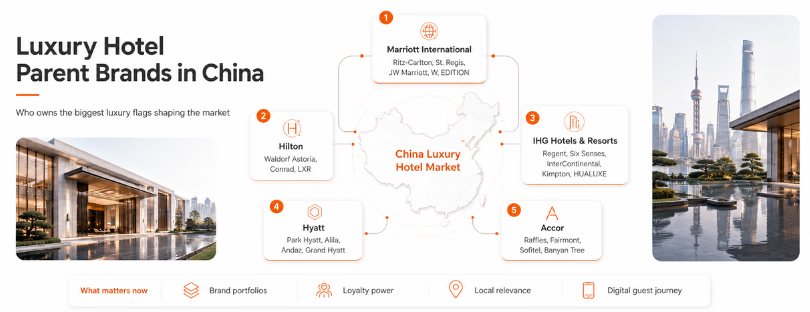
Hilton plays a slightly different card. Waldorf Astoria, Conrad, LXR and NoMad sit inside a luxury portfolio that is increasingly about lifestyle, design and high-end experience rather than only formality. Hilton’s own 2025 luxury outlook highlighted continued global expansion for its luxury brands, including Waldorf Astoria and Conrad openings across key markets. In China, that matters because the modern luxury guest is not always looking for marble, chandeliers and a silent lobby. Often, they want privacy, wellness, strong restaurants, good technology, and a hotel that feels like part of the city.
IHG is also worth watching closely. Its Greater China portfolio includes Six Senses, Regent, InterContinental, Vignette Collection, Kimpton and Hualuxe, the last being particularly interesting because it was created with Chinese guests in mind. IHG says it has over 1,300 open and pipeline hotels across more than 200 cities in Greater China, while its Luxury & Lifestyle brands now represent a much larger part of its global pipeline than five years ago.
That is the direction of travel. Luxury is not disappearing. It is being integrated into broader ecosystems.
Luxury is moving beyond prestige
The tricky part is demand.
China’s hotel market is not booming evenly. HVS noted that Beijing softened in 2025 due to weaker corporate and government travel, while Shanghai looked more resilient thanks to trade fairs and international visitors. Reuters also reported pressure on major hotel groups from weaker Greater China performance, including Marriott’s softer 2025 outlook linked partly to China demand.
This is why parent brands are important. A standalone luxury flag can look vulnerable in a choppy market. A parent group with strong loyalty data, corporate relationships, distribution channels, midscale brands, lifestyle brands and owner support has more room to adjust.
READ MORE: Jin Jiang International: A Powerhouse in the Global Hospitality Industry
That is exactly why the China story is not only about luxury. Global groups have also been pushing harder into midscale and upper-midscale segments as Chinese travellers become more value-conscious. The Financial Times reported that global hotel chains have been expanding at the cheaper end of the market in China as the economy slows, with Hyatt, IHG and Radisson among those sharpening their mid-market focus.
That does not mean luxury is dead. It means luxury has to justify itself better.
Local groups are not sitting quietly
The international names are not competing only with each other. Chinese hotel groups are becoming more sophisticated, more scalable, and more confident.
H World is a good example. The group has spoken openly about becoming the “Marriott of China,” with a target of 20,000 hotels by 2030 and a model built around rapid franchising and strong domestic execution. Jin Jiang, BTG, Wanda and other domestic players also understand Chinese consumer behaviour in a way international groups cannot simply import from Paris, New York or Dubai.
READ MORE: J Hotel Shanghai Tower: China’s Highest Luxury Stay Welcomes a New Era of Tourism
This creates an interesting split. International parent brands still carry huge prestige at the luxury end. But local parent companies often have sharper instincts around domestic travel patterns, payment habits, app ecosystems, city-tier expansion and price sensitivity.
For Alertify readers, this is where the hotel story starts to look like a technology story. The winning parent brands will be the ones that connect brand, booking, loyalty, mobile experience and on-property service into one smooth journey. A luxury guest in China does not want to fight with Wi-Fi, clunky apps, payment friction or disconnected service. The “luxury” moment starts before arrival and continues after checkout.
The new luxury test
The parent companies with the strongest China strategy will not necessarily be those with the most glamorous names. They will be the ones that know when to use a global luxury badge, when to localize the experience, and when to let lifestyle, wellness, food, digital service or loyalty do the real work.
Marriott has scale and brand depth. Hilton has lifestyle momentum and a modern luxury portfolio. IHG has a strong China footprint and a rare China-conscious brand architecture through Hualuxe. Hyatt remains powerful in luxury and lifestyle, especially with Park Hyatt, Andaz and Alila, while Accor brings breadth through brands such as Raffles, Fairmont, Sofitel and Banyan Tree.
But China is forcing all of them to become more precise.
Final thought
The luxury hotel market in China is no longer a beauty contest between famous hotel names. It is a systems contest between parent brands.
The best groups will still open beautiful hotels, of course. But the real advantage will sit behind the scenes: loyalty engines, local partnerships, owner confidence, digital convenience, brand discipline and the ability to understand China’s increasingly selective traveller.
Luxury in China is not getting smaller. It is getting harder to fake.