Louis Vuitton Enters Beauty With AI-Powered Virtual Try-On
When Louis Vuitton does something for the first time, the industry pays attention. When it enters beauty with a full makeup line and launches it hand in hand with advanced AI and AR technology, it becomes a signal moment for luxury, tech, and digital commerce alike.
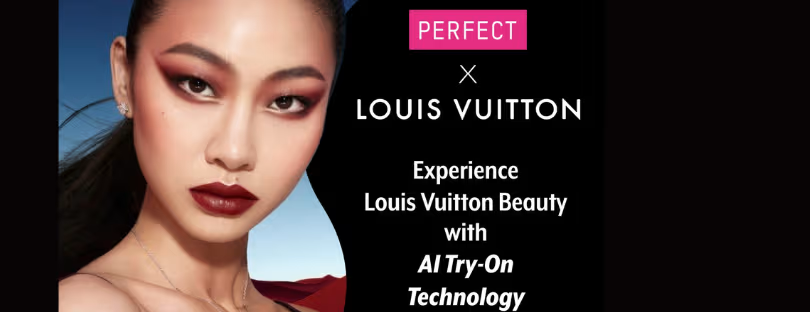
With the debut of La Beauté Louis Vuitton, the Maison is not just adding lipsticks and palettes to its portfolio. It is making a clear statement about how luxury beauty should be discovered, tested, and experienced in a digital-first world. And for that, Louis Vuitton turned to Perfect Corp., one of the most established players in AI-powered beauty technology.
A digital-first beauty debut
Louis Vuitton’s first-ever makeup collection launches with scale and intention. The line includes eight eyeshadow palettes, 65 lipstick shades across satin, matte, and balm finishes, and 24 curated makeup looks. But the real story sits beyond the product count.
From day one, the collection is supported by immersive virtual try-on experiences across web, mobile apps, and WeChat in China, reaching consumers in 33 countries. This is not a later-stage digital add-on. Virtual try-on is embedded directly into the launch strategy, signaling how seriously the brand takes digital discovery.
Luxury beauty has often been cautious with tech, favoring physical counters and controlled in-store environments. Louis Vuitton chose the opposite path, launching beauty as a fully hybrid experience where digital interaction is not a compromise but a core feature.
Why Perfect Corp matters here
Perfect Corp is not new to this space. Its technology already powers virtual try-on and AI diagnostics for hundreds of global beauty brands. What makes this collaboration notable is how deeply customized the experience is for Louis Vuitton.
Rather than applying generic filters or standard AR layers, the teams co-developed a bespoke experience that mirrors the brand’s obsession with craftsmanship and realism. The goal was not to impress users with flashy effects, but to make digital lipstick behave like real lipstick.
That distinction matters. Consumers are increasingly skeptical of overly polished beauty tech that looks good on screen but fails to reflect reality. Louis Vuitton and Perfect Corp leaned into realism over spectacle.

Industry-first features, explained simply
Smarter shade discovery
The virtual try-on experience includes AI-powered lipstick shade recommendations based on facial color analysis. Perfect Corp’s data capture technology feeds into Louis Vuitton’s own AI logic, helping users narrow down shades that work with their complexion rather than scrolling endlessly through options.
Filter-free realism
One of the most interesting choices was removing traditional overlay filters. Instead of placing a static color layer on the lips, the lipstick responds naturally to facial movement. If a user moves their hand across their face or turns their head, the lipstick stays true. It sounds subtle, but it dramatically improves trust in the experience.
Dual-shade comparison
Users can try two lipstick shades side by side in real time. This directly addresses a real online shopping pain point: choosing between similar shades. It is a small feature with big conversion implications.
Enhanced lip tracking
Precision lip tracking ensures clean edges and consistent application, even as lighting and angles change. Again, this is about credibility. If virtual try-on looks wrong, users abandon it instantly.
Luxury beauty meets modern commerce
This launch reflects a broader shift in how luxury brands approach beauty and cosmetics. Unlike fashion, beauty relies heavily on trial. Digital tools are now expected to close that gap.
By integrating virtual try-on at launch, Louis Vuitton aligns with changing consumer behavior. Shoppers want confidence before purchasing, especially at luxury price points. They also expect personalization, speed, and accessibility without sacrificing brand experience.
Maria-Jose Barrera Rojas, Global VP E-Commerce for Louis Vuitton, framed the launch as a creative expansion rather than a simple product release. That positioning is important. Beauty is not treated as a side category, but as an extension of the brand universe, supported by technology that respects its values.
Perfect Corp’s CEO Alice Chang echoed that sentiment, describing the collaboration as a glimpse into the future of luxury beauty where personalization and immersion are standard, not premium extras.

How does this compare to the wider market
Where others are playing
Luxury and premium beauty brands have been experimenting with AR for years. Brands under LVMH, Estée Lauder Companies, and L’Oréal have all deployed virtual try-on tools in various forms. Snapchat-powered lenses, in-app AR mirrors, and third-party plugins are now common.
What sets this apart
What differentiates the Louis Vuitton approach is restraint and integration. Many AR beauty experiences prioritize speed to market over realism. Filters look impressive but fail under scrutiny. This launch focuses on accuracy, movement realism, and decision-making support, not visual gimmicks.
Perfect Corp sits at the more mature end of the beauty tech spectrum, alongside players like ModiFace. The competitive edge here is execution quality and the willingness of a luxury brand to invest in bespoke development rather than off-the-shelf solutions.
Where the trend is heading
Industry reports from sources like McKinsey, Business of Fashion, and Vogue Business consistently point to three trends: personalization, digital trial, and AI-assisted commerce. Virtual try-on is no longer experimental. It is becoming a baseline expectation, especially for Gen Z and millennial consumers shopping online.
Luxury brands that delay this shift risk feeling outdated, particularly as beauty becomes an entry point for younger audiences discovering high-end maisons for the first time.
Conclusion
Louis Vuitton’s beauty debut shows how luxury can adopt technology without diluting its identity. By choosing realism over novelty and partnering with a proven tech leader like Perfect Corp, the brand avoids the common pitfalls of digital beauty experiences.
What stands out is not just the technology itself, but the confidence to make it part of the launch narrative rather than a background feature. Compared to many competitors still treating virtual try-on as a supporting tool, Louis Vuitton positions it as a core layer of the customer journey.
As beauty, fashion, and tech continue to converge, this launch sets a quiet but important benchmark. The future of luxury beauty is not about louder filters or faster rollouts. It is about believable experiences that help people make better decisions. And that is exactly where the market is heading.