


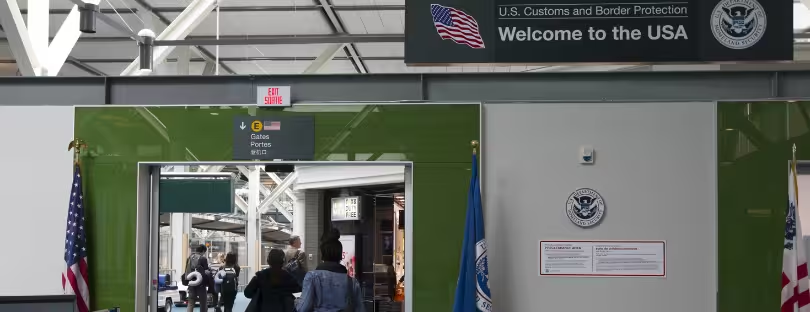
US Tourism Hits a Wall as International Arrivals Slide
In a gloomy finale to an already challenging year, international air arrivals to the United States fell again in December 2025. What was once expected to be a strong post-pandemic recovery has now clearly stalled, and the latest figures confirm that this is not a one-month anomaly, but part of a deeper, structural slowdown. international travel to the US
According to fresh data from the National Travel and Tourism Office, released in early January 2026, non US citizen air arrivals declined by 2.9 percent year over year. Total international arrivals reached roughly 5.3 million, a number that would have looked respectable a decade ago, but today signals lost momentum.
More concerning is the overseas segment. Excluding Canada and Mexico, overseas visitation slipped 1.3 percent to 3.2 million arrivals, marking the eighth consecutive monthly decline. While December’s fall was milder than October’s 3.1 percent and November’s 3.5 percent drops, the direction remains unmistakable.
By the end of 2025, international air arrivals were still hovering at just 92 percent of pre pandemic 2019 levels. In other words, the recovery has not only slowed, it has effectively plateaued.
The bigger picture shows a reversal, not a pause
Zooming out, the full year story is even more sobering. Overseas visitation to the US in 2025 declined by 2.5 percent compared to 2024, wiping out the gains that initially followed the reopening of borders after COVID.
This outcome sharply contradicts what the industry expected at the start of the year. Tourism Economics initially forecast a 9 percent increase in international arrivals for 2025. By mid year, that outlook was revised to an 8.2 percent decline, with analysts pointing to persistent sentiment headwinds rather than short term demand issues.
The World Travel & Tourism Council went further, estimating a $12.5 billion loss in international visitor spending for the year. That figure is particularly striking because it makes the United States the only major tourism economy to post a decline in inbound international spending while most of the world experienced a rebound.
Policy, perception, and the Trump effect
A recurring theme across industry reports is policy driven perception. The return of Donald Trump to the White House and the foreign policy direction of the Trump administration are widely seen as a central factor behind the downturn.
Under President Donald Trump, the US implemented sweeping tariffs on key trading partners including Canada, Mexico, China, and the European Union. At the same time, expanded travel bans affected anywhere between 19 and 55 countries, many from Africa and the Middle East.
Immigration enforcement at borders intensified, and new costs were introduced. The $250 Visa Integrity Fee was added, while ESTA fees for visa waiver travelers were doubled. For frequent international travelers, families, and long haul visitors, these changes sent a clear signal that visiting the US was becoming more expensive, more complex, and more uncertain.
Add to this the administration’s rhetoric. Public comments about annexing Canada as the 51st state or acquiring Greenland may have been political theatre, but internationally they reinforced a perception of instability and unpredictability. For tourism, perception matters almost as much as policy.
Canada and Western Europe pull back
The data shows that Canada and Western Europe bore the brunt of this shift. Tourism Economics estimates that arrivals from Canada fell between 20.2 and 25 percent overall in 2025, with certain air booking periods plunging by as much as 35 to 70 percent.
Western Europe also softened significantly. Depending on market and season, inbound travel dropped between 4.9 and 17 percent. Analysts consistently cite negative sentiment driven by tariffs, border crackdowns, and fears of detention or denial of entry.
Isolated but highly publicized reports of tourists being detained or turned away at US borders amplified these concerns. Several countries quietly updated travel advisories, urging citizens to be cautious about documentation and questioning.
Canadian travelers responded swiftly. Informal boycotts gained traction, and many redirected travel plans toward Mexico and the Caribbean. Booking data shows Mexico benefiting directly, with inbound Canadian travel rising between 11 and 13 percent in the same period.
European travelers followed a similar pattern. Airlines trimmed capacity and, in some cases, cut routes to major US hubs such as Las Vegas, Miami, and New York. For destinations dependent on long haul international spend, the impact was immediate.
The economic ripple effect across cities and states
What began as a demand slowdown quickly translated into an economic shortfall. Instead of the expected revenue boost, the US tourism sector faced a combined gap of $25 to $29 billion, factoring in lost growth and direct declines.
Major cities felt the pain unevenly but clearly.
Las Vegas reported a sharp drop in Canadian visitors, with local officials openly blaming tariffs, exchange rate pressures, and rising travel costs.
Miami saw weaker demand from Latin America and Canada, compounded by capacity constraints at its airport and heightened border scrutiny.
New York projected millions fewer international visitors than anticipated, translating into billions in lost spending across hotels, retail, and entertainment.
At the state level, California forecast a 0.7 percent overall decline in tourism. Overseas arrivals were down 3.7 percent, while Canadian visitation plunged by 18.4 percent, a staggering reversal for a market that traditionally relies heavily on Pacific and Canadian traffic.
These declines do not just affect airlines and hotels. They ripple through restaurants, attractions, transport providers, and employment across the travel ecosystem.
A self inflicted wound in a competitive market
The WTTC did not mince words, calling the downturn a self inflicted injury. While the US effectively put up a closed sign, competitors moved in the opposite direction.
China expanded visa free access. Countries across Southeast Asia simplified entry requirements. Even parts of Europe quietly improved border processes and digitalized visas to reduce friction.
To be clear, not all of the decline can be pinned on policy alone. A strong US dollar and broader global economic pressures account for an estimated 20 to 30 percent of the slowdown, depending on the market. But industry consensus is strikingly aligned. Trump era policies acted as the primary amplifier, turning what could have been a modest adjustment year into sustained weakness.
Analysts now warn that without meaningful changes, a full recovery could be delayed until 2029.
Conclusion: where the US stands in a changing tourism landscape
What makes the current situation particularly stark is the contrast with peer markets. While the US tightened access and raised costs, destinations like Japan, Mexico, Turkey, and parts of Southeast Asia leaned into openness, digital visas, and proactive tourism marketing. These countries captured displaced demand quickly, especially from price sensitive and sentiment driven travelers.
Reliable sources such as Tourism Economics, the World Travel & Tourism Council, and multiple airline capacity reports point to the same conclusion. In today’s tourism economy, competitiveness is not just about attractions or infrastructure. It is about ease, predictability, and welcome. international travel to the US
Mega events scheduled for 2026, including global sports tournaments, could offer a temporary lift. But without addressing the underlying barriers, those gains risk being short lived. Travelers now have more choice than ever, and loyalty to destinations is increasingly fragile.
For the US to reclaim its position as a leading global destination, the challenge is no longer demand. It is trust. Rebuilding that trust will require policy clarity, consistent messaging, and a conscious effort to signal that the country is open for business and open to visitors again.


