


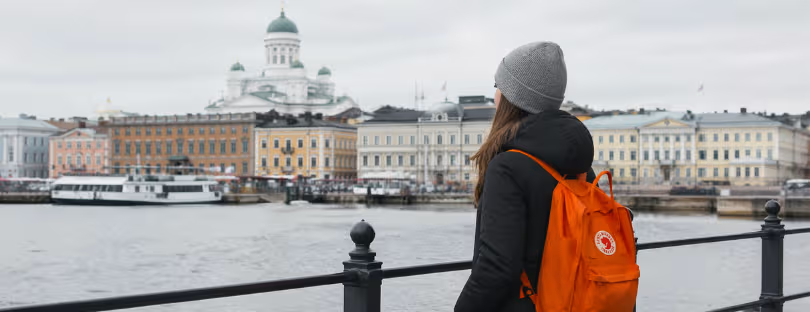
Finland May Introduce Tourist Tax: Here are Key Details
Finland is quietly exploring a move that’s becoming increasingly common across Europe: asking tourists to contribute a little more for the places they visit. Nothing is final yet, but the direction is clear. As visitor numbers grow and pressure on infrastructure increases, the idea of a tourist tax is back on the table.
Here’s what’s actually being discussed, and why it matters if Finland is on your travel list.
A small fee, bigger question
The Finnish government is considering introducing a tourist tax that would add a modest fee to overnight stays. The exact structure is still under discussion, but early signals point toward something relatively light. Think a few euros per night rather than anything that would dramatically change trip budgets.
This isn’t about discouraging travel. It’s about balancing it.
Finland has seen steady tourism growth over the past decade. From Lapland’s winter appeal to Helsinki’s design and culture scene, demand is consistent. But with that comes a familiar challenge: who pays for the upkeep?
Public transport, waste management, national parks, and local infrastructure all feel the impact of tourism. And increasingly, governments across Europe are asking visitors to share part of that cost.
Why now
There’s no single trigger, but the timing isn’t random.
Finland has built a reputation as one of the world’s most livable and sustainable destinations. That comes with expectations. Preserving natural areas, especially in regions like Lapland or archipelago zones, requires funding and careful management.
At the same time, tourism patterns are shifting. Short-term stays are rising. Seasonal peaks are more intense. And travelers are spreading beyond traditional hotspots.
That combination creates pressure in places that weren’t originally designed for high visitor volumes.
A tourist tax is one of the simplest tools governments can use to respond. It doesn’t require major structural changes, and if implemented well, it can generate predictable revenue.
Not a new idea in Europe
If Finland moves forward, it won’t be breaking new ground.
Countries like Italy and Spain have long used tourist taxes, often collected by hotels or accommodation platforms. In cities like Rome, Barcelona, or Berlin, these fees are already part of the booking experience.
They usually range between €1 and €5 per night, depending on the city, accommodation type, and season.
From a traveler’s perspective, it’s rarely a dealbreaker. It’s more of a line item you notice after booking.
From a policy perspective, though, it’s a significant lever. It allows governments to channel funds directly into tourism-related costs without raising taxes for residents.
Finland has been one of the few major European destinations without such a system. That’s what makes this potential shift notable.

Industry reactions are mixed
Unsurprisingly, the tourism sector is watching closely.
Hotels and operators are asking practical questions. How will the tax be collected? Will it apply uniformly across regions? Who controls the revenue, local municipalities or the central government?
There’s also the usual concern about competitiveness. Finland is already considered a relatively expensive destination, especially compared to southern Europe. Even a small additional cost can influence perception, if not actual demand.
That said, experience from other markets suggests the impact is limited. Travelers rarely cancel trips over a few euros per night, especially in destinations with strong appeal or unique experiences.
The bigger issue is transparency. If visitors can see where the money goes, whether it’s maintaining hiking trails, improving public transport, or protecting natural areas, acceptance tends to be much higher.
What it means for travelers
Right now, there’s no confirmed timeline and no final structure. But it’s worth factoring this into future planning.
If introduced, the tax will likely be bundled into accommodation pricing or added at checkout. In most cases, you won’t need to do anything differently.
For a typical stay, the added cost would probably be somewhere between €5 and €20 total. Noticeable, but not disruptive.
What matters more is the broader trend. Travel is becoming less about pure price comparison and more about value, sustainability, and experience. Small fees like this are part of that shift.
A signal of where travel is going
This isn’t just about Finland. It’s part of a wider recalibration happening across global tourism.
Destinations are moving away from volume-driven strategies and toward more controlled, sustainable models. Tourist taxes, visitor caps, and environmental fees are all tools in that toolkit.
You’re already seeing this in cities like Venice, which introduced entry fees for day visitors, and in regions that limit access to sensitive natural sites.
Finland’s approach, if implemented, will likely be more measured. The country doesn’t face overtourism in the same way as southern European hotspots. But it’s clearly looking ahead rather than reacting late.
The real takeaway
Tourist taxes tend to spark debate, but in reality, they’re becoming standard practice.
What will matter most is execution.
If Finland introduces a clear, transparent system where revenue is visibly reinvested into infrastructure and environmental protection, the impact on travelers will be minimal and the long-term benefits meaningful.
Compared to markets like Italy or Spain, Finland still has the advantage of controlling this early. It can design a system that fits its tourism model rather than retrofitting one under pressure.
The trend is obvious. Travel is getting more structured, more regulated, and more intentional.
For you as a traveler, the takeaway is simple. Expect small additional costs. But also expect better-managed destinations in return.
And in a place like Finland, that trade-off is probably worth it.


