How eSIM Works With Mobile Network Operators
You know that oddly satisfying moment when you scan a QR code, tap “Add eSIM,” and suddenly your phone has signal in a new country? It feels like magic.
But on the operator side, it is not magic. It is a very structured, standards-based handoff between your device, an eSIM provisioning platform, and a mobile network operator’s core network.
This is the part most travel eSIM marketing skips. Not because it is secret, but because it sounds complicated. Let’s make it simple, without dumbing it down.
eSIM vs eUICC vs “profile”
First, vocabulary, because the industry loves confusing people.
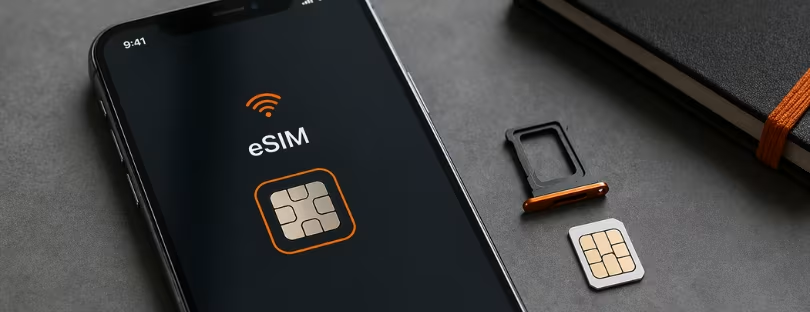
An “eSIM” in everyday conversation usually means the embedded chip plus the software capability to load a carrier plan digitally. In standards language, what matters is the eUICC (embedded Universal Integrated Circuit Card). That is the secure element that can store and run one or more SIM profiles.
A profile is basically a carrier subscription packaged for remote delivery. Think: the identity and credentials that let you authenticate on a network, plus policy bits that tell the device how to behave. The format and rules for building and loading profiles are standardized across the ecosystem.
So when you “install an eSIM,” what you are really doing is downloading and enabling a carrier profile onto an eUICC.
Who does what: your phone, the operator, and the provisioning plumbing
Here’s the cast:
- Your device (iPhone/Android): has the eUICC and the OS user interface. It requests and installs profiles.
- The mobile network operator (MNO): issues the subscription and ultimately authenticates you onto its network.
- Provisioning platform: securely stores and delivers the profile to your device.
In the consumer world, the provisioning workhorse is typically called SM-DP+ (Subscription Manager Data Preparation+). That server prepares the encrypted profile and delivers it to your device when you trigger an activation.
In older machine-to-machine deployments (think industrial IoT fleets), you also see components like SM-SR (Subscription Manager Secure Routing) handling secure routing and lifecycle management.
The key point: your phone never receives raw carrier secrets in the clear. Profiles are delivered encrypted, and the eUICC only accepts installs under strict security rules defined by the GSMA ecosystem.
What actually happens when you “Add eSIM”
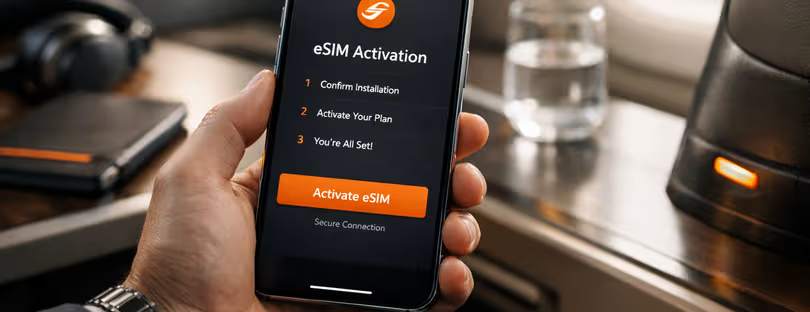
From the user side, it is a few taps. Under the hood, it is a multi-step secure exchange.
The “QR code” flow in real life
Apple’s setup guide shows the user-facing version: scan QR, “Cellular Plan Detected,” tap through, sometimes enter a confirmation code.
That QR code typically contains an activation address (often tied to the SM-DP+ platform) and a matching code. Your phone uses that to find the right provisioning server and request the correct profile.
The back-end flow in plain English
Here is the story without the alphabet soup:
- Your phone contacts the provisioning server (SM-DP+) over a secure connection.
- The server verifies you are allowed to download that profile (this is where confirmation codes, carrier checks, and entitlement rules show up).
- The server sends an encrypted profile package that only your eUICC can install.
- Your eUICC installs it and marks it as available.
- You enable it, and your phone starts registering on the operator network using that profile’s identity.
If you have ever wondered why an eSIM install can fail on hotel Wi-Fi but succeed on a different network, this is why: the phone needs reliable connectivity long enough to complete a secure download and install sequence.
“Okay, but how does the operator recognize me?”
This is the operator part that matters.
A SIM profile contains the identity and authentication material that the network uses to verify you. When your phone tries to attach to the network, the operator core runs an authentication procedure (modern cores use variants of the same SIM-based trust model that has existed for decades).
So even though eSIM feels new, the trust model is familiar: the operator still relies on SIM credentials, and the SIM still lives in a tamper-resistant environment. Standards like ETSI’s UICC-terminal interaction specs sit in this world.
The novelty is the logistics: instead of shipping plastic, the operator (or a partner platform) ships a profile digitally.
Why operators care: eSIM changes distribution, not physics
From a mobile operator’s perspective, eSIM is not “just convenience.” It reshapes:
- Acquisition: you can activate a new line without a shop visit.
- Churn dynamics: switching becomes easier, which is both a threat and an opportunity.
- Multi-profile reality: devices can store multiple subscriptions and flip between them.
This is why you see operators balancing “easy activation” with controls like confirmation codes, entitlement checks, and device eligibility rules.
Where travel eSIM brands sit in this picture
Most travel eSIM brands are not operators. They are usually:
- resellers of operator subscriptions,
- aggregators buying capacity from multiple carriers,
- or MVNO-like setups using partner infrastructure.
To you, it looks like “one brand, many countries.” Underneath, it is often “many operator profiles, delivered through a handful of provisioning stacks.”
And this is where things can feel different between providers, even if the UI looks identical. One brand may rely heavily on a small set of roaming partners. Another may integrate deeper with local networks. Another may optimize the profile lifecycle (how profiles are issued, swapped, reissued, or recovered when something breaks).
When you review eSIM quality, you are not just judging “coverage.” You are judging how cleanly that provider connects provisioning to operator reality.
Consumer eSIM vs IoT eSIM: the standards are splitting for a reason
If you want the bigger trend, eSIM standards have been evolving into distinct tracks because smartphones are not the same as constrained IoT devices.
- Consumer eSIM is the mainstream phone model.
- M2M eSIM is the older industrial model built around managed fleets.
- IoT eSIM (SGP.32 era) targets constrained devices with limited UI, intermittent links, and long lifetimes.
GSMA publishes and tracks these specifications, and the industry is actively moving toward IoT-focused approaches where the device may need an intermediary component to handle constrained networking realities.
Why this matters for travel: the more eSIM spreads beyond phones into routers, wearables, cars, and enterprise devices, the more “operator integration” becomes a platform capability, not a consumer feature.

The most common misunderstandings I see (and what’s actually true)
Myths that keep coming back
- “eSIM means no SIM security risk.”
eSIM is still SIM security. It just moves delivery into a remote provisioning model governed by standards. - “If it is installed, it will work everywhere.”
Install success means the profile landed correctly. Performance still depends on roaming agreements, radio conditions, and how the operator routes you. - “All eSIM brands are the same because they all use QR codes.”
QR is just the trigger. The real differences are in provisioning reliability, partner network depth, and how profiles are managed over time.
A practical mental model
If a travel eSIM brand feels “flaky,” it is usually one of three things:
- provisioning friction (install, reissue, recovery),
- roaming partner limitations (coverage or priority),
- or policy mismatches (APNs, routing, throttling rules).
Conclusion: eSIM is becoming operator infrastructure, not a gadget feature
Here’s the honest conclusion I keep landing on: eSIM is not primarily a consumer convenience story anymore. It is an operator distribution and control story, and travel brands are simply the most visible front-end of it.
When you compare “similar players on the market,” most differences you experience as a traveler are not about the eSIM chip or whether the app is pretty. They are about how well each player has built a bridge between two worlds:
- the standards-based provisioning world (GSMA eUICC, profile packaging, SM-DP+ type systems),
and - the operator core world (authentication, roaming relationships, routing policies, and increasingly, enterprise-grade lifecycle management).
The trendline is clear: as GSMA pushes forward with newer IoT-oriented specifications and the ecosystem matures, the winners will look less like “eSIM coupon brands” and more like connectivity infrastructure companies.
For Alertify readers, that is the real takeaway. Stop asking only “How many countries?” Start asking: How reliable is provisioning, how transparent is policy, and how deep is the operator relationship? Because eSIM is no longer a feature you try once. It is the layer your mobility depends on.