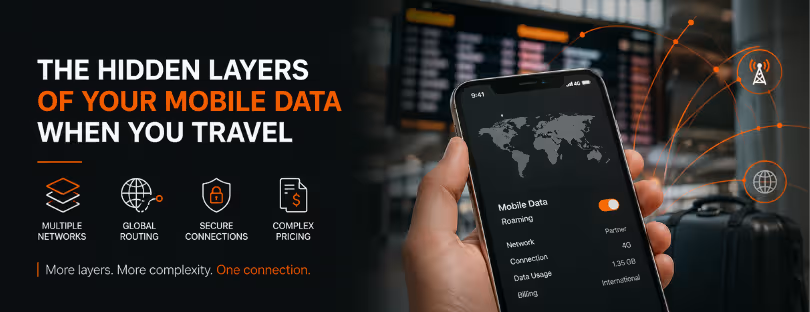
But that “Connected” label hides one of the most complex systems in modern telecom.
Because when you use mobile data abroad, you’re not just connecting to a network. You’re moving through layers of infrastructure, agreements, intermediaries, and routing decisions that most users never see.
Let’s unpack what’s really happening behind your screen.
The illusion of a single network
The biggest misconception travelers have is simple: “I’m using a network in this country.”
You’re not. Not really.
What’s actually happening is roaming. Your phone is temporarily “borrowing” access from a local carrier while still being tied to your home provider.
That means three entities are involved immediately:
01
Your home carrier
This is your original provider. They still control your identity, billing, and permissions.
02
The visited network
This is the local operator in the country you’re visiting. They provide the actual signal.
03
The roaming agreement
This is the invisible contract between those two networks that allows you to connect in the first place.
Every time you load Instagram or open Google Maps abroad, your data isn’t just flowing locally. It’s being authenticated, routed, and often billed through your home carrier.
And that’s where things start getting complicated.
The authentication handshake
The moment your phone connects to a foreign network, there’s a rapid “handshake” happening in the background.
Here’s what it looks like in simple terms:
01
Network scan
Your phone searches for available networks and selects one allowed by your SIM or eSIM profile.
02
Identity check
The local network asks: “Who is this user?” Your SIM or eSIM responds with identifiers like IMSI, acting as your global identity key.
03
Home network verification
The visited network contacts your home carrier to confirm you’re allowed to connect.
04
Temporary access granted
If everything checks out, you’re given access to the local network.
This entire process happens in seconds. But technically, your data session is now anchored between two countries, not one.
This is why roaming is fundamentally more complex than just “using local internet.”
Where your data actually travels
Here’s where it gets even more interesting.
When you’re abroad, your data often doesn’t stay in the country you’re in.
Instead, it can take a detour:
From your phone → local tower
From local network → international carrier exchange
From there → back to your home network
Then → out to the internet
And back again
These routes are handled through private telecom highways called IPX networks, which connect carriers globally and ensure secure data exchange.
So when you’re in Bangkok opening a website, your data might actually be processed in Frankfurt or London before returning to your phone.
That added distance is one reason roaming can feel slower or less stable.
The pricing layer nobody explains
Now we get to the part that travelers feel most: cost.
Roaming pricing isn’t based on what you use locally. It’s based on what your home carrier pays the foreign network plus their markup.
And that markup can be aggressive.
In some cases, data can cost over €1 per MB without a plan.
Why?
Because behind the scenes:
The visited network charges wholesale access fees
The home carrier adds retail pricing
Intermediaries may take a cut
Billing systems add complexity
By the time it reaches you, the price has gone through multiple layers.
This is why roaming has historically felt unpredictable and expensive. It’s not one price. It’s a stack of them.
They prioritize flexibility and pricing over control
In high-traffic situations, this can affect performance. Host network users are often prioritized over MVNO users.
So while your eSIM might be cheaper, it may not always be equal in quality.
Again, another layer.
The stack behind a single “Connected” icon
If you zoom out, your mobile data while traveling is not one service. It’s a stack:
Infrastructure layer
Physical networks, towers, spectrum
Carrier layer
MNOs managing network access
Agreement layer
Roaming deals and wholesale pricing
Platform layer
eSIM providers, aggregators, MVNOs
Provisioning layer
SM-DP+, profile delivery, authentication
Routing layer
IPX networks and global data exchange
And all of that collapses into a single word on your screen:
Connected.
Why this matters now
This isn’t just a technical curiosity.
It’s becoming a real differentiator in the market.
Travel eSIM adoption is accelerating fast, with projections suggesting massive growth over the next few years as users move away from traditional roaming.
And most users still don’t know which one they’re actually buying from.
Conclusion: the real shift isn’t eSIM, it’s visibility
The biggest change happening in travel connectivity isn’t eSIM itself.
It’s transparency.
For years, roaming worked because users didn’t understand it. Pricing was opaque, routing invisible, and responsibility unclear.
Now that’s changing.
Players like Airalo, Yesim, and others have made pricing more predictable. Structural challengers like Fairplay are rethinking what “unlimited” even means. Infrastructure players are moving up the stack, while API-driven companies are embedding connectivity directly into apps and platforms.
But here’s the uncomfortable truth:
Most providers still don’t control the full experience.
They sit on top of layers they don’t own.
And that means your connectivity quality, routing, and even performance can vary depending on who’s actually behind your plan.
If you look at reports from GSMA and companies like Kaleido Intelligence, the direction is clear. The market is shifting toward fewer infrastructure owners and more distribution layers built on top of them.
In other words, more brands. Same underlying pipes.
So the next time your phone says “Connected” in a new country, it’s worth asking:
Connected to what, exactly?
Because in travel connectivity today, what you see is just the surface.
Driven by wanderlust and a passion for tech, Sandra is the creative force behind Alertify. Love for exploration and discovery is what sparked the idea for Alertify, a product that likely combines Sandra’s technological expertise with the desire to simplify or enhance travel experiences in some way.