
Global Telecom Managed Services Market Report
For years, telecom managed services sounded like one of those useful but slightly dull industry categories. Network operations, infrastructure management, security support, field services, service assurance, and customer operations. Important work, yes. Exciting? Not always.
But that is changing.
The telecom managed services market is moving from basic outsourcing into something much more strategic. Operators are under pressure to modernize networks, reduce operational complexity, improve service quality, support enterprise customers, and prepare for 5G-Advanced, AI-native networks and eventually 6G. At the same time, many telcos simply do not want to carry every part of that burden internally anymore.
That is why the market is growing quickly. Mordor Intelligence estimates the telecom managed services market at USD 31.93 billion in 2026, rising to USD 53.83 billion by 2031, with an 11.02% CAGR. Fortune Business Insights gives a similar direction, projecting growth from USD 28.38 billion in 2025 to USD 66.34 billion by 2032. The exact numbers differ, but the signal is consistent: managed telecom operations are no longer just a cost-cutting tool. They are becoming part of the transformation playbook.
Why operators are outsourcing more
The simple answer is complexity.
Telecom networks are no longer just radio towers, core networks and billing systems. They now include cloud infrastructure, cybersecurity, APIs, automation layers, private networks, IoT platforms, enterprise mobility, edge computing, analytics, customer experience tools and increasingly AI-based operations.
That is a lot to manage while also dealing with declining legacy revenues, expensive spectrum, high energy costs and demanding customers.
This is where managed services become attractive. Instead of trying to build every capability internally, operators can work with specialist partners that manage parts of the network, service stack or enterprise operations on their behalf. For some telcos, this means outsourcing network operations. For others, it means managed security, cloud migration, customer experience platforms or enterprise connectivity management.
The old version of managed services was mostly about “do this cheaper than we can.” The new version is closer to “help us move faster without breaking the network.”
That difference matters.

Automation changes the model
The next phase of telecom managed services will not be won by the provider with the biggest support team. It will be won by the provider with the best automation, orchestration and operational intelligence.
GSMA’s Open Telco AI initiative, launched in March 2026, is a good example of where the industry is going. The aim is to accelerate telco-grade AI through open collaboration, which says a lot about the pressure operators feel to make AI practical inside networks, not just fashionable in presentations.
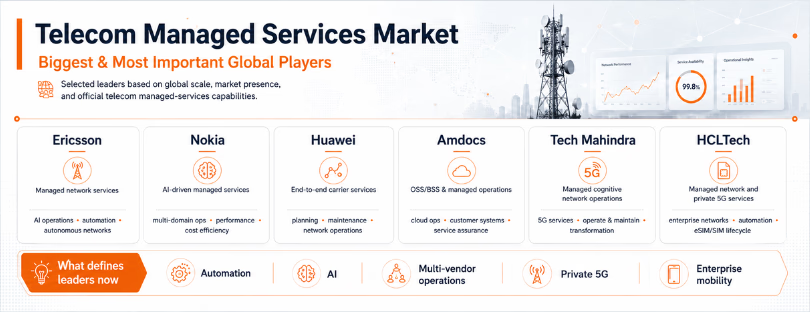
Ericsson and Nokia are also pushing harder into intelligent automation. In March 2026, the two companies announced cooperation around autonomous networks, with Ericsson joining Nokia’s SMO Marketplace and Nokia joining Ericsson’s Intelligent Automation Platform ecosystem. That is not a small symbolic move. It shows that even large infrastructure rivals understand that future networks will be multi-vendor, software-driven and increasingly automated.
For managed services providers, this is both an opportunity and a warning. Basic operations support will become commoditized. The real value will sit in predictive maintenance, automated incident resolution, multi-vendor orchestration, AI-assisted service assurance and measurable business outcomes.
In plain English, operators will not pay a premium forever for someone to “monitor the network.” They will pay for fewer outages, faster recovery, lower operational cost and better customer experience.
Enterprise demand is pulling the market forward
There is another reason this market is becoming more relevant to Alertify readers: enterprise connectivity.
Businesses now expect telecom services to behave more like cloud software. They want dashboards, usage controls, policy management, predictable billing, security, global coverage and fast deployment. That is especially visible in areas such as enterprise eSIM, private 5G, IoT connectivity and global workforce mobility.
This creates a natural opening for managed telecom providers. Enterprises do not want to negotiate with ten operators, manage roaming disputes, chase SIM replacements or guess why devices stopped connecting in another country. They want someone to manage the complexity.
That is why the boundary between telecom managed services, enterprise mobility management and connectivity platforms is starting to blur.
Traditional players such as Ericsson, Nokia, Huawei and IBM still matter because they understand network operations at scale. But newer and more specialized providers are entering from the cloud, cybersecurity, enterprise mobility and eSIM sides of the market. The competition is no longer only about who can run a network. It is about who can turn connectivity into a managed, visible and controllable service.
The pressure on traditional telcos
This creates a slightly uncomfortable question for telecom operators.
If managed service partners run the network, software providers control the automation layer, hyperscalers host more infrastructure, and specialist platforms manage enterprise connectivity, where does the telco sit?
That question is already shaping strategy. Operators want to avoid becoming passive infrastructure owners, while others capture the customer relationship and the intelligence layer. Managed services can help them modernize, but they also force them to decide what they want to keep close.
Some will focus on infrastructure and wholesale. Some will become stronger enterprise service providers. Some will build their own automation and AI layers. Others will rely heavily on partners.
There is no single winning model. But there is one losing model: trying to do everything manually, internally and slowly.

What this really means
The telecom managed services market is not exciting because it is growing. Plenty of markets grow.
It is exciting because it shows where telecom is quietly being rebuilt.
The industry is moving away from heavy, operator-owned, manually managed systems toward more automated, partner-led and outcome-based models. Ericsson and Nokia are leaning into autonomous networks. GSMA is pushing telco-grade AI collaboration. Market researchers are forecasting double-digit growth. Enterprises are asking for telecom services that feel more like managed software than old-fashioned connectivity contracts.
The winners will not simply be the biggest vendors. They will be the players that can reduce complexity without taking control away from the operator or enterprise customer.
That is the balance to watch.
Managed services used to be about outsourcing the boring parts of telecom. Now, they may become one of the places where the future operating model of telecom is actually decided.