From Payments to eSIM: Nosh Expands Globally
The telecom and fintech worlds are quietly converging. What used to be separate ecosystems, payments, digital assets, and mobile connectivity, are increasingly merging into single platforms designed for people who live internationally.
Travelers, remote workers, and cross-border professionals no longer just need internet access. They need payment tools, financial flexibility, and reliable connectivity that move with them across countries.
That shift is exactly where a new type of platform is emerging.
One of the latest players stepping into this hybrid space is Nosh, which has officially launched its eSIM feature, expanding its platform beyond digital asset trading and bill payments into global mobile connectivity.
The move signals a broader industry direction: connectivity is becoming a core layer of digital finance ecosystems.
From fintech platform to connectivity ecosystem
Nosh built its reputation as a financial platform that simplifies digital transactions for globally mobile users. Its services already include cryptocurrency trading, gift card transactions, bill payments, and a variety of everyday financial utilities.
Now the company is expanding its scope.
With the launch of its eSIM capability, Nosh is introducing mobile connectivity directly inside its existing platform, allowing users to purchase and manage mobile data plans alongside their financial activities.
This shift reflects a growing recognition that connectivity is not just a telecom product anymore. It is infrastructure for digital life.
For many users, especially those who operate across borders, managing multiple services across multiple apps creates friction. Switching between payment platforms, telecom apps, and travel tools is inefficient.
Nosh’s approach attempts to reduce that fragmentation by bringing several services under a single interface.
How the new eSIM feature works
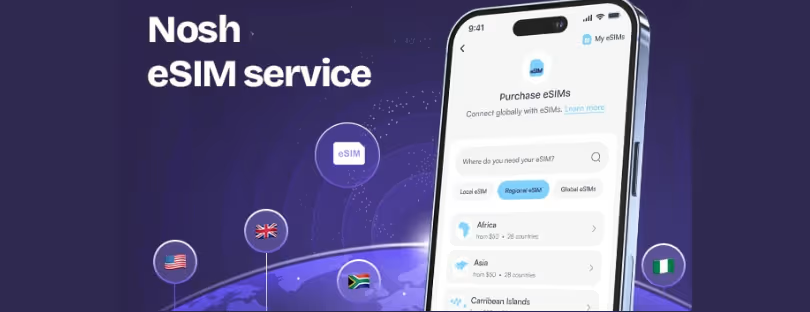
The newly launched eSIM feature allows users to buy, activate, top up, and manage their mobile plans directly from their Nosh account.
Because the service relies on embedded SIM technology, users do not need a physical SIM card. Once a compatible device installs the profile, the plan can be activated instantly.
For travelers and remote workers, this removes one of the most persistent inconveniences of international mobility: the need to hunt for local SIM cards or rely on expensive roaming plans.
Within the Nosh app, users can select from different types of connectivity plans depending on their needs.
Plan types available
- Data-only plans for users who primarily need internet access
- Full plans that support data, voice calls, and SMS messaging
- Local plans for single-country use
- Regional plans covering multiple countries
- Global plans designed for frequent international travelers
The platform currently supports connectivity in up to 136 countries through partnerships with multiple network providers.
That coverage places it within the competitive range of most global travel eSIM providers.
But the differentiator is not necessarily the connectivity itself.
It is the integration.

A platform designed for cross-border digital life
The addition of eSIM expands Nosh from a fintech utility into something closer to a digital lifestyle infrastructure.
In addition to connectivity, the platform already supports a broad range of services:
Financial and lifestyle services inside the Nosh platform
- Buying and selling gift cards
- Selling cryptocurrency for cash
- Paying utility bills, such as electricity and internet
- Purchasing airtime and mobile data
- Paying for cable television services
- Settling betting transactions
- Booking flights
Each of these services addresses a different aspect of modern digital living. Together, they form a platform that aims to simplify everyday tasks for users who operate across different financial and geographic systems.
Adding connectivity strengthens that model because mobile data is the gateway to all other digital activity.
Without internet access, none of the other services matter.
The company’s vision for connectivity and finance
According to Ahmod Balogun, Chief Executive Officer of Nosh, the eSIM launch is a direct extension of the company’s broader mission.
He emphasized that the goal is to simplify digital life by reducing friction between essential services.
“You + NOSH = A Great Life,” he said while introducing the new feature, encouraging users to “Say hello to easy and fun solutions with NOSH!”
The message reflects a platform philosophy that prioritizes simplicity and accessibility.
Instead of forcing users to manage multiple providers, the company aims to consolidate the most common digital services into a single environment.
That approach mirrors a larger trend in the fintech sector, where platforms increasingly expand beyond pure financial services into lifestyle ecosystems.

Connectivity becomes part of fintech infrastructure
Nosh is not the first company to explore the intersection between fintech and mobile connectivity.
Several platforms around the world have experimented with telecom services as part of broader digital ecosystems.
For example, Revolut introduced mobile plans in certain markets, while other fintech players have explored partnerships with telecom providers to offer integrated connectivity packages.
Meanwhile, in the travel connectivity space, providers like Airalo, Yesim, Ubigi, and Nomad focus specifically on delivering global eSIM data services for travelers.
Those companies specialize in connectivity alone.
What Nosh is doing is different.
It is positioning connectivity as a utility layer inside a financial platform rather than as a standalone telecom product.
In other words, eSIM becomes just one tool within a broader digital toolkit.
Why this model matters
The reason this convergence is happening is simple.
Global mobility is increasing.
According to the World Tourism Organization (UNWTO), international travel has rebounded strongly in recent years, while remote work and digital nomadism continue to expand. Millions of people now live, work, and transact across borders.
These users face a common challenge: fragmented digital services.
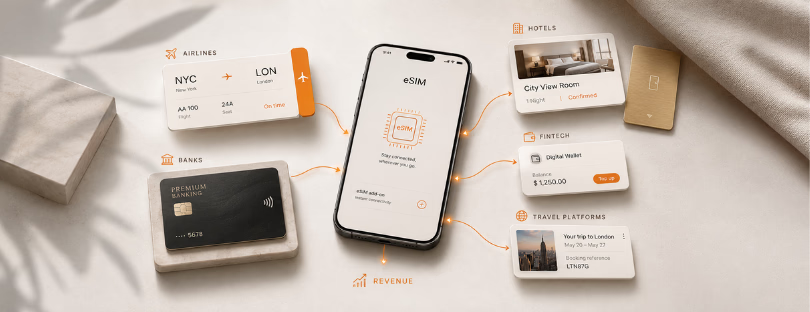
They often need one app for banking, another for cryptocurrency, another for travel bookings, and yet another for mobile connectivity.
Each additional platform adds friction.
Companies like Nosh are betting that users will prefer ecosystems that reduce that complexity.
If payments, connectivity, and travel utilities exist within the same interface, the overall experience becomes simpler.
The bigger shift in telecom
From a telecom perspective, the rise of eSIM technology is what makes this convergence possible.
Traditional SIM cards required physical distribution, carrier contracts, and complicated activation processes. That model made integration with digital platforms difficult.
eSIM changes that.
Because profiles can be provisioned remotely, connectivity can now be embedded into apps, devices, and platforms almost instantly.
The GSMA, which oversees global mobile standards, has repeatedly emphasized that eSIM technology will enable new business models where connectivity becomes part of broader digital services.
In many ways, the Nosh launch reflects exactly that prediction.
Connectivity is no longer limited to telecom companies.
It is becoming an API-driven capability that platforms can integrate into their ecosystems.
Where Nosh fits in the evolving market
The question now is how platforms like Nosh will compete in a rapidly growing eSIM landscape.
Specialized travel eSIM providers still dominate the market for international connectivity. Many of them offer wider coverage, stronger telecom partnerships, and sophisticated network optimization.
However, Nosh is not necessarily competing head-to-head with those providers.
Its strategy appears closer to the “super-app” model seen in markets like Asia, where platforms combine payments, lifestyle services, and connectivity.
In that context, the eSIM feature is not the core product.
It is one component of a larger ecosystem.
And that may be its real advantage.
Conclusion: connectivity is becoming a platform feature
The launch of Nosh’s eSIM service illustrates a larger transformation happening across telecom and fintech.
Connectivity is gradually moving from being a standalone service to becoming an embedded feature inside broader digital platforms.
For companies focused purely on telecom, the competition will remain centered around coverage, pricing, and network performance.
But for hybrid platforms like Nosh, the value proposition is different.
The goal is not simply to sell data.
It is to integrate connectivity with the tools people already use to manage money, travel, and digital life.
As eSIM adoption accelerates worldwide, more platforms are likely to experiment with this model. The boundary between fintech and telecom is becoming increasingly blurred.
And if that trend continues, the future of connectivity may not belong exclusively to telecom operators.
It may belong to the ecosystems that integrate connectivity seamlessly into everyday digital life.