eSIM Security Shift: Inside Excuor’s PQC Strategy
There’s a new layer of urgency creeping into telecom security, and it’s not coming from the usual suspects like roaming fraud or SIM swaps. It’s coming from something more structural: the reality that today’s encryption won’t survive the quantum era.
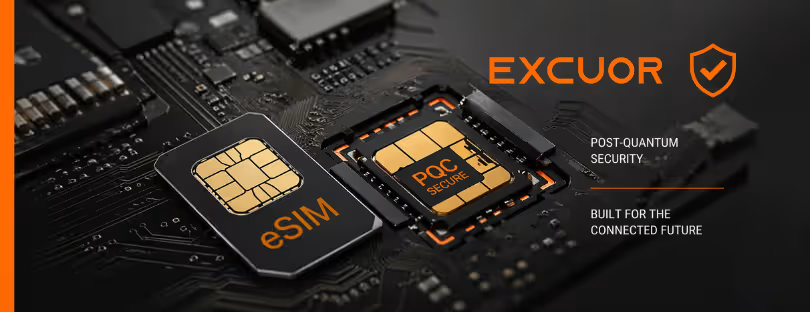
That’s the context behind Excuor’s latest move. The company announced it is developing USIM and eSIM solutions built with security (PQC), alongside a broader push into collaborative research and real-world validation.
At first glance, it sounds like a technical upgrade. It’s not. It’s a repositioning of where trust actually lives in connected devices.
Beyond Encryption: Rebuilding the Trust Stack
Excuor isn’t doing this alone. The initiative is being developed in partnership with Naoris Quantum Protocol, which brings a different angle into the mix: distributed consensus verification.
That combination matters. PQC protects against future quantum attacks. Distributed verification reduces reliance on centralized trust models. Together, they hint at a shift from “secure communication” to “verifiable infrastructure.”
The company’s goal is to integrate these technologies directly into its existing telecom and financial smart card business. In practical terms, that means embedding quantum-resistant security into the SIM layer itself, not bolting it on later.
And that’s the key distinction. Most of the industry is still thinking in terms of network-level upgrades. Excuor is starting at the hardware root.
Why SIM Is Becoming Strategic Again
For years, SIM cards quietly faded into the background. eSIM made them invisible. Cloud provisioning made them feel replaceable.
Now they’re coming back into focus, but for a completely different reason.
Excuor already has deep infrastructure credibility here. The company has developed its own USIM chip operating systems and IoT-based eSIM technology, and has supplied over 60 million USIM chips to Korea’s three major mobile carriers. That scale gives it a realistic path to deploy something like PQC beyond a lab environment.
What they’re proposing is fairly ambitious. A system where private keys are generated and stored directly within secure microcontrollers inside the SIM, backed by cryptographic engines. On top of that, a quantum-resistant digital signature algorithm would handle authentication and participate in consensus processes.
This turns the SIM into more than a connectivity module. It becomes a hardware-based root of trust.
Distributed Security, Not Centralized Control
One of the more interesting parts of the architecture is how the workload is split. The USIM anchors trust, but it doesn’t operate in isolation. The device’s Trusted Execution Environment, operating system, and network server all share computational responsibilities.
That’s a departure from traditional telecom security models, which tend to centralize authentication logic within operator-controlled systems.
Instead, Excuor is leaning toward a distributed model where multiple layers validate each other. It’s closer to how modern zero-trust architectures work in enterprise IT than how telecom has historically operated.
According to the company, this approach allows a wide range of devices to function as verifiable security entities. Not just smartphones, but vehicles, industrial IoT systems, and wearables.
That’s where this starts to get interesting for the broader ecosystem.

The Real Play: Securing the IoT Explosion
If you zoom out, this isn’t really about smartphones. It’s about scale.
IoT is growing fast, but security is lagging behind. Most connected devices still rely on relatively basic authentication models, often tied to centralized servers that can become single points of failure.
Embedding quantum-resistant, hardware-based identity into SIM or eSIM changes that equation. It allows each device to carry its own verifiable identity, anchored in secure hardware and validated across a distributed system.
That’s a much stronger foundation for things like connected cars, industrial automation, and critical infrastructure.
It also aligns with where regulators are heading. The EU, the US, and parts of Asia are all pushing for stronger device-level security standards, especially in IoT.
Where the Market Stands Right Now
Excuor isn’t the only player thinking about post-quantum telecom security. The GSMA has already started exploring future-proof cryptographic standards for mobile networks, and major vendors like Thales and IDEMIA are investing heavily in secure element evolution.
But most of that work is still early-stage or focused on standards and infrastructure layers.
What’s different here is the attempt to operationalize it at the SIM level, where deployment can actually scale relatively quickly through existing distribution channels.
That said, there are real challenges ahead.
Quantum-resistant algorithms are typically heavier in terms of computation and memory. Integrating them into constrained environments like SIM cards isn’t trivial. There’s also the question of interoperability with existing networks and devices, which still rely on classical cryptography.
And then there’s timing. Fully capable quantum computers that can break current encryption aren’t here yet. But the industry is already operating under a “harvest now, decrypt later” assumption, where encrypted data captured today could be compromised in the future.
That’s why this work is happening now, not later.
What This Signals for eSIM and Connectivity
From an Alertify perspective, this is another sign that eSIM is evolving beyond convenience.
We’ve spent the last few years talking about eSIM in terms of travel, cost savings, and flexibility. That’s still valid. But underneath that, the SIM layer is quietly becoming one of the most strategic control points in the entire connectivity stack.
Security, identity, authentication, and even participation in distributed systems. It’s all starting to converge there.
Excuor’s move doesn’t immediately change the market. You won’t see “quantum-resistant eSIM” in travel apps tomorrow.
But it does point to where things are heading.
Conclusion
The most important takeaway here isn’t that Excuor is building PQC-enabled SIMs. It’s that the industry is starting to rethink where trust should live.
Companies like Thales and IDEMIA are strengthening secure elements. The GSMA is working on future standards. Now Excuor is pushing the idea that SIM and eSIM can act as active participants in distributed security systems, not just passive authentication tools.
That’s a meaningful shift.
Because if quantum computing forces a full reset of cryptographic infrastructure, the winners won’t be the ones who simply upgrade algorithms. They’ll be the ones who redesign the architecture of trust from the ground up.
SIM, surprisingly, might end up at the center of that redesign.