eSIM for Students: The End of Roaming Stress
There’s a moment every student who travels abroad recognizes.
You land. You switch off airplane mode. And suddenly… nothing works the way it should.
No data. No maps. No WhatsApp. No way to tell your parents you arrived safely.
For years, that gap was just accepted. Roaming was expensive, local SIMs were inconvenient, and Wi-Fi became the fallback.
That’s changing fast. And if you look closely, eSIM is becoming the default connectivity layer for a generation that moves constantly.
The student mobility boom
Let’s start with context. Programs like Erasmus, exchange semesters, and international degrees are no longer niche. Millions of students move across borders every year, especially within Europe, where cross-border education is almost expected.
What’s different today is that connectivity is no longer a “nice to have.” It’s infrastructure.
Students aren’t just texting. They are attending online lectures, submitting coursework, navigating unfamiliar cities, managing finances, and staying socially connected across multiple countries at once.
That creates a simple requirement: always-on, reliable, and affordable data.
Traditional telecom models were never designed for that.
Why traditional roaming breaks for students
Roaming was built around occasional travel. A business trip. A holiday.
Students don’t travel like that.
They move for months. Sometimes across multiple countries. Sometimes back and forth.
And that’s where roaming collapses.
Costs are unpredictable. Plans are tied to home operators. And even with EU “Roam Like at Home,” the experience isn’t always consistent, especially when students move beyond the EU or rely heavily on data.
This is why many students historically ended up juggling SIM cards, buying local plans, or simply limiting usage.
Not ideal for a generation that lives online.
Enter eSIM: not a feature, but a shift
eSIM isn’t just a digital SIM card. It’s a different model of connectivity.
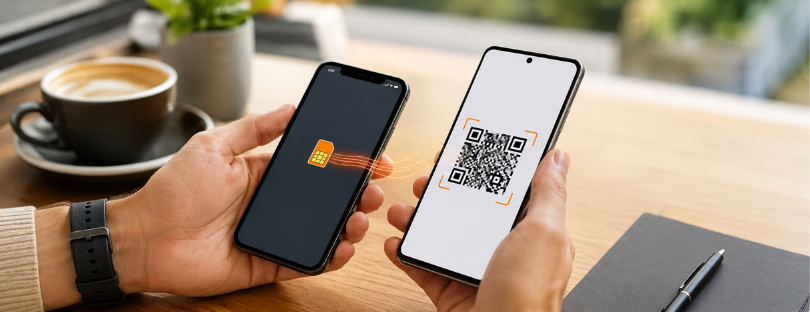
Instead of being locked into one operator, students can download a plan instantly, switch networks, and manage everything from their phone.
That changes behavior immediately.
Students can activate a plan before they leave home and land connected from minute one. No kiosks. No paperwork. No friction.
And more importantly, they can move between countries without resetting their entire connectivity setup.
That’s not just convenience. That’s continuity.
Cost is still the killer feature
Let’s be honest. Students care about price.
And this is where eSIM really wins.
Compared to traditional roaming, students can save anywhere from 60 to 70 percent on mobile data, depending on usage and destination.
That’s not marginal. That’s the difference between worrying about data and just using it.
More importantly, pricing is transparent. Prepaid, no surprises, no “bill shock.”
For students managing tight budgets, that predictability matters more than anything.
Flexibility fits student life
Student life is messy. Plans change. Trips happen at the last minute. Semesters overlap.
eSIM fits that chaos surprisingly well.
You can keep your home number active while using a local data plan abroad.
You can switch between countries without buying a new SIM.
You can top up instantly when you run out of data.
And increasingly, providers offer regional plans that cover multiple countries under one package, which aligns perfectly with how students actually travel.
This isn’t just about saving money. It’s about removing friction from everyday decisions.
Universities are catching on
What’s interesting is that it’s not just students driving this.
Universities and program coordinators are starting to see connectivity as part of the experience they provide.
Group travel programs, field courses, and exchange coordinators now use eSIM to ensure students are connected from day one, improving safety, communication, and logistics.
Some platforms even offer centralized dashboards to monitor usage across groups.
That’s a subtle but important shift.
Connectivity is moving from “student responsibility” to “institutional infrastructure.”
The market is moving fast
Zoom out, and the bigger picture becomes clear.
The global eSIM market is projected to grow from around $2.1 billion in 2026 to over $7.6 billion by 2034.
That kind of growth doesn’t happen without demand.
And students are a big part of that demand.
They are early adopters, highly mobile, and less attached to traditional telecom brands. They don’t have legacy contracts holding them back.
In many ways, they are the perfect eSIM user.
Where things get interesting
But here’s where it gets more nuanced.
The student eSIM market is becoming crowded.
Players like Airalo, Holafly, and Nomad eSIM dominate the conversation on the consumer side.
At the same time, telcos and infrastructure players are entering the space, trying to reclaim lost roaming revenue and integrate eSIM into their core offers.
That creates tension.
On one side, you have agile, digital-first eSIM brands focused on price and UX.
On the other hand, traditional operators are trying to adapt without cannibalizing their own business.
Students are caught in the middle, but also benefiting from the competition.
Where this is heading
The next phase isn’t about selling data.
It’s about embedding connectivity into experiences.
Student cards. University apps. Travel platforms. Even fintech products.
Instead of asking “which eSIM should I buy,” the question becomes “why isn’t connectivity already included?”
We’re already seeing early signs of this with partnerships between student organizations, travel platforms, and eSIM providers.
And it makes sense.
Students don’t want to think about connectivity. They just expect it to work.
Conclusion: Students are shaping the future of telecom
Here’s the real takeaway.
eSIM for students isn’t just a niche use case. It’s a preview of where the entire telecom industry is going.
A generation that refuses to deal with SIM cards, roaming complexity, and opaque pricing is forcing the industry to evolve.
Compared to traditional telcos, travel eSIM players moved faster, simplified the experience, and captured attention.
But now the lines are blurring.
Operators are entering the space. Platforms are embedding connectivity. And new distribution channels are emerging, from universities to travel ecosystems.
The question is no longer whether students will use eSIM.
They already are.
The real question is who will own that relationship.
Because in a world where connectivity becomes invisible, the winners won’t be the ones selling data.
They’ll be the ones who integrate it best into the student experience.