GO UP
tech background
eSIM for Apple Watch

eSIM for Apple Watch: Freedom, With Conditions

Leave the iPhone at home, go for a run and answer a call from your wrist. That is the promise behind a cellular Apple Watch. The reality is that its eSIM is not the same product travellers buy for an iPhone before flying abroad.


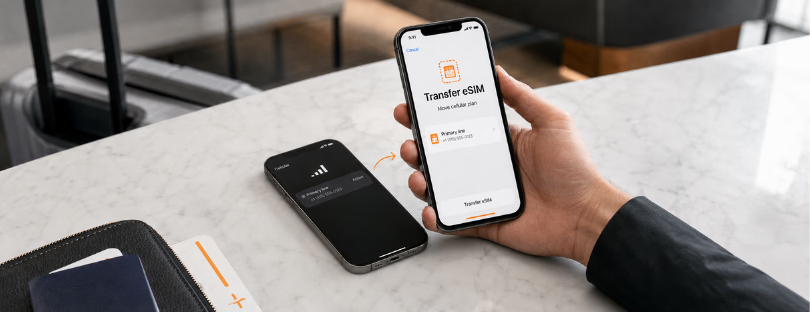
Apple Watch uses an embedded SIM, but activation normally happens through a supported mobile operator. The watch is added to an eligible phone plan, as a companion device sharing the iPhone’s number. Apple says the iPhone and watch must use the same carrier, although watches configured through Apple Watch For Your Kids can use another.

That distinction matters. You cannot usually browse an eSIM marketplace, purchase a data package and scan its QR code into an Apple Watch. The device, operating system and carrier provisioning process are tightly connected. It feels effortless when your operator supports it. When it does not, there is no travel hack hiding in the settings.

What cellular actually changes

A GPS-only Apple Watch already handles notifications, payments, downloaded music, workouts and many everyday functions when the iPhone is nearby or known Wi-Fi is available. Cellular becomes valuable when neither is true.

A runner can leave the phone behind and still receive an urgent call. A parent can reach a child wearing a family-managed watch. Someone whose phone battery has died can send a message or call for help. These moments explain why the feature becomes difficult to give up.

Apple’s current cellular lineup includes Apple Watch Series 11, SE 3 and Ultra 3. Those models support 5G where available through participating carriers, while earlier generations rely on LTE and, sometimes, older network technology. The watch automatically moves among the paired iPhone, Wi-Fi and cellular.

The trade-off is battery life. Cellular radios away from the phone use more power; Apple’s Series 11 testing assumes four hours of cellular use within a 24-hour day. A connected watch is not a miniature phone designed for nonstop standalone use.

apple watch

Carrier support is the real product

Buying the correct hardware is only the first check. The more important question is whether your operator, tariff and account type support Apple Watch cellular service.

Apple’s carrier directory shows support across many markets, but availability remains uneven. In Croatia, Apple lists A1 Hrvatska and Hrvatski Telekom, not every national operator. Prepaid, legacy, corporate and enterprise plans can also be excluded despite the carrier appearing on Apple’s list.

Activation is completed in the Watch app on the paired iPhone. The operator verifies the account, provisions the embedded SIM and may add a monthly fee. A separate number can appear in account records, although Apple says it is generally for billing or tracking; calls and messages still use the shared-number experience.

Dual-SIM iPhone users have more flexibility than many realise. Apple allows several eligible plans to be added to the watch, although only one can connect at a time. That helps with personal and business lines, but both must be supported. It does not make the watch an open eSIM device.

Travel remains awkward

International roaming has improved. Apple supports it on Series 5 and later, Apple Watch SE models and the Ultra range, provided the operator supports VoLTE and watch roaming. Users need the watch included in their iPhone roaming arrangement, and coverage is determined by the home carrier.

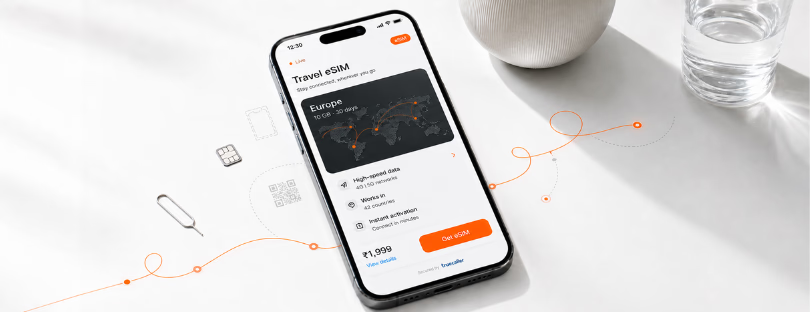
This is where the experience falls behind the travel-eSIM market. An iPhone user can install a destination plan in minutes, compare prices and keep a home line active. The Apple Watch cannot generally follow that travel eSIM independently. Standalone connectivity abroad remains controlled by the operator relationship.

For a runner occasionally leaving the hotel without a phone, roaming support may be enough. For a digital nomad changing countries and local plans often, cellular Apple Watch service can feel old-fashioned. Family-managed watches have another limitation: Apple says international roaming is unavailable in that setup.

There is also a hardware issue. Apple sells different cellular variants for different frequency regions and warns that there is no single worldwide Apple Watch model. Buying one overseas without checking the model and intended country can create an expensive Wi-Fi-only outcome.

More on Alertify
Follow the latest eSIM and smartwatch news
Explore smartwatch connectivity, wearable eSIM support, standalone mobile plans, device launches and the telecom developments shaping connected wearables.

Explore news

Is cellular worth paying for?

The answer depends less on technology than behaviour. Cellular is worthwhile for runners, cyclists, swimmers, parents using family setup, people working where carrying a phone is inconvenient, and anyone valuing backup communication.

It is harder to justify when the iPhone is almost always in a pocket or bag. The GPS model provides nearly the same experience then, without an operator charge. Endurance users may prefer a Garmin-style sports watch with longer battery life, accepting less independent calling and messaging.

Android users have comparable choices. Samsung’s LTE Galaxy Watch also relies on carrier activation, through the paired phone’s operator. Google’s LTE Pixel Watch can call, message and use apps without the phone nearby, but roaming remains carrier- and region-dependent. Apple is not uniquely restrictive; the wearable market still treats cellular watches as operator-managed companion devices.

Conclusion

The Apple Watch eSIM is excellent at making the iPhone temporarily unnecessary, but poor at making the carrier irrelevant. That difference defines the product.

Apple remains the smartwatch market leader: Counterpoint reported a 23% global shipment share in the first quarter of 2026, with Apple shipments growing 21% year over year. Its scale gives operators a reason to support number sharing, family plans and roaming. Yet the next meaningful step is not another sensor or faster radio. It is more portable, transparent connectivity.

Travel eSIMs have trained customers to expect instant activation, visible pricing and freedom to switch. Cellular watches still offer limited carrier lists, account checks, regional models and uncertain roaming. Samsung and Google face many of the same constraints, leaving a wider market opportunity.

For now, buy cellular Apple Watch for independence during ordinary life, not borderless connectivity. It is a strong companion product and useful safety layer. It is not yet the open, travel-friendly eSIM device its name might suggest.

Driven by wanderlust and a passion for tech, Sandra is the creative force behind Alertify. Love for exploration and discovery is what sparked the idea for Alertify, a product that likely combines Sandra’s technological expertise with the desire to simplify or enhance travel experiences in some way.