eSIM Is Quietly Changing How People Think About Internet Access
There’s a shift happening in how people think about internet access while traveling, and it’s not the kind of thing that gets announced in a press release. It’s behavioral. Quiet. But it’s real, and it’s accelerating.
For most of the 2000s and 2010s, mobile data abroad was something you planned for. It was a deliberate purchase, often stressful, sometimes expensive, and almost always a reminder that you were operating inside someone else’s network. You hunted for SIM cards at the airport, compared prepaid plans in hotel lobbies, and rationed your usage because the cost of getting it wrong could be high. The default state was disconnected, and connectivity was something you added on top.
eSIM didn’t change that overnight. There was no single breakthrough moment. But by steadily removing friction — physical SIM cards, activation delays, local workarounds — it has started to dismantle that entire mental model. And what’s replacing it is more than convenience. It’s a different expectation altogether.
Not access, but availability.
From Transaction to Expectation
The removal of friction doesn’t just improve the experience. It changes the nature of the decision.
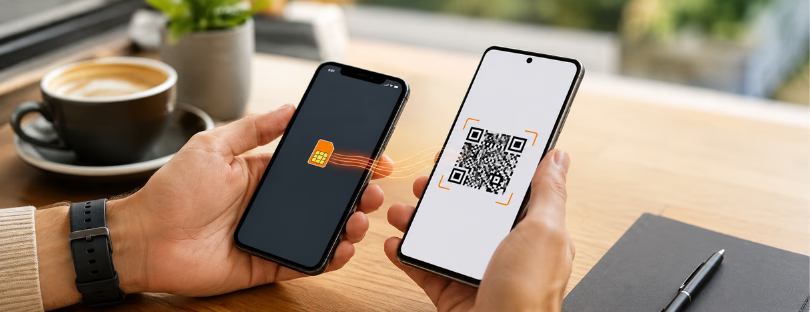
When connectivity can be activated instantly, before departure, with a few taps, it stops feeling like something you acquire. It starts to feel like something that should already exist. You arrive in a new country and you are online before you leave the airport. There is no moment of disconnection, no transition phase where you “sort out data.”
That continuity has a compounding effect. After a few trips like this, the old behavior begins to feel unnecessary. Not inconvenient, but outdated.
What emerges instead is a baseline expectation. Not “do I need data here?” but “why wouldn’t I be connected?”
That shift is subtle, but it is structurally important. Because once users stop thinking in terms of transactions, the entire logic of the product starts to change.
The Pressure on Trip-Based Models
Most of the eSIM market is still built around the assumption that connectivity is tied to a trip. You go somewhere, you buy a plan, you use it, and you move on. It’s a clean model, and for occasional travelers, it works well enough.
But it starts to break down the moment travel becomes more continuous. Not in a dramatic way, but through accumulation. Each new destination introduces another small decision. Another plan. Another comparison. Another activation.
Individually, those frictions are minor. Together, they recreate exactly the kind of cognitive overhead eSIM was supposed to remove.
That’s where the gap is starting to appear. Not between providers, but between models.
Some are still optimizing around trips. Others are beginning to respond to something else entirely — a pattern of use where connectivity is expected to persist across borders, devices, and timeframes without needing to be reconfigured each time.
Fairplay sits closer to that second category, but what’s more interesting is not the product itself, but the assumption behind it. It treats connectivity less as something to be consumed in units and more as something to be maintained over time. That distinction is still rare in how the market presents itself, even if user behavior is already moving in that direction.
 A Market That Looks Crowded but Isn’t
 A Market That Looks Crowded but Isn’t
On the surface, the eSIM space appears saturated. There are dozens of providers offering similar packages, similar pricing structures, and similar coverage claims. But that similarity is mostly superficial.
Holafly built early momentum by removing anxiety around data limits, positioning unlimited plans as a form of reassurance. Airalo focused on distribution scale, becoming the default layer in many travel-related integrations. Ubigi and Nomad carved out space with more technical features and multi-device use cases. Yesim has been gradually expanding beyond data, layering additional services in an attempt to turn connectivity into a broader platform.
Each of these approaches makes sense within a trip-based framework. But none of them fully resolves the underlying shift toward continuity.
That’s where the market starts to separate.
[/vc_column_text][/vc_column][/vc_row]Not by pricing or coverage, but by whether connectivity is treated as an event or as an environment.
The GSMA’s projection of more than 8 billion eSIM connections by 2030 is often cited as a sign of growth. But the more relevant signal is where that growth is concentrated. Adoption is strongest among users who move frequently, work across locations, and expect their devices to function without interruption. In other words, the segment already behaves as if connectivity should be continuous.
The infrastructure mindset is not evenly distributed yet. But it is clearly forming.
The Wi-Fi Parallel
This kind of shift is not new. It has happened before, most visibly with Wi-Fi.
There was a period when hotel Wi-Fi was a premium service. Then it became a differentiator. Then, quite quickly, it became an expectation. Charging for it didn’t just feel inconvenient; it felt misaligned with how people thought about access.
Mobile connectivity abroad is following a similar path, although more slowly and with more structural resistance. The economics are different, the stakeholders more complex. But the direction is comparable.
As the friction of getting connected approaches zero, the decision itself starts to disappear.
And once the decision disappears, the category changes.
Where This Actually Leads
What makes this shift interesting is that it doesn’t immediately show up in pricing or product comparisons. On the surface, the market still looks like a competition over gigabytes, coverage maps, and promotional offers.
But underneath that, something else is forming
If connectivity becomes something users assume rather than evaluate, then the value moves away from the unit being sold and toward the continuity being provided. Reliability, predictability, and invisibility start to matter more than optimization.
That creates a different kind of pressure on providers.
Not to be cheaper, but to be less noticeable.
Not t offer better deals, but to remove the need for decisions.
And that is not a small adjustment. It challenges the core structure of how most eSIM products are currently designed and sold.
The final thoughts
The shift toward always-on connectivity is often described as a future scenario. In practice, it is already visible — just unevenly distributed.
A growing segment of users has stopped thinking about data as something they buy. They treat it as something that should persist. The rest of the market is still catching up to that expectation.
What matters now is not who can offer the best plan for a trip, but who understands what happens when trips stop being the unit of thinking altogether.
Most providers are still optimizing for transactions. A smaller group is starting to align with continuity. Fairplay is one of the clearer examples of that second direction, but it’s unlikely to be the last. As travel becomes more fluid and work becomes more location-independent, this model becomes less of a niche and more of a necessity.
Because once connectivity becomes something that is simply there, the competitive question changes.
It is no longer “who sells data better.”
It becomes “who makes connectivity disappear most effectively.”