Project CORaiL: AI, Edge Tech and Coral Reef Monitoring
Coral reefs are usually discussed through the language of crisis: bleaching, warming seas, overfishing, coastal development and the slow disappearance of one of the planet’s most valuable ecosystems. But Project: CORaiL offers a different angle. It shows how artificial intelligence, edge computing and environmental science can work together to monitor reefs without turning conservation into another human-heavy, manual process.
Project: CORaiL was developed by Accenture, Intel and the Sulubaaï Environmental Foundation to help researchers monitor, characterize and analyze coral reef resilience. The system was deployed around Pangatalan Island in the Philippines, where it collected around 40,000 underwater images to help researchers assess reef health in real time.
“Project: CORaiL is an incredible example of how AI and edge technology can be used to assist researchers with monitoring and restoring the coral reef. We are very proud to partner with Accenture and the Sulubaaï Environmental Foundation on this important effort to protect our planet.”
– Rose Schooler, Intel corporate vice president in the Sales and Marketing Group
That quote still feels relevant because the core problem has not gone away. If anything, the need for better reef intelligence has become more urgent. UNEP says coral reefs cover less than 1% of the seafloor but support at least 25% of marine species, while up to 90% of corals could be lost by 2050 even if warming is limited to 1.5°C.
Why reefs need better data
Coral reefs are not just beautiful underwater scenery. They are living infrastructure. They support fisheries, protect coastlines from storms, attract tourism and provide food and income for millions of people. According to UNEP-WCMC, reef ecosystems support around 25% of all marine life and provide society with resources and services worth hundreds of billions of dollars each year.
The challenge is that reefs are hard to monitor properly. Traditional reef surveys often depend on divers who collect data directly underwater or capture photos and video for later analysis. That work is valuable, but it has limits. Divers have a restricted time below the surface, their presence can alter fish behavior, and analysis can be slow. In conservation, delay matters. A reef can change quickly after heat stress, disease, pollution or human disturbance.
READ MORE: New Coral eSIM Donates Per GB to Protect Reefs
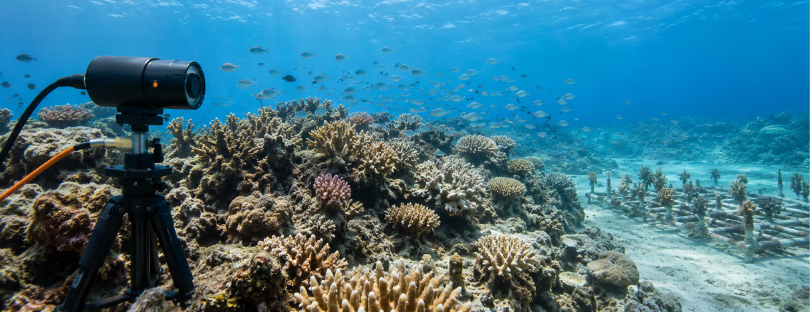
Project: CORaiL tries to solve this by moving the intelligence closer to the reef itself. Instead of only sending divers down periodically, the system uses smart underwater cameras and AI-based video analytics to detect and classify marine life. Fish abundance and diversity are important indicators because they reveal whether a reef is functioning as a living habitat, not just surviving as coral structure.
How Project: CORaiL works
The project combines restoration hardware with digital monitoring. Sulubaaï designed the Sulu-Reef Prosthesis, a concrete underwater platform that gives unstable coral fragments a stronger base. Living coral fragments are integrated into the structure so they can grow over time and create a hybrid habitat for fish and other marine life.
Around this environment, intelligent underwater cameras capture video of fish moving through the reef. Accenture’s Applied Intelligence Video Analytics Services Platform, or VASP, uses AI to detect, count and classify marine life. That data is then sent to a surface dashboard, giving researchers a clearer view of trends without constantly disturbing the underwater environment.
“Artificial intelligence provides unprecedented opportunities to solve some of society’s most vexing problems,” said Jason Mitchell, a managing director in Accenture’s Communications, Media & Technology practice. “Our ecosystem of corporate and social partners for this ‘AI for social good’ project proves that there is strength in numbers to make a positive environmental impact.”
The key point here is not that AI magically “saves” reefs. It does not. What it can do is make reef monitoring more continuous, less invasive and more useful for decision-making. That is where the real value sits.
“The value of your data depends on how quickly you can glean insights to make decisions from it,” said Athina Kanioura, Accenture’s chief analytics officer and Accenture Applied Intelligence lead. “With the ability to do real-time analysis on streaming video, VASP enables us to tap into a rich data source — in effect doing ‘hands on’ monitoring without disrupting the underwater environment.”
Edge computing matters here
One of the smarter parts of Project: CORaiL is the use of edge technology. Underwater environments are not ideal for traditional cloud-first systems. Connectivity is limited, power is difficult, and raw video data is heavy. Processing more data near the source makes practical sense.
Accenture’s VASP solution uses Intel technologies including Intel Xeon processors, Intel FPGA Programmable Acceleration Cards, Intel Movidius VPU and the Intel Distribution of OpenVINO toolkit. The technical stack matters because environmental AI is often judged by the wrong standard. It is not only about having the best model. It is about building something that can survive in the field, run efficiently and give researchers usable information.
READ MORE: The Role of Technology in Sustainable Travel
That makes Project: CORaiL part of a wider trend: conservation is becoming more sensor-driven. Satellite monitoring, drones, acoustic sensors, AI image recognition and environmental DNA are all being used to understand ecosystems faster. For reefs, this shift is especially important because climate pressure is moving faster than traditional reporting cycles.
Not a replacement for restoration
There is one caveat. Technology can improve monitoring, but it cannot replace climate action, local protection or proper marine management. AI can tell researchers that reef health is deteriorating. It can help identify where restoration is working. It can even support enforcement in protected areas. But it cannot cool the ocean, stop destructive fishing or fix poor coastal planning on its own.
This is where Project: CORaiL should be understood realistically. Its value is not in the headline “AI saves coral reefs.” Its value is in giving researchers a better feedback loop. That matters because restoration without monitoring is guesswork. And conservation without data often struggles to win funding, policy support and public attention.
Conclusion
Project: CORaiL is still one of the better examples of environmental technology because it does not treat AI as a gimmick. It places AI where it can actually help: observation, pattern detection and faster decision-making. Compared with broader reef initiatives that rely on satellites, manual surveys or post-event reporting, this approach gets closer to the daily life of the reef.
The bigger trend is clear. Conservation is becoming more like critical infrastructure management. Reefs, forests, oceans and wildlife corridors need live intelligence, not occasional snapshots. Project: CORaiL will not solve coral decline by itself, but it points in the right direction. The future of reef protection will not be just divers, donations and awareness campaigns. It will be a mix of local stewardship, serious climate action and quiet technologies working in the background, watching ecosystems closely enough that humans can act before it is too late.