Contactless Payments: From Convenience to Infrastructure
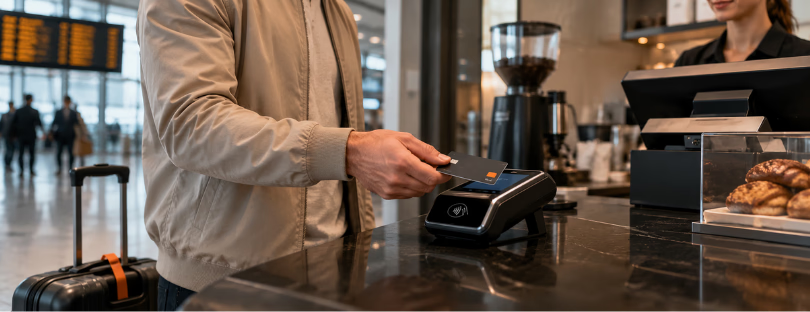
Contactless payment used to feel like a small convenience. A faster coffee. A smoother supermarket queue. A card tap at the metro gate instead of digging for coins or a paper ticket.
Now it looks much bigger than that.
Across Europe, contactless has moved from “nice to have” into everyday payment infrastructure. According to the European Central Bank, the euro area recorded 29.6 billion contactless card payments at physical terminals in the first half of 2025, up 12.8% year on year. Contactless payments made up 83% of all non-remote card payments by number, while 93% of POS terminals accepted contactless transactions. That is not a trend anymore. That is behaviour becoming standard.
For travellers, this matters more than people realise. Payment is part of the travel experience. It decides how quickly you leave the airport, board public transport, buy a coffee, pay for a taxi, enter a museum, or settle a hotel bill. Connectivity gets you online. Payments get you moving. The two are increasingly connected.
Travel changed the use case
The strongest contactless story is not really retail. It is mobility.
Transport systems have become one of the biggest drivers of tap-to-pay adoption because they remove one of the most annoying travel frictions: figuring out how to pay locally. Mastercard points to cities such as London, Tokyo, Sydney and Singapore as early examples of how contactless transit simplified commuting, reduced queues and lowered operating costs for transport agencies. It also noted that contactless accounted for more than 75% of transactions on its network in 2025.
That is important for travel brands. The payment moment is no longer just a transaction at the end of a purchase. It is part of access. Tap to ride. Tap to check in. Tap to unlock a scooter. Tap to enter a lounge. Tap to buy roaming data, insurance, or a city pass.
This is where contactless payments become interesting for the wider travel tech market. The winning experience is not “we accept cards.” Everyone does. The winning experience is payment disappearing into the journey so the traveller does not have to stop, think, download another app, or decode another local system.
 Cards, wallets and the platform layer
 Cards, wallets and the platform layer
Three main players are shaping the contactless market: card networks, device platforms, and financial apps.
Visa and Mastercard remain deeply embedded in global acceptance. Apple Pay and Google Pay control the device-native wallet experience on smartphones and watches. Banks, fintechs and travel apps sit closer to the customer relationship. Meanwhile, local and regional payment schemes are trying to avoid becoming invisible infrastructure behind global platforms.
Europe is especially interesting here. The ECB recently signed agreements with European standard-setting organisations to support digital euro payments, including CPACE standards for contactless tap-to-pay using near-field communication. The ECB also made a pointed observation: Europe lacks a universally available open standard across payment terminals and depends heavily on proprietary standards owned by international card schemes and global digital wallets.
READ MORE: The Best Mobile Payment Apps
That sentence says a lot. Contactless payment is not just about speed at checkout. It is about control. Who owns the wallet? Who owns the standard? Who owns the merchant relationship? Who owns the data trail around the transaction?
Travel companies should pay attention because the same power shift is happening in connectivity. Airlines, hotels, banks and booking platforms all want to own more of the travel journey. Payments and connectivity are two of the most useful layers to control because they are used repeatedly, not once.
Why this matters for travel brands
For hotels, contactless payment means faster check-in, fewer front-desk bottlenecks, cleaner self-service flows and better support for international guests. For airlines, it can make ancillaries easier to buy in the airport, in-app, or onboard. For public transport and destination platforms, it removes the need for visitors to understand local ticketing rules before they move around.
But there is a subtle risk. When payment becomes too seamless, the travel brand can become invisible. If the customer taps with Apple Pay, rides through an open-loop transit system, buys extras through a marketplace and uses a neobank card abroad, the traveller may remember the platform more than the operator.
READ MORE: How fintech, neobanks, travel platforms embed connectivity
That is why contactless payment should not be treated as a back-office upgrade. It is a customer experience layer. The smartest travel brands will connect payment with loyalty, local offers, digital identity, connectivity bundles and real-time support. Not in an annoying way. In a useful way.
For example, a hotel could combine mobile check-in, room access, card-on-file payment and local eSIM activation into one pre-arrival flow. A transport app could let tourists tap into the city and receive relevant add-ons only when they make sense. An airline could use the arrival moment to offer connectivity, lounge access, airport transfer or local transport without forcing the passenger through another clunky checkout.
Security matters
The good news is that modern contactless payments are not just “card data flying through the air.” Security is built around several layers, including EMV standards, encryption, device authentication and tokenisation. EMVCo explains that payment tokenisation replaces the primary account number with a unique token that can be limited to a specific merchant, device or payment scenario, reducing the value of stolen payment information. The U.S. Payments Forum also describes tokenisation as a foundational component of mobile and contactless payment security and notes that wallets use tokens as proxies for real card numbers during transactions. Still, the security conversation should not be oversold.
Contactless is safer than many old payment behaviours, but it is not magic. Users still need bank alerts, strong device locks, biometric authentication where available, and basic awareness in crowded environments. Merchants and wallet providers also need clean provisioning, fraud monitoring and secure POS operations. Trust is not created by the tap. It is created by the system around it.
Final thoughts
Contactless payment is becoming what eSIM is also becoming: a quiet infrastructure layer that users only notice when it fails. The interesting competition is no longer between cash and card. That battle is mostly over in many travel environments. The real competition is between card networks, mobile wallets, banks, fintech apps, transit systems and travel platforms that all want to sit closest to the customer at the moment of need.
For Alertify readers, the lesson is simple but important. Travel technology is moving toward fewer visible steps and more embedded services. Connectivity, payments, identity, ticketing and loyalty are starting to blend into one journey. Companies that treat contactless as a payment terminal feature will get operational efficiency. Companies that treat it as part of the traveller relationship will get something more valuable: timing, trust and repeat usage. That is where the market is heading.