Apple Pay App: The Quiet Power Move Inside Your iPhone
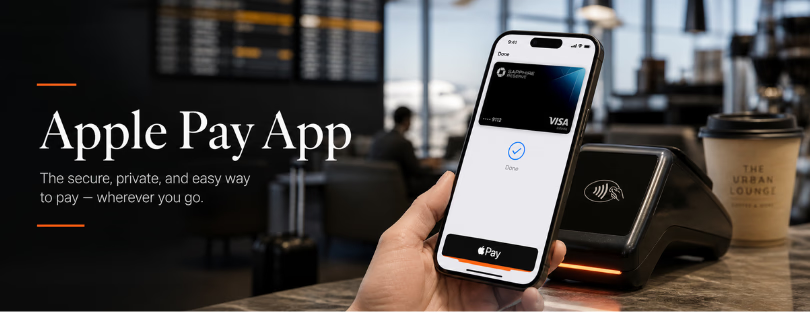
Search for “Apple Pay app” and you hit the first small confusion: Apple Pay is not really a standalone app in the usual sense. The app you open is Apple Wallet. Apple Pay is the payment layer inside it, the part that lets you tap your iPhone or Apple Watch at a terminal, pay inside apps, check out on websites, and in some markets, use stored cards or Apple Cash for online purchases. Apple describes Apple Pay as a way to make secure contactless purchases using cards added to Wallet, while Wallet itself is the place where cards, transit passes, tickets, keys and IDs increasingly live together.
That distinction matters because Apple is not just building a payment button. It is building the front door to daily transactions. Payments, tickets, travel passes, boarding passes, hotel keys, loyalty cards, IDs and order tracking are slowly being pulled into one interface. For a traveller, that can mean one place for the airport, the metro, the hotel door and the coffee before boarding. For a merchant, it means Apple is sitting very close to the checkout moment.
Why Apple Pay feels so sticky
Apple Pay’s genius is not that it invented mobile payments. It didn’t. The smart part is that it removed friction at exactly the moment people hate friction most: checkout.
Nobody wants to create another account while booking a taxi from an airport. Nobody wants to type card details on a small screen while buying a train ticket. Apple Pay turns that into a double-click, Face ID, and done. Apple’s developer material positions Apple Pay as a secure way to pay in iOS, iPadOS and watchOS apps, on websites in Safari, and even in selected messaging contexts. The payment sheet can also pass payment, shipping and contact information, which is why it matters so much for conversion.
For travel brands, this is more than convenience. Airlines, OTAs, eSIM providers, parking apps, ride-hailing platforms and hotel booking engines all fight the same problem: people abandon purchases when the final step feels annoying. Apple Pay reduces that final-step anxiety. It also makes small, impulse-style travel purchases easier. Extra baggage. Lounge access. A city pass. An eSIM plan. A taxi booking. The lower the friction, the more likely the transaction is to happen.
The Wallet effect
The bigger story is Apple Wallet, not just Apple Pay.
Wallet is becoming a container for travel behaviour. Apple says Wallet can store boarding passes, tickets, transit cards, gift cards, keys and more. Developers can also create passes that appear based on time or location, such as when someone arrives at an airport or walks into a store. Passes can be updated through push notifications if details change.
That is exactly why the “Apple Pay app” idea is slightly too small. Apple is not only processing payments. It is organizing context around payments. A boarding pass is not a payment, but it leads to payments. A hotel key is not a payment, but it sits inside the same travel journey. A transit card is not an e-commerce checkout, but it trains users to trust their phone as a wallet.
This is where Apple’s model differs from PayPal, Google Wallet, Revolut, Klarna or local bank wallets. PayPal is strong online. Google Wallet is powerful across Android. Revolut owns a financial relationship. Klarna owns a shopping and credit moment. But Apple owns the device layer, the biometric layer and the physical tap-to-pay habit on iPhone. That is a very different kind of advantage.
Europe changed the conversation
For years, one of the biggest criticisms of Apple Pay was NFC access. On iPhone, rivals could not simply build their own full tap-to-pay experience in the same way Apple Pay could. That became a competition issue in Europe.
In July 2024, the European Commission accepted legally binding commitments from Apple to open NFC access on iOS devices in the European Economic Area. The commitments allow third-party wallet providers to access NFC for contactless payments without using Apple Pay or Apple Wallet, and they are set to remain in effect for 10 years.
This does not mean Apple Pay suddenly becomes weak. Far from it. Default behaviour is powerful. Users already know the double-click. Banks already support it. Merchants already accept it. But Europe’s move changes the strategic direction. It means Apple Pay has to compete more on experience, trust and convenience, not just privileged access to the iPhone’s NFC layer.
For fintechs and banks, that opens a door. For Apple, it raises the standard. The company still has the best real estate on the device, but it cannot assume the wallet battle is permanently closed.
Supported countries and regions
Apple Pay and selected wallet features are available across these markets. Some services may vary by country, device, browser, or transit system.
Africa
Egypt · Morocco · South Africa
North America
Canada · United States Apple Cash is only available here
Asia-Pacific
Australia · China mainland Web only, no macOS · Hong Kong · Japan · Macao · Malaysia · Mongolia · New Zealand · Singapore · South Korea · Taiwan · Vietnam
Latin America and the Caribbean
Argentina · Bahamas · Brazil · Chile · Colombia · Costa Rica · Dominican Republic · Ecuador · El Salvador · Guatemala · Honduras · Mexico · Panama · Paraguay · Peru · Uruguay
Middle East
Bahrain · Israel · Jordan · Kuwait · Oman · Palestine · Qatar · Saudi Arabia · United Arab Emirates
Europe
Albania · Andorra · Armenia · Austria · Azerbaijan · Belarus · Belgium · Bosnia & Herzegovina · Bulgaria · Croatia · Cyprus · Czechia · Denmark · Estonia · Faroe Islands · Finland · France · Georgia · Germany · Greece · Greenland · Guernsey · Hungary · Iceland · Ireland · Isle of Man · Italy · Kazakhstan · Kosovo · Jersey · Latvia · Liechtenstein · Lithuania · Luxembourg · Malta · Moldova · Monaco · Montenegro · Netherlands · North Macedonia · Norway · Poland · Portugal · Romania · San Marino · Serbia · Slovakia · Slovenia · Spain · Sweden · Switzerland · Ukraine · United Kingdom · Vatican City
Apple Cash is available exclusively in the United States. Express Transit is available in select cities worldwide.
What this means for travel and connectivity
For Alertify readers, the Apple Pay app story is really a travel commerce story.
Think about the modern travel stack. Booking.com wants the hotel booking. Uber wants the airport transfer. Revolut wants the card. Airalo, Holafly, Nomad and other eSIM providers want the connectivity purchase. Airlines want ancillaries. Airports want retail spend. Hotels want upgrades. Everyone wants the same thing: to be present at the moment the traveller is ready to pay.
Apple Pay sits across all of that.
This is especially relevant for eSIM and travel tech brands. A traveller landing in Japan, Turkey or the United States may not care about the provider’s backend, roaming agreements or app design. They care whether the purchase works in 20 seconds. Apple Pay helps remove the psychological barrier between intent and purchase. That is why eSIM providers that make checkout feel native, fast and trustworthy often feel more premium than those that still push users through clunky forms and card entry screens.
The same logic applies to airlines and hotels. The future of travel retail is not only about having more products to sell. It is about making the right product purchasable at the right moment with almost no effort.
 Final thoughts
 Final thoughts
Apple Pay is often described as a payment feature, but that undersells it. It is closer to a trust layer for digital and physical commerce. The user does not think, “I am using a fintech product.” They think, “I can pay with my phone.” That simplicity is the moat.
Compared with Google Wallet, Apple Pay benefits from Apple’s tighter hardware and software control. Compared with PayPal, it is much stronger at the physical point of sale. Compared with bank wallets, it feels more universal. Compared with super-app ambitions like X Money or regional European wallet projects such as Wero, Apple already has a daily habit on the device. But the European NFC decision shows the next chapter will be more competitive, especially in markets where banks and fintechs want a direct relationship with customers.
For travel brands, the lesson is simple: payments are no longer the boring last step. They are part of the product experience. If checkout feels slow, uncertain or old-fashioned, the traveller disappears. If it feels instant, secure and native, the sale quietly happens.
That is the real power of Apple Pay. Not the tap. The timing.