China Southern Airlines and the New China Travel Map
China Southern Airlines is one of those carriers that is easy to underestimate from Europe. People know Emirates, Qatar Airways, Turkish Airlines, and Singapore Airlines. They know the Gulf super-connectors, the polished Southeast Asian brands, the European legacy groups. But China Southern? For many travellers, it still sits somewhere in the background: huge, important, but not always emotionally familiar.
That may be a mistake.
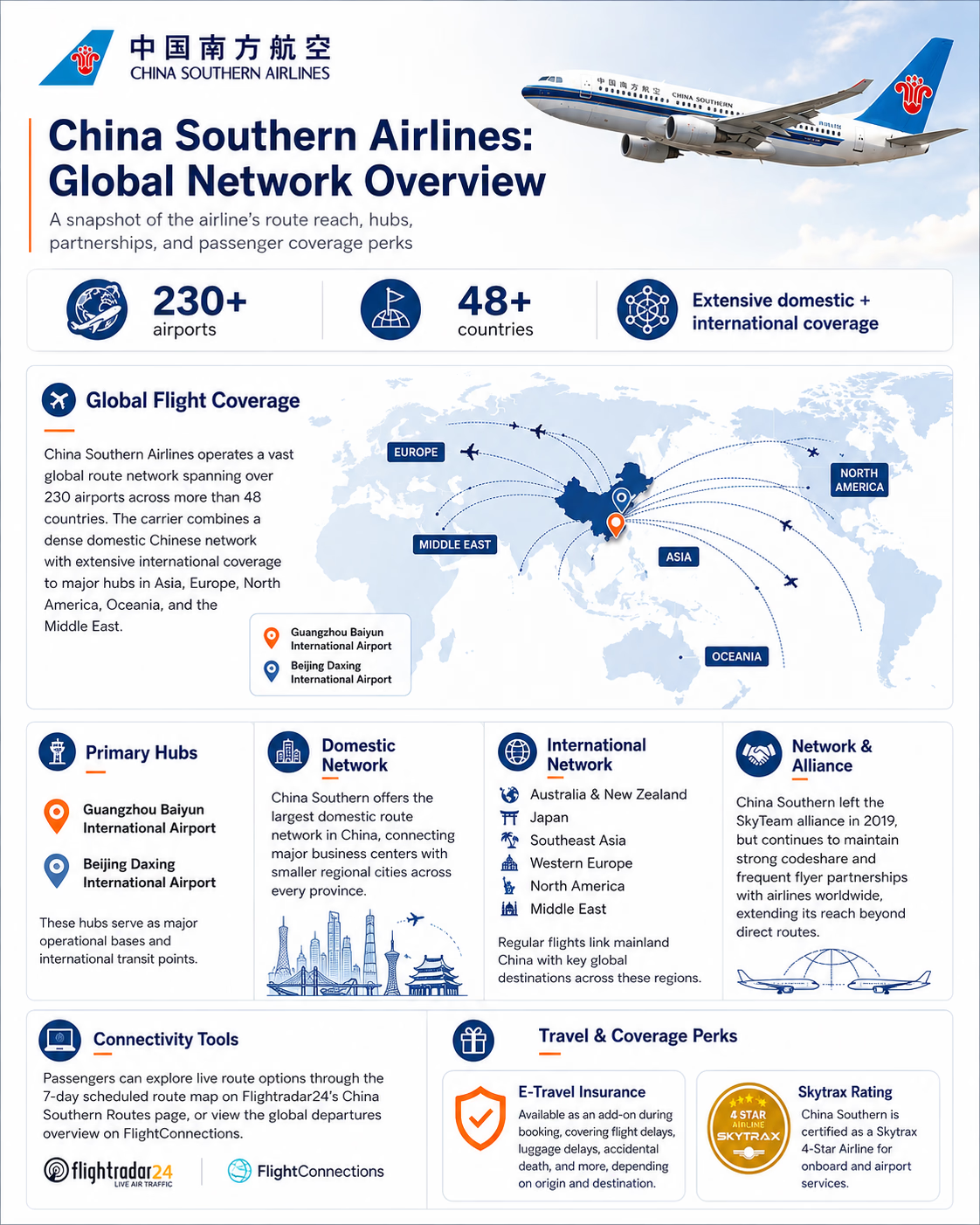
China Southern is now one of the clearest indicators of where Chinese aviation is heading next. It is not just rebuilding after the difficult post-pandemic years. It is trying to turn scale into strategic power. According to its 2025 annual report, the group describes itself as the airline with the largest annual passenger traffic in China, operating a fleet of 972 passenger and cargo aircraft by the end of the reporting period. Its network covers China, the rest of Asia, and connects into Europe, America, Australia, and Africa.
That scale matters because China’s travel recovery has not been neat or perfectly balanced. Domestic aviation has been stronger than the international recovery. IATA noted in 2025 that China’s domestic aviation segment was growing, while international recovery remained slower. China Southern sits right in the middle of that tension: massive domestic strength, but with a clear need to make international routes work harder.
Guangzhou still matters
China Southern’s natural advantage is Guangzhou. While Beijing and Shanghai often dominate the outside view of Chinese aviation, Guangzhou is a serious aviation and trade gateway, especially for Southeast Asia, Oceania, Africa, and parts of Europe.
The airline has been using that position carefully. During the 2025 summer travel peak, China Southern Group said it planned to operate more than 320,000 flights across over 970 domestic routes and 260 international and regional routes. At peak periods, it is expected to manage more than 3,000 flights per day. That is not a small seasonal push. It is a reminder that China Southern’s real engine is still volume, frequency, and network depth.
The interesting part is not only where it flies, but how it can connect demand. A traveller from Europe may see Guangzhou as “one more Chinese city.” A Chinese carrier sees it as a transfer machine. From Guangzhou, China Southern can feed passengers into Southeast Asia, Australia, domestic China, and long-haul markets. That is a different model from the Gulf carriers, which built global relevance through one mega-hub between continents. China Southern’s advantage is more domestic-heavy, but potentially just as powerful if inbound and outbound China demand keeps improving.
Profit changes the story
The biggest recent signal is financial. Reuters reported that China Southern returned to profit in 2025 after five years of losses, posting a net profit of RMB857 million. It was also the only one of China’s three major state-owned airlines to report a full-year net profit for 2025.
That does not mean everything is easy. Aviation margins are still thin. Fuel costs, aircraft delivery delays, maintenance expenses, exchange rates, and uneven international demand can quickly damage airline results. China Southern’s own annual report highlights jet fuel as a major expenditure, noting that a 10% average increase or decrease in fuel prices would affect operating expenses by RMB5.253 billion, assuming fuel consumption stayed unchanged.
So the better reading is this: China Southern is not suddenly in a comfortable position. It is in a more credible position. After years of pressure, it has been shown that tighter cost control and better capacity allocation can produce a real turnaround. That matters for investors, airports, tourism boards, and competitors watching China’s outbound travel rebuild.
The airline experience question
For Alertify readers, the more interesting angle is passenger experience. China Southern’s next chapter will not be won only by aircraft numbers. It will be won by how smooth the journey feels.
This is where Chinese airlines still face a perception gap. Many international travellers associate Asian premium aviation with Singapore Airlines, ANA, Cathay Pacific, Korean Air, or EVA Air. They associate long-haul connectivity with Emirates, Qatar Airways, Turkish Airlines, and Etihad. Chinese carriers have scale, but they have not always had the same soft-power effect internationally.
READ MORE: In China, airlines plug ‘all you can fly’ deals
China Southern has to close that gap. Fleet size gets attention, but cabin consistency, digital service, airport transfer experience, Wi-Fi, payment options, loyalty benefits, multilingual support, and disruption handling are what turn a one-time fare decision into brand preference.
There is also a travel tech layer here. Airlines increasingly own more of the passenger journey: booking, seat selection, airport services, payment, loyalty, connectivity, destination services, and post-arrival add-ons. The smarter airlines will not only sell tickets. They will sell confidence. For international passengers arriving in China or connecting through China, that means simple digital check-in, clear app support, reliable connectivity information, and fewer “what now?” moments.
Competition is not standing still
China Southern is not operating in a vacuum. Air China has the Beijing political and long-haul capital advantage. China Eastern has Shanghai and a strong commercial gateway. Cathay Pacific is rebuilding Hong Kong’s hub relevance. Singapore Airlines continues to set the premium benchmark. Turkish Airlines is expanding through geography and connectivity. The Gulf carriers remain extremely strong at making long-haul transfers feel easy.
China Southern’s opportunity is different. It does not need to copy Emirates or Singapore Airlines. Its strongest card is China itself: domestic depth, regional reach, and a home market that still has enormous travel upside. But to win more international attention, it needs to package that scale better.
A traveller should understand why flying through Guangzhou makes sense. A tourism board should see China Southern as a serious inbound partner. A business traveller should trust the consistency. A digital traveller should not feel lost between airport Wi-Fi, app language settings, payment tools, and roaming uncertainty.
Conclusion
China Southern Airlines is becoming one of the most important airlines to watch, not because it is suddenly glamorous, but because it shows the next phase of Chinese aviation very clearly.
The first phase was survival. The second was recovery. Now comes the more difficult phase: turning scale into trust.
That is where the comparison with global players becomes useful. Emirates made Dubai feel obvious. Turkish Airlines made Istanbul feel unavoidable. Singapore Airlines made premium service its global language. China Southern has the ingredients to do something different: make Guangzhou and China’s domestic network feel practical, connected, and internationally usable.
If it gets that right, China Southern will not just be China’s biggest airline by traffic. It could become one of the carriers that quietly redraws how travellers move between China, Asia, Europe, and Oceania. And in aviation, quiet shifts often matter more than loud announcements.