Alertify / Destination Connectivity Intelligence

Bosnia and Herzegovina eSIM Guide

A road trip from Dubrovnik to Mostar or a weekend in Sarajevo can take you across one of Europe’s most consequential mobile tariff borders. Prepare your data before crossing into Bosnia and Herzegovina.

Mobile networksBH Telecom · m:tel · HT Eronet
Roaming frameworkWestern Balkans roaming
Local calling code+387
Before departureInstall on reliable Wi-Fi
The faster decision

Choose your Bosnia connection style

Match your mobile data to the journey before comparing packages.

↗

Short visits

Compare a small prepaid allowance for maps, transfers and messaging in Sarajevo, Mostar and the Neretva valley.

Explore Airalo →
⇄

Cross-border journeys

Compare the dedicated Balkan package against a country-only plan.

Explore Nomad eSIM →
∞

Heavy data

Compare larger and unlimited options where available, including fair-use and hotspot terms.

Explore Yesim →
◎

Return trips

Consider reusable connectivity or selected non-expiring data rather than buying a fresh plan on every visit.

Explore BNESIM →
Sarajevo cityscape
!

The Bosnia difference: check your roaming zone first

Crossing from Croatia can change your roaming charges immediately. Bosnia is in the Western Balkans regional roaming framework, not yet the EU roaming regime. EU extension negotiations opened on 6 November 2026; they do not mean surcharge-free roaming is already in force.

Provider comparison

Compare Bosnia eSIM providers

6 affiliate options selected for different travel needs. This is an editorial guide, not a live price ranking.

6 providers
ProviderWorth considering forImportant Bosnia considerationView offer
Airalo
Plan variety
Local and regional packages
Compare the country list, allowance and renewal settings.View plans ↗
Nomad eSIM
Regional journeys
Local and multi-country data
Its 12-country Balkans plan includes this destination; Kosovo is not listed.View plans ↗
Yesim
Flexible data
Fixed and unlimited options
Check fair-use speeds and destination eligibility.View plans ↗
BNESIM
Repeat visits
Expiring and selected non-expiring data
Select the non-expiring product explicitly where available.View plans ↗
Roamless
Pay as you go
Reusable balance and data packages
Compare usage-based rates against a fixed bundle.View plans ↗
Saily
Security-minded travel
App-managed travel data
Check the selected package and included security tools.View plans ↗

Affiliate disclosure: Alertify may earn a commission at no additional cost to you. This selection is editorial and not a network performance test. Prices, plan availability, partner networks and terms may change. Check the actual offer before purchasing.

Beyond the price tag

What each of the 6 providers brings

Compare the product model and actual journey requirements, not simply the number of gigabytes.

Airalo

Plan variety

Its destination catalogue includes fixed and unlimited products. Compare a dedicated package with a regional offer if travelling onward.

Watch: Compare the country list, allowance and renewal settings.Check Airalo plans →

Nomad eSIM

Regional journeys

Nomad offers destination-specific data and regional alternatives. Its dedicated Balkans package lists 12 countries, including Bosnia and Herzegovina, Montenegro, North Macedonia, Bulgaria and Romania, but not Moldova or Kosovo.

Watch: Check the exact regional coverage list and activation deadline.Check Nomad eSIM plans →

Yesim

Flexible data

Yesim lists this destination among its trial-eligible markets and offers flexible travel data products. Compare the full-speed allowance and validity of the actual offer.

Watch: Check fair-use speeds and destination eligibility.Check Yesim plans →

BNESIM

Repeat visits

BNESIM is worth comparing for travellers who return regularly and prefer not to lose unused data. Review the distinction between its time-limited and non-expiring bundles.

Watch: Select the non-expiring product explicitly where available.Check BNESIM plans →

Roamless

Pay as you go

Roamless uses a reusable global profile and offers balance-based connectivity as well as packages. This can be useful on trips involving several short stops.

Watch: Compare usage-based rates against a fixed bundle.Check Roamless plans →

Saily

Security-minded travel

Saily combines prepaid mobile data and app-based security features. Compare a country plan with eligible regional packages and check tethering conditions.

Watch: Check the selected package and included security tools.Check Saily plans →
Stari Most bridge
Right-size your plan

How much mobile data do you need in Bosnia?

These are indicative allowances, not guaranteed consumption figures. Video and tethering can use considerably more data than maps and messaging.

1–3 GB

Short visits

Transfers, messages and occasional map checks.

5–10 GB

Typical holiday

Everyday browsing, bookings and exploring Sarajevo, Mostar and the Neretva valley.

20 GB+

Extended stays

Video calls, cloud services and occasional laptop sessions.

Unlimited

Heavy daily use

Check high-speed thresholds and separate hotspot conditions.

The important part

Set up your Bosnia eSIM before departure

Prepare on reliable internet before arriving or crossing the border.

  1. 01
    Check the deviceConfirm eSIM support and that your phone is carrier-unlocked.
  2. 02
    Check the roaming entitlementReview the destination and fair-use allowance of your existing subscription.
  3. 03
    Buy and installFollow the provider’s app or QR code instructions. Check when validity begins.
  4. 04
    Protect your home lineKeep it available for important messages if necessary; disable unintended data roaming and automatic switching.
  5. 05
    Connect at arrivalSelect your travel eSIM for mobile data and enable roaming on that profile if instructed.
  6. 06
    Test before leaving the airport or border areaOpen navigation and messaging; save emergency and accommodation details offline.
Alertify perspective

Connectivity should follow the itinerary.

Download maps before travelling through the Neretva valley or mountain roads. The network serving Sarajevo may not be the strongest choice for every rural itinerary.

BH Telecom markets prepaid tourist products with regional coverage; m:tel and HT Eronet also offer local connectivity. Compare the local number, registration requirements, data allowance and regional conditions with a travel eSIM.

For a short visit, the convenience of installation before departure can outweigh a lower local price. For a longer trip or heavy laptop use, compare the total cost and network access of both approaches.

!

Need a local +387 number?

Most international travel eSIMs are data-only. A local number, traditional SMS and voice must be explicitly included in the product; internet calling is not the same as a local subscription.

Before buying

Four details Bosnia travellers overlook

Network access is plan-specific

Major mobile brands: BH Telecom · m:tel · HT Eronet. Your travel eSIM may not connect to every network.

Borders and coverage

Crossing from Croatia can change your roaming charges immediately. Bosnia is in the Western Balkans regional roaming framework, not yet the EU roaming regime. EU extension negotiations opened on 6 November 2026; they do not mean surcharge-free roaming is already in force.

Offline preparation

Download maps before travelling through the Neretva valley or mountain roads. The network serving Sarajevo may not be the strongest choice for every rural itinerary.

Local number and high-volume data

BH Telecom markets prepaid tourist products with regional coverage; m:tel and HT Eronet also offer local connectivity. Compare the local number, registration requirements, data allowance and regional conditions with a travel eSIM.

Quick answers

Bosnia eSIM frequently asked questions

What is the best eSIM for Bosnia?

The right choice depends on trip duration, data and onward destinations. Compare Airalo, Nomad eSIM and other shortlisted providers against your exact itinerary.

Does EU roaming cover Bosnia and Herzegovina?

Crossing from Croatia can change your roaming charges immediately. Bosnia is in the Western Balkans regional roaming framework, not yet the EU roaming regime. EU extension negotiations opened on 6 November 2026; they do not mean surcharge-free roaming is already in force.

Can I use a Bosnia eSIM in neighbouring countries?

Only if the exact package includes those destinations. A regional roaming agreement does not automatically expand the coverage of a commercial travel eSIM.

Which networks operate in Bosnia and Herzegovina?

Major mobile brands include BH Telecom · m:tel · HT Eronet. Check the actual roaming partner offered by the selected eSIM.

Can I get a local +387 number?

BH Telecom markets prepaid tourist products with regional coverage; m:tel and HT Eronet also offer local connectivity. Compare the local number, registration requirements, data allowance and regional conditions with a travel eSIM.

Does unlimited data include unlimited hotspot?

Not necessarily. Full-speed data and tethering may have separate fair-use conditions.

Should I install before travelling?

Usually yes, using a reliable internet connection. Check whether installation or first connection starts validity.

Can I keep my regular SIM active?

On compatible dual-SIM devices, yes. Select the travel eSIM for data and check your home operator’s voice and SMS roaming charges.

Is 5G guaranteed?

No. Access depends on local coverage, handset, network agreement and the selected plan.

Is a local SIM better for a long stay?

It can be, particularly for a local number or large data volumes. Compare registration, validity, cost and convenience.

Your next step

Stay connected throughout Bosnia and Herzegovina — and beyond.

Check your existing roaming allowance, compare the right data package and prepare before departure. A good connectivity decision starts with the route.

GO UP
tech background
china southern airlines

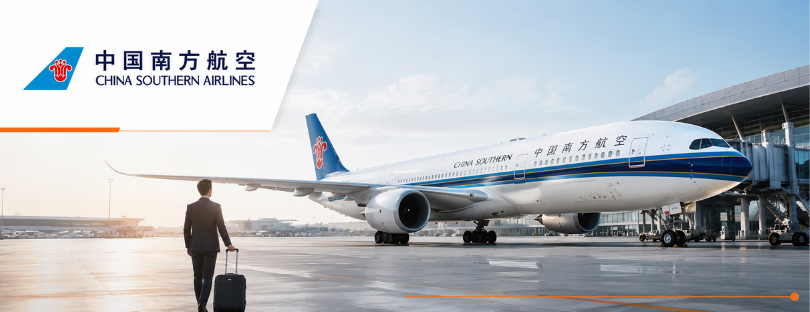
China Southern Airlines and the New China Travel Map

China Southern Airlines is one of those carriers that is easy to underestimate from Europe. People know Emirates, Qatar Airways, Turkish Airlines, and Singapore Airlines. They know the Gulf super-connectors, the polished Southeast Asian brands, the European legacy groups. But China Southern? For many travellers, it still sits somewhere in the background: huge, important, but not always emotionally familiar.

That may be a mistake.

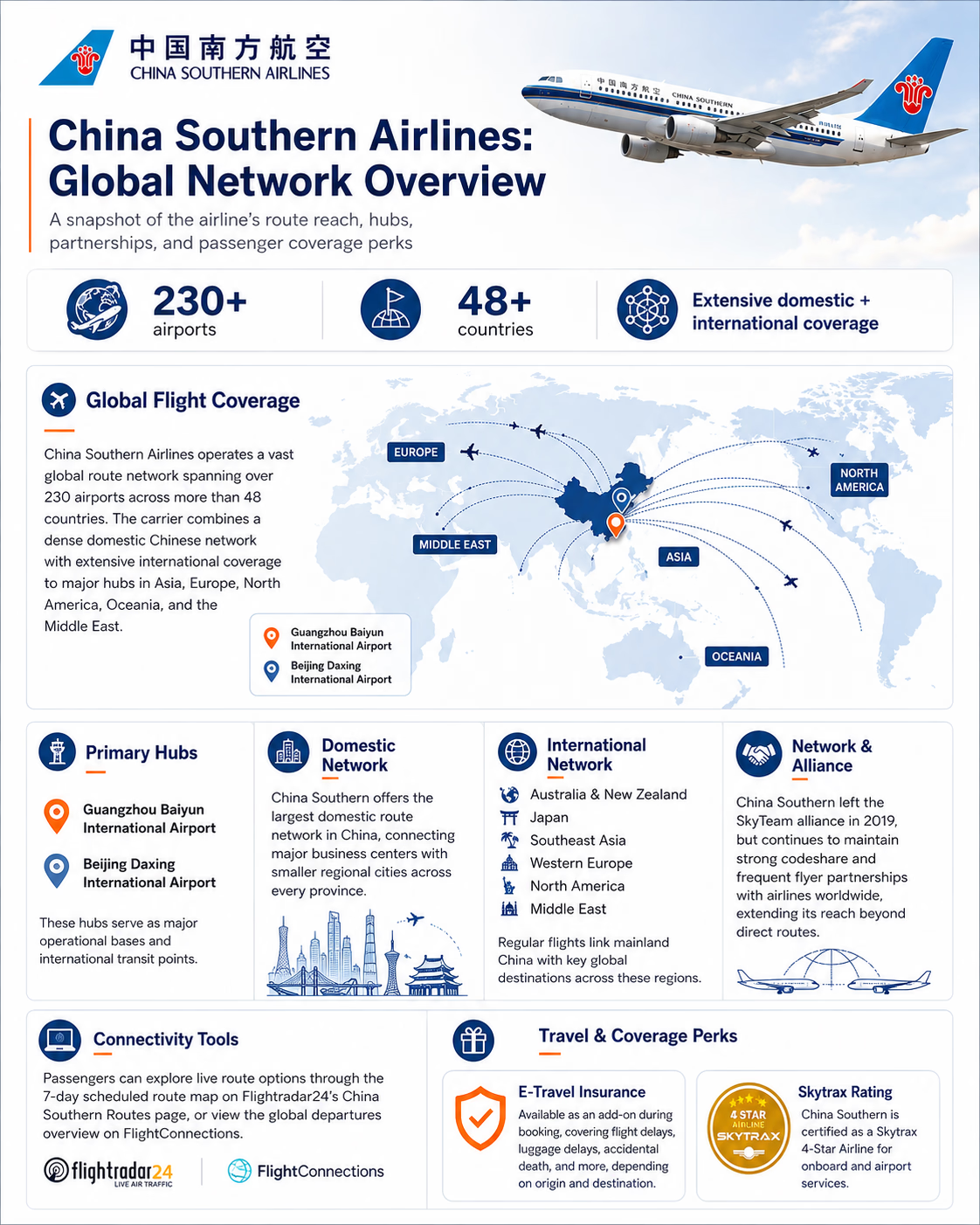
China Southern is now one of the clearest indicators of where Chinese aviation is heading next. It is not just rebuilding after the difficult post-pandemic years. It is trying to turn scale into strategic power. According to its 2025 annual report, the group describes itself as the airline with the largest annual passenger traffic in China, operating a fleet of 972 passenger and cargo aircraft by the end of the reporting period. Its network covers China, the rest of Asia, and connects into Europe, America, Australia, and Africa.

That scale matters because China’s travel recovery has not been neat or perfectly balanced. Domestic aviation has been stronger than the international recovery. IATA noted in 2025 that China’s domestic aviation segment was growing, while international recovery remained slower. China Southern sits right in the middle of that tension: massive domestic strength, but with a clear need to make international routes work harder.

Guangzhou still matters

China Southern’s natural advantage is Guangzhou. While Beijing and Shanghai often dominate the outside view of Chinese aviation, Guangzhou is a serious aviation and trade gateway, especially for Southeast Asia, Oceania, Africa, and parts of Europe.

The airline has been using that position carefully. During the 2025 summer travel peak, China Southern Group said it planned to operate more than 320,000 flights across over 970 domestic routes and 260 international and regional routes. At peak periods, it is expected to manage more than 3,000 flights per day. That is not a small seasonal push. It is a reminder that China Southern’s real engine is still volume, frequency, and network depth.

The interesting part is not only where it flies, but how it can connect demand. A traveller from Europe may see Guangzhou as “one more Chinese city.” A Chinese carrier sees it as a transfer machine. From Guangzhou, China Southern can feed passengers into Southeast Asia, Australia, domestic China, and long-haul markets. That is a different model from the Gulf carriers, which built global relevance through one mega-hub between continents. China Southern’s advantage is more domestic-heavy, but potentially just as powerful if inbound and outbound China demand keeps improving.
china southern airlines info

Profit changes the story

The biggest recent signal is financial. Reuters reported that China Southern returned to profit in 2025 after five years of losses, posting a net profit of RMB857 million. It was also the only one of China’s three major state-owned airlines to report a full-year net profit for 2025.

That does not mean everything is easy. Aviation margins are still thin. Fuel costs, aircraft delivery delays, maintenance expenses, exchange rates, and uneven international demand can quickly damage airline results. China Southern’s own annual report highlights jet fuel as a major expenditure, noting that a 10% average increase or decrease in fuel prices would affect operating expenses by RMB5.253 billion, assuming fuel consumption stayed unchanged.

So the better reading is this: China Southern is not suddenly in a comfortable position. It is in a more credible position. After years of pressure, it has been shown that tighter cost control and better capacity allocation can produce a real turnaround. That matters for investors, airports, tourism boards, and competitors watching China’s outbound travel rebuild.

The airline experience question

For Alertify readers, the more interesting angle is passenger experience. China Southern’s next chapter will not be won only by aircraft numbers. It will be won by how smooth the journey feels.

This is where Chinese airlines still face a perception gap. Many international travellers associate Asian premium aviation with Singapore Airlines, ANA, Cathay Pacific, Korean Air, or EVA Air. They associate long-haul connectivity with Emirates, Qatar Airways, Turkish Airlines, and Etihad. Chinese carriers have scale, but they have not always had the same soft-power effect internationally.

READ MORE: In China, airlines plug ‘all you can fly’ deals

China Southern has to close that gap. Fleet size gets attention, but cabin consistency, digital service, airport transfer experience, Wi-Fi, payment options, loyalty benefits, multilingual support, and disruption handling are what turn a one-time fare decision into brand preference.

There is also a travel tech layer here. Airlines increasingly own more of the passenger journey: booking, seat selection, airport services, payment, loyalty, connectivity, destination services, and post-arrival add-ons. The smarter airlines will not only sell tickets. They will sell confidence. For international passengers arriving in China or connecting through China, that means simple digital check-in, clear app support, reliable connectivity information, and fewer “what now?” moments.

More on Alertify
Follow the latest China Southern Airlines news
Route network updates, China aviation recovery, Guangzhou hub moves, passenger experience stories and travel industry signals from one of Asia’s biggest carriers.

Explore news →

Competition is not standing still

China Southern is not operating in a vacuum. Air China has the Beijing political and long-haul capital advantage. China Eastern has Shanghai and a strong commercial gateway. Cathay Pacific is rebuilding Hong Kong’s hub relevance. Singapore Airlines continues to set the premium benchmark. Turkish Airlines is expanding through geography and connectivity. The Gulf carriers remain extremely strong at making long-haul transfers feel easy.

China Southern’s opportunity is different. It does not need to copy Emirates or Singapore Airlines. Its strongest card is China itself: domestic depth, regional reach, and a home market that still has enormous travel upside. But to win more international attention, it needs to package that scale better.

A traveller should understand why flying through Guangzhou makes sense. A tourism board should see China Southern as a serious inbound partner. A business traveller should trust the consistency. A digital traveller should not feel lost between airport Wi-Fi, app language settings, payment tools, and roaming uncertainty.

Conclusion

China Southern Airlines is becoming one of the most important airlines to watch, not because it is suddenly glamorous, but because it shows the next phase of Chinese aviation very clearly.

The first phase was survival. The second was recovery. Now comes the more difficult phase: turning scale into trust.

That is where the comparison with global players becomes useful. Emirates made Dubai feel obvious. Turkish Airlines made Istanbul feel unavoidable. Singapore Airlines made premium service its global language. China Southern has the ingredients to do something different: make Guangzhou and China’s domestic network feel practical, connected, and internationally usable.

If it gets that right, China Southern will not just be China’s biggest airline by traffic. It could become one of the carriers that quietly redraws how travellers move between China, Asia, Europe, and Oceania. And in aviation, quiet shifts often matter more than loud announcements.

Driven by wanderlust and a passion for tech, Sandra is the creative force behind Alertify. Love for exploration and discovery is what sparked the idea for Alertify, a product that likely combines Sandra’s technological expertise with the desire to simplify or enhance travel experiences in some way.