Chile and Argentina roaming: a regional milestone for mobile users
The end of roaming charges between Chile and Argentina marked one of the most important telecom integration moves in South America. What began as a bilateral ambition in 2019 later became a practical benefit for travellers, businesses, and cross-border communities: mobile users from both countries could use voice, SMS, and mobile data while visiting the neighbouring country without paying traditional international roaming surcharges.
The agreement was driven by both governments as part of a wider push for digital and economic integration. At the time, Chile’s Undersecretary of Telecommunications, Pamela Gidi, described the initiative as an important step toward stronger bilateral and regional cooperation. Her message was clear: Latin America needed to accelerate its digital economy, reduce unnecessary barriers, and close part of the gap with more developed markets.
On the Argentine side, the process involved key representatives from the country’s communications and technology institutions, including ENACOM and the Secretariat of Information Technologies and Communications. The political signal was important because roaming is not only a telecom issue. It affects tourism, trade, border mobility, business travel, and even family communication between two countries with deep social and economic ties.
The agreement required legislative approval in both countries before entering into force. Once the legal and regulatory steps were completed, Argentina formally implemented the measure through ENACOM Resolution 927/2020, published in August 2020. The rule established that mobile services used while roaming between Argentina and Chile, including calls, messaging, and mobile data, would be billed at local domestic prices rather than charged as international roaming.
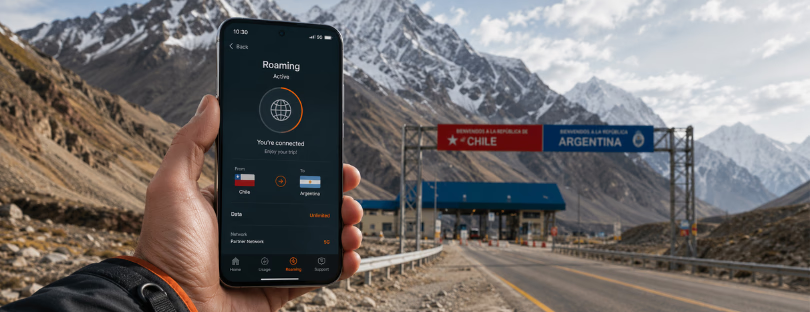
In practical terms, this meant that a Chilean user travelling in Argentina, or an Argentine user travelling in Chile, could connect to a partner mobile network without facing the usual roaming premium. Identification continued through the user’s SIM card, allowing the visited network to recognize the customer and apply the relevant domestic-style pricing model. The benefit was also defined with usage limits, including 90 consecutive days or 120 non-consecutive days within the same year.
Why this mattered
For travellers, the most obvious impact was cost. Before agreements like this, roaming between neighbouring countries could feel disproportionately expensive, especially for people who crossed the border regularly. Tourists might switch off mobile data, rely on hotel Wi-Fi, or buy temporary local SIM cards just to avoid unexpected charges.
For businesses, the benefit was even clearer. Companies with teams moving between Chile and Argentina gained more predictable mobile costs. Sales teams, logistics operators, consultants, event professionals, and executives could stay connected without treating every border crossing as a telecom expense problem.
READ MORE: Virgin Mobile Chile introduces eSIMs
The measure also supported the wider digital economy. Mobile connectivity is now tied to payments, maps, ride-hailing, messaging, authentication, bookings, and remote work. Removing roaming friction helps people use digital services naturally when travelling, instead of disconnecting the moment they cross a border.
Chile and Argentina roaming markets
The Chilean and Argentine roaming markets have historically reflected different regulatory environments. Chile’s telecom sector has been supervised by the Subsecretaría de Telecomunicaciones, known as SUBTEL, and the country has often been seen as one of the more advanced and competitive mobile markets in Latin America. Chile has also been active in digital policy, including early moves on net neutrality and mobile broadband development.
Argentina, meanwhile, has had a more uneven telecom market, shaped by regulatory reforms, inflationary pressures, and changing policy priorities. Roaming prices in Argentina were historically considered high compared with some neighbouring markets, which made the bilateral agreement with Chile particularly relevant.
The most interesting point is that this was not only about lowering prices. It showed how a roaming policy can be used as a tool of regional integration. Instead of treating cross-border mobile use as a premium service, Argentina and Chile moved closer to the idea that connectivity should follow people, trade, and tourism more naturally.
A wider South American signal
The Chile and Argentina roaming agreement also fits into a broader regional conversation. South America has long discussed reducing or eliminating roaming charges between neighbouring countries, including within Mercosur and the Andean Community. Progress has been uneven, but the Chile-Argentina case remains an important example of what can happen when political will, regulatory coordination, and operator implementation come together.
READ MORE: Argentina approves end of roaming rates in Mercosur
For consumers, this is the direction mobile connectivity should take. Borders still matter for operators, licenses, taxation, and network agreements. But from the user’s point of view, mobile data has become too essential to be treated like a luxury add-on every time someone travels across a border.
Conclusion
The elimination of Chile and Argentina roaming charges was more than a tariff adjustment. It was a sign that regional telecom policy can become practical, visible, and genuinely useful for ordinary users. In a market where travellers increasingly compare local SIMs, travel eSIMs, operator roaming bundles, and cross-border agreements, this kind of regulation gives national mobile operators a stronger reason to stay relevant.
Still, it also shows the challenge ahead. Bilateral agreements are helpful, but travellers do not move only between two countries. They move across regions. That is why eSIM providers, regional operators, and regulators are all pushing, in different ways, toward the same outcome: simpler mobile connectivity abroad. The winners will be the players who make roaming feel less like a penalty and more like a normal part of modern travel.