Why iPhone eSIM Is the Smartest Travel Shift in Years
If you’ve been using an iPhone over the last few years, you’ve probably felt it yourself—Apple has been slowly pushing us toward a future without physical SIM cards. And honestly… that future isn’t as scary as it sounds. Actually, for travelers, it’s kind of amazing.
Apple didn’t invent the eSIM, but they absolutely normalized it. They took a niche telecom feature and dropped it right in the middle of the iPhone ecosystem, where everything becomes simpler, cleaner, and a little more magical.
So let’s talk about what Apple eSIM actually means — not in that over-explained technical way, but the real, everyday version that travelers, digital nomads, and business users actually deal with.
Because if you own an iPhone, you’re already sitting on one of the easiest global connectivity tools ever built. Most people just haven’t explored it yet.
So, what is Apple eSIM (in real language)?
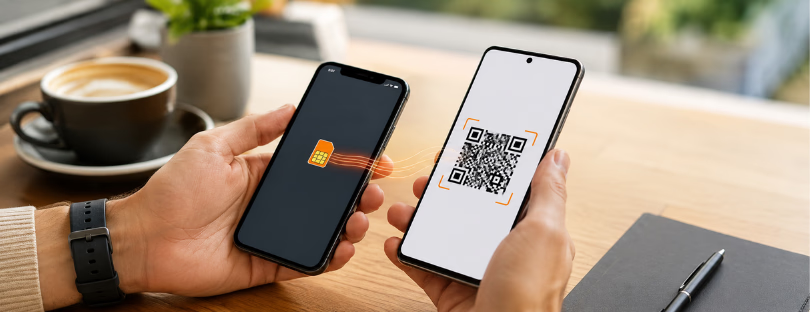
Think of eSIM as a digital version of the little plastic SIM card you’ve been swapping for years. The difference? It’s built directly into your iPhone’s hardware. You don’t put anything in. You don’t take anything out. You just download a profile, and boom—you’re connected.
It’s basically the App Store version of a SIM card.
No shops. No needles to eject trays. No “sorry, we’re out of stock.” No airport kiosks charge €30 for 3 GB of data. (We’ve all been there.)
And because the iPhone does all the heavy lifting, Apple eSIM feels way more intuitive than most people expect.
A quick timeline to make sense of Apple’s eSIM journey
Apple didn’t jump into this overnight. Here’s the quick, very human version of what happened:
- 2018: iPhone XS, XS Max, and XR become the first Apple devices with eSIM support. People are confused. Carriers are nervous. Tech blogs pretend they’re not.
- 2019–2021: Apple quietly rolls out eSIM on more iPhones, iPads, and even Apple Watches. Travelers start paying attention.
- 2022: The iPhone 14 line in the U.S. goes full eSIM only. No physical SIM slot. This is the moment everyone realizes Apple is building an eSIM world on purpose.
- 2023–2025: Apple doubles down. eSIM activation becomes ridiculously smooth. More carriers join. Travel eSIM apps explode. And iPhone users suddenly have more choices than ever.
And that’s really the key point: choice.
Apple didn’t just make eSIM possible—they made it a standard. And once something becomes the “Apple way,” the whole industry moves.

Why iPhone users actually love eSIM (even if they didn’t expect to)
Let’s skip the marketing buzzwords. Here’s what Apple eSIM actually means in your daily life:
1. Buying a travel plan takes minutes, not hours
You’re sitting in the back of an Uber on the way to the airport. You remember you forgot to sort out roaming. Normally, this would be panic mode.
With Apple eSIM, it’s literally:
- Open an eSIM provider app
- Choose the country
- Tap “Install eSIM”
- Start scrolling Instagram on airport Wi-Fi like nothing happened
No lines. No paperwork. No asking strangers “do you sell SIM cards?”
2. Dual SIM is suddenly useful
Apple lets you run two lines at once — one for “home,” one for “travel.”
And it’s seamless. You can choose which line handles data, calls, SMS, and iMessage.
This is perfect for:
- Business travelers who want to keep their main number active
- People juggling personal/work lines
- Digital nomads who need constant local coverage
Seriously, once you try dual eSIM, going back feels like using a flip phone.
3. No more losing SIM cards (or the tiny tray tool)
Apple basically removed the two things travelers lose the most:
- SIM cards
- Sanity when they can’t open the SIM tray
With eSIM, you can’t lose anything. And you don’t need anything except your iPhone and Wi-Fi.
4. Your iPhone becomes a global connectivity hub
This sounds dramatic, but it’s true.
Your iPhone can hold multiple eSIMs at once (even if only a few are active). Meaning:
- You can pre-install plans for multiple trips
- You can switch between carriers instantly
- You can test which network is stronger in a new city (digital nomad superpower)
Basically, your iPhone becomes the “control center” for your connectivity. And it feels very Apple-like—smooth, clean, and invisible.

The Apple factor: why their eSIM experience feels different
Every phone manufacturer supports eSIM now, but Apple’s implementation is uniquely frictionless. A few reasons:
1. They hide the complexity
Apple takes a technology that’s normally full of QR codes, long codes, APNs, and settings menus… and simplifies it to a single “Add eSIM” button.
2. They force carriers to behave
If carriers want iPhone users (and they do), they have to comply with Apple’s standards—and those standards are strict. Activation must be quick. Profiles must be stable. Support must exist.
Apple basically said:
“Make eSIM work properly, or your customers will blame you, not us.”
Carriers listened.
3. Apple’s ecosystem makes switching painless
You can activate and manage eSIMs on:
- iPhone
- iPad
- Apple Watch
And if you’re upgrading your phone? You can transfer your eSIM during setup.
It feels like AirDrop for mobile plans.

The part nobody tells you: eSIM gives you pricing power
Physical SIMs are limited by geography.
eSIM is unlimited by it.
That means you can compare providers globally—not just whichever shop is nearest.
This is exactly why travel eSIM apps exploded. When competition goes global, prices drop fast.
For example, a local operator might sell 10GB for €35, but an eSIM app offers the same plan for €9.
Apple didn’t intend to create a price war. But they absolutely did. And travelers are cashing in.

Any downsides to Apple eSIM?
A few—let’s keep it real:
- If you’re using a U.S. iPhone 14 or newer, you can’t use physical SIMs at all. Some people miss the flexibility.
- Some older or smaller carriers still don’t support eSIM properly.
- Activating certain domestic plans can require talking to customer support (never fun).
- Transferring eSIMs between devices is smooth most of the time—but not always.
But overall? The benefits massively outweigh the inconveniences.
So… should you switch to Apple eSIM for your next trip?
Honestly? Yes.
If you travel even once a year, the convenience alone is worth it.
If you travel often, it’s a no-brainer.
With Apple eSIM, you can:
- Install a plan before you even leave your house
- Avoid insane roaming fees
- Stay connected instantly when you land
- Keep your main number active for iMessage and calls
- Switch plans as easily as switching apps
It’s cleaner, smarter, and more modern—and it fits perfectly into the way travelers actually move today.
Apple quietly built one of the best travel tools in your pocket.
You might as well use it.