Airalo Japan eSIM: Easy Data Before You Land
Japan is one of those destinations where mobile data stops feeling like an extra and becomes basic infrastructure.
You need it before you even leave the airport. Train transfers, Google Maps, translation apps, QR menus, hotel check-ins, digital tickets, restaurant bookings, cashless payments and those tiny station exits that somehow decide your whole day. In Tokyo or Osaka, being offline is not romantic. It is annoying.
That is why the Airalo Japan eSIM deserves attention. Not because Airalo is the only option, because it clearly is not, but because Japan is exactly the kind of market where a simple, app-based travel eSIM makes practical sense.
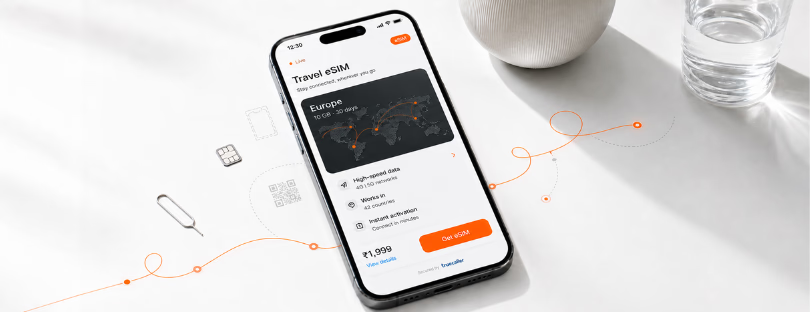
Airalo positions itself as a globaI eSIM store covering more than 200 destinations, with local, regional and global plans available through its app and website. Its Japan eSIM page currently shows Japan plans starting from $4, which puts it in the familiar “easy entry” travel eSIM category: low commitment, quick install, data-first, and designed for travellers who would rather avoid airport counters and roaming surprises.
Why Airalo works for Japan
The biggest strength of Airalo in Japan is not some dramatic technical breakthrough. It is familiarity.
A lot of travellers already know the app. They have used it in Thailand, the US, Turkey, Spain or somewhere else, and that matters. GSMA Intelligence made an interesting point recently: many consumers may not shop around for the best-value travel eSIM in every single country. They often stick with one app because it is already installed, already understood, and “good enough” for the next trip.
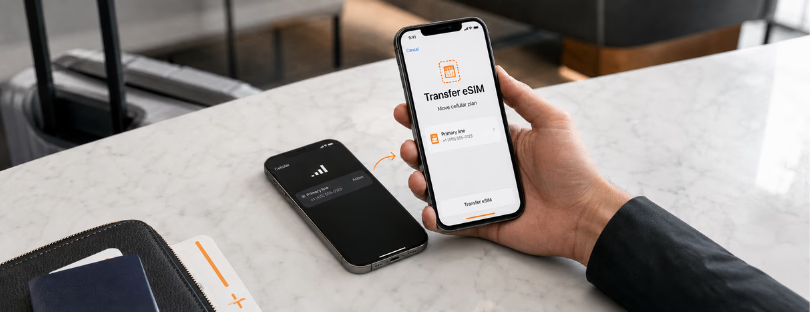
That is very much Airalo’s advantage. It has become a default choice for many mainstream travellers. You open the app, choose Japan, buy a package, install the eSIM, and activate it when you land. For someone arriving at Haneda after a long flight, that kind of predictability is worth something.
Airalo’s Japan eSIM is especially relevant for short city trips, first-time visitors, families, and travellers who want a clean backup data plan without worrying about network contracts. It is also useful for people who want to keep their home SIM active for calls, banking texts or two-factor authentication, while using the Airalo eSIM for mobile data.
That dual-SIM setup is one of the quiet reasons travel eSIMs became so popular. You do not need to abandon your main number. You simply add a temporary data layer.
The real Japan test
Japan is not a destination where travellers use data casually.
A weak connection can turn into a missed train, a wrong platform, a failed translation, or a very awkward attempt to find a hotel entrance in a side street behind Shinjuku Station. This is why the real test for any Japan eSIM is not just price per gigabyte. It is whether the plan feels stable during normal travel behaviour.
Normal travel behaviour in Japan means using maps all day, checking train times constantly, uploading photos, scanning menus, messaging friends, translating signs, and sometimes using video calls from a hotel lobby or café. A 1 GB plan may look cheap, but in Japan it can disappear quickly if you are careless with video, cloud backups or social media.
So, Airalo’s cheaper entry point is attractive, but travellers should still match the plan to the trip. A weekend in Tokyo is one thing. A two-week Tokyo, Kyoto, Osaka, Hiroshima route is another. Japan encourages movement, and movement consumes data.
This is where Alertify’s advice is simple: do not buy the smallest plan just because it is there. Buy the plan that matches how you actually travel.
A crowded market now
Airalo is not alone in Japan. That is important.
Japan has become one of the showcase markets for travel eSIM competition. Airalo, Ubigi, Nomad eSIM, Saily, Holafly, GigSky, Jetpac and several regional players all fight for the same traveller: someone landing in Japan who wants data without roaming pain. Some providers push low-cost fixed data bundles. Some focus on unlimited-style plans. Some lean into premium network experience, app design, security features or regional Asia coverage.
That is where comparison gets interesting.
Airalo is strong on global recognition, app simplicity and broad destination coverage. Ubigi, backed by Transatel, often has a strong reputation among travellers who care about network-level quality and repeat usage. Holafly tends to appeal to users who prefer unlimited-style simplicity, even if fair usage and speed management still need careful reading. Saily benefits from Nord Security’s consumer trust halo and security-led positioning. Nomad is often competitive on pricing and plan variety.
The market has moved beyond “who sells an eSIM.” Everyone sells an eSIM now. The better question is: who gives the traveller the least friction for the specific trip?
For Japan, Airalo sits comfortably in the mainstream sweet spot. It may not always be the cheapest per gigabyte. It may not always be the most advanced technically. But it is easy, recognizable and widely used. In travel connectivity, that combination is powerful.
Tourism pressure helps the category
The timing also matters. Japan’s inbound tourism remains huge. Travel Voice, citing JNTO data, reported that Japan reached 10,683,500 international arrivals in the first three months of 2026, with March alone hitting a record 3,618,900 arrivals for that month.
That is not just good news for hotels, airlines and rail operators. It is good news for travel connectivity platforms.
More visitors means more people trying to solve the same basic problem: “How do I get online the moment I land?” Airport SIM counters and pocket Wi-Fi rentals are still around, but the direction of travel is obvious. Connectivity is moving into the app layer before the trip even starts.
GSMA Intelligence also notes that travel eSIM adoption is growing, with its consumer survey showing that 12% of international travellers across 11 major surveyed countries used eSIM while travelling abroad. The same analysis points out that travel eSIMs are becoming both a consumer convenience and a revenue opportunity for travel platforms, banks and other digital services.
That is the bigger story behind Airalo Japan eSIM. It is not just a product page. It is part of a wider shift where roaming is no longer controlled only by mobile operators.
Final take about Airalo Japan eSIM
Airalo’s Japan eSIM is a sensible choice for travellers who value simplicity, app familiarity and fast setup more than endless plan comparison. For many visitors, that is enough. Japan is a high-data, high-mobility destination, and Airalo removes one of the old annoyances: landing, searching for Wi-Fi, queuing for a SIM, or gambling with home roaming rates.
But the market is getting sharper. Airalo now competes with providers that are pushing harder on unlimited plans, premium routing, security features, loyalty models and regional bundles. That means Airalo’s advantage in Japan is not just coverage or price. It is trust through repetition. People use what they already understand.
And that may be the most important trend in travel eSIMs right now. The winner is not always the provider with the loudest “best eSIM for Japan” claim. It is the provider that becomes part of the traveller’s routine before the airport even enters the story.