Wizz Air Launches WIZZ Link and Changes Connected Travel
Wizz Air’s latest move is less about adding routes and more about reclaiming how travellers actually build trips across Europe. With the launch of WIZZ Link, the airline is no longer just selling point-to-point tickets. It is stepping into connected travel, an area traditionally dominated by network carriers, global alliances, and online travel agencies.
Developed in partnership with Dohop, WIZZ Link allows passengers to book multi leg journeys in a single transaction directly on Wizz Air’s platform. For an ultra-low-cost carrier, that is not a cosmetic upgrade. It is a structural shift in how value is created and retained.
The real problem WIZZ Link is trying to solve
European travelers have been building self transfer itineraries for years. A London to Budapest flight followed by Budapest to Abu Dhabi. Rome to Tirana via Warsaw. These are not edge cases. They are common behaviors driven by fragmented networks, low fares, and flexible schedules.
The problem is friction.
Searching each segment separately, checking baggage compatibility, aligning minimum connection times, and managing multiple bookings is work. Industry studies consistently show travelers spend several hours planning and managing complex trips, and the more legs involved, the higher the abandonment rate. That friction has pushed millions of travelers toward OTAs and aggregators, even when they prefer to book direct.
WIZZ Link is designed to intercept that behavior before it leaves Wizz Air’s ecosystem.
What actually changes for passengers
With WIZZ Link, travelers can access close to 8,000 new origin and destination combinations through wizzlink.wizzair.com, using key connection points such as Budapest, Rome, London, Warsaw, and Tirana.
The experience matters here. This is not just a search overlay.
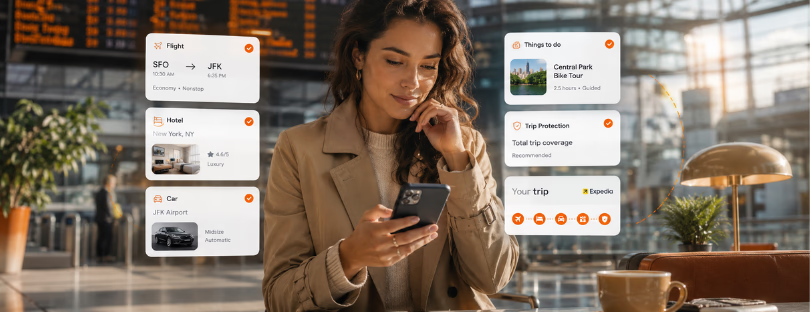
Passengers can book multi-segment journeys in one purchase, manage ancillaries across all flights, and add services like seat selection, priority boarding, and meals without juggling separate reservations. The optional ConnectSure protection adds a layer of reassurance in case of delays or missed connections, a critical trust component for self-transfer travel.
For passengers used to stitching trips together manually, this removes cognitive load. For less confident travelers, it lowers the barrier to using low-cost carriers for longer, more complex routes.
Why this matters strategically for Wizz Air
Michael Delehant, Senior Chief Commercial and Operations Officer at Wizz Air, was explicit about the commercial logic behind the move:
“Online Travel Agencies continue to command a large share of the online market — over a third of travellers book flights via OTAs nowadays. At the same time, multi-leg itineraries already account for a meaningful share of traffic and are expected to grow toward low double digits of all flight bookings. WIZZ Link helps keep these multi-segment sales inside our ecosystem, lifting conversion and segments per passengers. And for the passengers themselves, the service offers added convenience and choice, bringing together Wizz Air’s extensive network coverage within a single, connected booking experience. WIZZ Link represents a strong step forward for our Customer First Compass commitments and for Wizz Air’s long-term growth. This launch is a key milestone in our strategy to make air travel even more accessible, connected, and customer-centric.”
The key phrase is “inside our ecosystem”.
Multi leg bookings typically have higher average order value. They also carry more ancillaries and create more opportunities for post booking engagement. By owning the journey, not just the segment, Wizz Air protects margin and data while reducing dependency on intermediaries.
The technology layer that makes it possible
WIZZ Link is powered by Dohop’s RetailConnect technology, part of a broader category often referred to as alternative interlining. Unlike traditional interline agreements that rely on legacy airline systems, this approach is lighter, faster to deploy, and commercially flexible.
Dohop already supports connected travel solutions for over 100 airlines worldwide. Its model allows carriers to create virtual networks without formal alliances, while retaining control over pricing, distribution, and customer experience.
Hugh Aitken, Chief Operating Officer at Dohop, framed it clearly:
“WIZZ Link demonstrates how low-cost carriers can use alternative interline technology to expand their network efficiently and offer passengers a better way to connect. We are proud to support Wizz Air as it takes this important step in simplifying travel across Europe, creating new travel options and improving the passenger experience, all while keeping the process simple and cost-efficient for the airline.”
This is important because it signals maturity. Alternative interlining is no longer experimental. It is becoming infrastructure.
How are competitors approaching the same problem?
Wizz Air is not alone in this direction, but its execution stands out.
Ryanair has tested similar ideas through partnerships and limited connection products, but has historically been cautious about complexity. easyJet has leaned into connected travel through easyJet Worldwide, also powered by Dohop, with a stronger focus on long-haul feed.
The difference is intent.
WIZZ Link is not positioned as a niche add on. It is framed as a core growth lever tied to loyalty, conversion, and ecosystem control. That aligns with broader industry trends highlighted by sources like IATA, Skift, and Phocuswright, all of which point to increasing demand for flexible, modular travel rather than rigid round-trip itineraries.
At the same time, airlines are under pressure to reduce distribution costs and reclaim customer relationships from OTAs. Direct connected booking is one of the few levers that addresses both.
The sustainability and efficiency angle
Wizz Air has consistently positioned itself as Europe’s most emissions-efficient airline per passenger-kilometer. While WIZZ Link is primarily a commercial and experience play, there is a secondary effect worth noting.
Better planned connections reduce unnecessary repositioning flights and last-minute rebooking chaos during disruptions. Over time, more predictable passenger flows and higher load factors support both operational efficiency and environmental goals.
That narrative fits neatly with Wizz Air’s broader positioning, including its repeated recognition by the World Finance Sustainability Awards and its visibility on the London Stock Exchange.
What does this signal mean for the low-cost model?
For years, low-cost carriers defined simplicity as limitation. No connections. No baggage transfers. No responsibility beyond the segment.
That definition is changing.
Today, simplicity is about reducing mental effort, not removing options. WIZZ Link reflects that shift. It preserves the cost discipline of the low-cost model while selectively adding intelligence where it matters most to travelers.
The broader implication is that the line between low-cost and network carriers continues to blur, not in pricing, but in digital capability.
Conclusion
WIZZ Link is not just a booking feature. It is a signal.
It shows how low cost airlines are evolving from fare sellers into journey designers, using technology rather than alliances to expand reach. Compared with similar initiatives across Europe, Wizz Air’s approach is notably pragmatic. It avoids heavy interline complexity, keeps control in-house, and focuses on high-intent use cases that already exist in traveler behavior.
As connected travel grows into a low double-digit share of bookings, as predicted by industry analysts at Phocuswright and Skift, the winners will be airlines that make complexity invisible without surrendering the customer relationship. Wizz Air is clearly positioning itself in that camp.
For travelers, this means fewer tabs, fewer assumptions, and fewer surprises. For the industry, it confirms that connected travel is no longer a premium airline privilege. It is becoming a baseline expectation, even in the ultra-low-cost world.
Driven by wanderlust and a passion for tech, Sandra is the creative force behind Alertify. Love for exploration and discovery is what sparked the idea for Alertify, a product that likely combines Sandra’s technological expertise with the desire to simplify or enhance travel experiences in some way.