GO UP
tech background
what is an esim card

What Is an eSIM Card and Why It Changes Travel

The SIM card used to be something you physically touched. You bought it at an airport, swapped it with a tiny pin, and hoped you didn’t lose it somewhere between your passport and boarding pass.

That ritual is quietly disappearing.

The eSIM card is not just a smaller SIM. It’s a different idea entirely. And while most travelers already “use” it, very few actually understand what it changes. This is where things get interesting.

Because eSIM is no longer just about convenience. It is becoming infrastructure.

What an eSIM actually is

At its core, an eSIM is simply a SIM card that’s already built into your device. No plastic, no slot, no swapping.

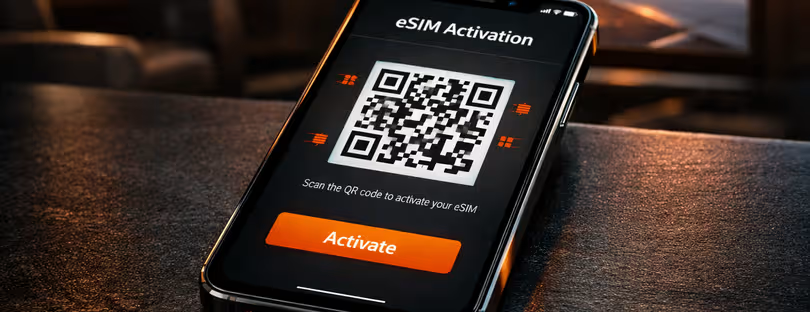
Instead of inserting a card, you download a mobile plan digitally. Usually by scanning a QR code or using an app.

Technically, it lives on something called an eUICC chip inside your phone. That chip can store multiple operator profiles and switch between them instantly.

So instead of carrying multiple SIM cards, your phone carries multiple identities.

That sounds simple. But it fundamentally changes how connectivity works.

The moment connectivity became software

The biggest shift with eSIM is not hardware. It’s control.

You no longer need a store, a contract desk, or even a local telecom operator to get connected. Everything becomes software-driven.

  • You land in Tokyo → scan a QR code → you’re online in seconds
  • You need a second number → download a new profile
  • You switch providers → no physical change required

That’s why many in the industry describe eSIM as the moment telecom started behaving like SaaS.

And for travelers, this is where the value becomes obvious.

Why travelers are driving eSIM adoption

If you look at where eSIM is actually growing fastest, it’s not traditional telecom markets. It’s travel.

More than half of eSIM users today adopt it specifically for travel use cases.

Why?

Because it solves three long-standing problems instantly:

No more roaming shock

eSIM allows you to bypass your home operator and buy local or global data plans. That alone reshapes roaming economics.

No more airport SIM hunting

You don’t need kiosks, queues, or cash. Connectivity becomes something you prepare before departure.

No more friction switching networks

You can move between countries without changing hardware.

This is why travel eSIMs are projected to grow rapidly over the next decade, with downloads expected to multiply several times by 2030.

But the story doesn’t stop at travel.

Yesim unlimited day plans

The hidden advantages most users overlook

Most people think eSIM equals convenience. That’s true, but incomplete.

There are deeper advantages that matter more over time.

Security

Because the SIM is embedded, it’s harder to remove, steal, or clone.

Multi-profile flexibility

Your phone can store multiple plans. Work, personal, travel. All in one place.

Environmental impact

No plastic cards, no packaging, no shipping. A small change, but at global scale it matters.

Instant provisioning

For businesses, this is huge. Devices can be deployed globally without physical logistics.

This last point is what’s quietly pushing eSIM beyond consumer travel.

From smartphones to infrastructure

eSIM is no longer just a phone feature.

It’s moving into:

  • Connected cars
  • IoT devices
  • Enterprise fleets
  • Wearables
  • Even industrial systems

By 2025, the number of connected devices globally is expected to exceed 75 billion, and eSIM is becoming a key enabler of that growth.

Think about that for a second.

Connectivity is no longer tied to a person. It’s tied to everything.

And eSIM is the layer that makes that scalable.

esim data

So why isn’t everyone using it yet?

Here’s the paradox.

Despite all these advantages, global adoption is still relatively low. Around 5% of connections in 2025.

That surprises a lot of people.

But when you look closer, it makes sense.

Fragmented support

Not all operators support eSIM properly. Especially in smaller markets.

Confusing onboarding

QR codes, activation steps, carrier limitations. It’s still not as seamless as it should be.

Consumer habits

People are used to physical SIM cards. Changing behavior takes time.

Device limitations

Although over 60% of new smartphones are now eSIM-compatible, the transition is still ongoing.

In short, the technology is ready. The ecosystem is still catching up.

The market is growing anyway

Even with slow adoption, the market trajectory is clear.

  • eSIM shipments grew significantly in 2025, with strong consumer activation growth
  • The global market is expected to expand rapidly, reaching multi-billion-dollar scale in the next decade
  • Travel remains the biggest entry point, but enterprise and IoT are the real long-term drivers

This is a classic pattern.

First comes the niche use case. Then the infrastructure shift.

We’re currently somewhere in the middle.

The new players reshaping the market

One of the most interesting aspects of eSIM is who is winning.

It’s not just traditional telecom operators anymore.

New categories have emerged:

Travel eSIM providers

Companies like Airalo, Holafly, Airhub, Ubigi, Yesim. They focus on global data and simple onboarding.

Connectivity platforms

Players offering APIs and white-label solutions. They don’t sell directly to consumers but power others.

Enterprises and OEMs

Car manufacturers, airlines, and device makers are embedding connectivity directly into products.

This is where it gets disruptive.

Because eSIM removes the physical barrier, anyone can become a connectivity provider.

And that changes the entire telecom value chain.

Where this is going next

If you zoom out, eSIM is part of a bigger shift.

Connectivity is becoming:

  • Invisible
  • On-demand
  • Embedded into products
  • Controlled by software

We are moving from “buying a SIM” to “activating connectivity.”

And eventually, even that step disappears.

Your device, your car, your hotel room. Everything just connects.

Automatically.

Conclusion: eSIM is not the end, it’s the transition

It’s tempting to think of eSIM as the final step in SIM evolution.

It isn’t.

It’s a bridge.

Between physical telecom infrastructure and fully digital connectivity layers.

Right now, the market is fragmented:

  • Travel eSIM providers compete on price and simplicity
  • Operators try to protect roaming revenue
  • Platforms build API-driven ecosystems
  • Device makers push toward eSIM-only hardware

Some players focus on unlimited plans. Others on flexibility. Some on enterprise-grade security.

But the direction is consistent.

Connectivity is becoming abstracted.

And once that happens, the real competition shifts.

Not who owns the network.

But who owns the customer relationship?

That’s why travel eSIM brands are growing so fast. That’s why platforms are emerging. And that’s why operators are starting to feel pressure.

The bigger picture is this.

eSIM is doing to telecom what cloud did to computing.

It removes friction, decentralizes control, and opens the market to new players.

And like cloud, the early phase looks messy.

Fragmented offers. Confusing onboarding. Competing standards.

But underneath that noise, something much bigger is happening.

Connectivity is becoming a layer you don’t think about anymore.

And when that happens, the companies that win won’t be the ones selling SIM cards.

They’ll be the ones redefining what connectivity means.

Driven by wanderlust and a passion for tech, Sandra is the creative force behind Alertify. Love for exploration and discovery is what sparked the idea for Alertify, a product that likely combines Sandra’s technological expertise with the desire to simplify or enhance travel experiences in some way.