The Rise of Travel Connectivity Startups
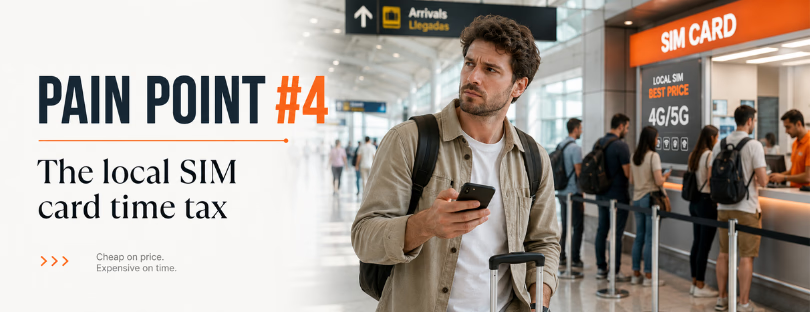
Let’s be honest — nobody misses the days of frantically hunting for a SIM card kiosk at a foreign airport after a 12-hour flight. Or worse, realizing your mobile data is draining €15 per megabyte because you forgot to turn off roaming. Those were the dark ages of travel connectivity — a mix of confusion, overpriced plans, and zero transparency.
Let’s update the narrative, because by 2026, this is no longer just a “cool travel tech trend.”
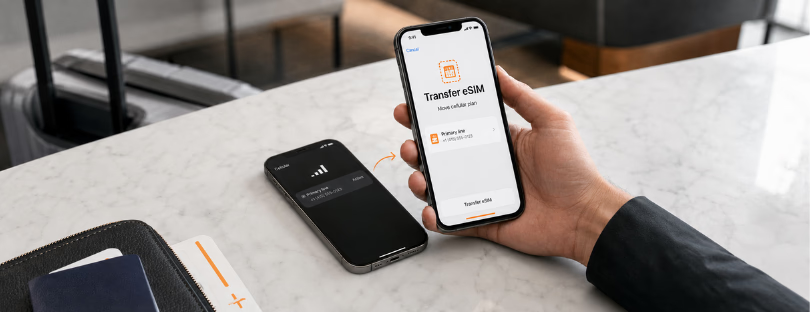
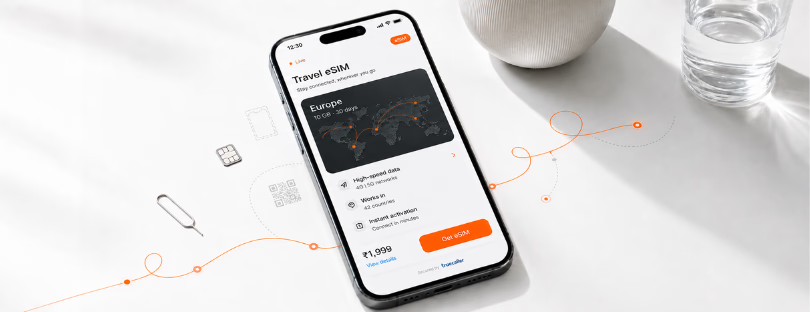
Travel connectivity startups have moved from the edges of telecom into something much bigger. They are no longer just selling eSIM plans. They are shaping how connectivity is packaged, distributed, and experienced globally.
And the shift is subtle but important.
This is no longer about avoiding roaming fees.
This is about who controls global connectivity in a world where movement is constant.
From eSIM Disruption to Category Creation
A few years ago, the pitch was simple:
“Download an eSIM. Save money on roaming.”
That worked. It got traction. It built the first wave of companies like Airalo, Holafly, Nomad, and Yesim.
But in 2026, that message is almost too basic.
Because the real shift is that travel connectivity is no longer a feature. It’s becoming its own category.
What startups realized before telecom operators did is this: travelers don’t think in terms of networks or carriers. They think in terms of outcomes.
“I need internet when I land.”
“I need to stay connected across multiple countries.”
“I don’t want to think about it.”
That mindset is what allowed startups to repackage connectivity into something simpler, more flexible, and more aligned with how people actually move.
The New Layer: Connectivity as a Product
Here’s what changed between 2023 and 2026.
Startups stopped acting like resellers. They started acting like product companies.
Instead of just listing data plans, they began designing experiences: global plans that don’t reset at borders, day-based usage instead of rigid validity periods, auto-top-ups and spend caps to remove bill shock, and interfaces that actually show real usage instead of hiding limitations.
This is where subscription logic and structured models started gaining traction.
It’s also where companies like Yesim began positioning themselves not just as providers, but as infrastructure layers.
And that’s a big shift.
Because once you move from selling plans to building infrastructure, you’re no longer competing on price. You’re competing on how the system works.

Distribution Is the Real Battlefield
If you want to understand where the market is going in 2026, don’t look at pricing. Look at the distribution.
Because the biggest question now is not who has the best eSIM. It’s who owns the moment when connectivity is needed.
And that moment is increasingly happening before travelers even think about buying an eSIM.
We’re seeing connectivity embedded into airline booking flows, banking and fintech apps, travel platforms and OTAs, corporate travel tools, and even hotel check-in experiences.
This is where companies like Airhub are quietly winning.
They’re not just selling to travelers. They’re enabling other companies to sell connectivity.
And when that happens, something interesting occurs.
The end user might not even know which provider they’re using.
Which raises a real question for the industry. Is that a distribution win or a branding failure?
The Death of “Cheap eSIM” Positioning
One of the biggest misconceptions still floating around is that this market is about price. It’s not.
In fact, 2026 is proving the opposite.
The “cheap eSIM” model is starting to break down under its own logic.
Customer acquisition costs are rising fast. Users are more experienced and less price-sensitive. Poor performance leads to churn, not loyalty. And many unlimited plans still come with hidden limitations.
What’s emerging instead is a shift toward value-based positioning. Predictability over raw price. Performance over headline discounts. Transparency over marketing claims.
That’s why you’re seeing more structured pricing models, usage tiers, and hybrid subscription logic entering the market.
The industry is moving away from cheap data toward reliable global connectivity systems.
B2B Is Where the Real Growth Is Happening
If you only look at consumer eSIM apps, you’re missing half the story.
The real acceleration in 2026 is happening in B2B.
Enterprises, travel platforms, fintech companies, and mobility providers all have the same realization. Connectivity is not a side feature. It’s part of the core user experience.
And startups are stepping in to provide that layer.
We’re seeing corporate eSIM management platforms for employee travel, white-label solutions for airlines and travel brands, API-based connectivity embedded into financial apps, and IoT and fleet connectivity expanding beyond traditional telecom.
This is where companies like SureSIM are pushing a different narrative.
Not travel convenience, but operational continuity, control, and risk management.
Because if your team loses connectivity during a critical moment, that’s no longer a tech issue. It’s a business risk.
The Infrastructure Shift Nobody Talks About
There’s another layer most people don’t see yet.
Behind all these startups, a new type of ecosystem is forming.
It includes eSIM provisioning platforms, MVNE and MVNO infrastructure players, API connectivity layers, global wholesale agreements, and satellite connectivity experiments.
This is where things get serious.
Because the companies that control this layer don’t just sell connectivity. They enable entire markets.
And in 2026, we’re starting to see a quiet shift where retail brands become distribution fronts, infrastructure players become power centers, and APIs become the real product.
It’s very similar to what happened in fintech. You don’t see the infrastructure, but it powers everything.

What Comes Next: Intelligent, Invisible Connectivity
The next phase is already forming.
And it’s not about more plans or more providers.
It’s about removing the need to choose at all.
Connectivity is becoming context-aware, automatically activated, integrated into travel flows, and invisible to the user.
AI will play a role here, but not as a flashy feature. It will act as a decision layer that optimizes connectivity in the background.
At the same time, satellite connectivity is entering the conversation, not as a replacement for mobile networks, but as a fallback layer.
Which means the future stack looks like local mobile networks for performance, eSIM platforms for orchestration, and satellite for coverage gaps.
And the user does not think about any of this. They just stay connected.
Why This Shift Matters More Than It Seems
It’s easy to look at travel connectivity startups and think this is just a niche. It’s not.
This is one of the clearest examples of how legacy industries get rebuilt. You start with a painful user problem, simplify the experience, repackage the product, expand into infrastructure, and capture distribution.
We’ve seen it in banking. We’ve seen it in mobility. Now we’re seeing it in telecom.
And travel is just the entry point.
Because once you solve connectivity for travelers, you’re one step away from solving it for enterprises, devices, vehicles, and entire digital ecosystems.
Conclusion
The rise of travel connectivity startups in 2026 is no longer about eSIMs. That was just the entry point.
What we’re actually watching is the early stage of a much bigger transformation.
Connectivity is being unbundled from telecom operators and rebuilt as a flexible, software-driven, globally distributed service.
Startups are not just competing with telcos anymore. They are redefining what a telecom product even is.
And the winners will not be the ones with the cheapest plans.
They will be the ones who control distribution, build infrastructure, simplify the experience, and ultimately disappear into it.
Because the endgame is not better connectivity. Its connectivity you don’t have to think about at all.