Telenet eSIM: What Belgian Users Should Know
Telenet’s smartphone eSIM launch is not the loudest telecom move in Europe, but it is a practical upgrade that matters more than it first appears. For Belgian customers, the point is simple: your mobile subscription no longer has to wait for a plastic card, a postal delivery, or a tiny SIM tray tool.
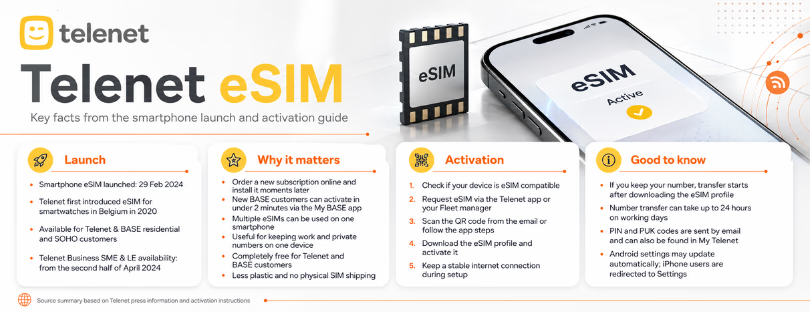
Telenet and BASE launched eSIM for smartphones after already offering eSIM support for smartwatches through Telenet One Number. That timing matters. It shows Belgium moving from eSIM as a premium wearable add-on to eSIM as normal mobile infrastructure.
A quieter kind of upgrade
The most useful thing about Telenet eSIM is not that it sounds modern. It is that it removes friction from mobile life. A new subscription can be ordered online, the eSIM profile can be downloaded, and the device can be activated without waiting for a physical SIM card. BASE has pushed this even further, saying new customers can order and activate a mobile subscription in less than two minutes through the My BASE app.
That is where eSIM changes onboarding. For operators, it cuts logistics. For customers, it reduces the gap between “I bought a plan” and “my phone works.” That gap used to be accepted as normal. Now it looks increasingly outdated.
Telenet’s instructions are fairly straightforward: check device compatibility, scan the QR code received by email or request the eSIM through the Telenet app, download the profile, and activate it. Android users may see settings updated automatically, while iPhone users are redirected into the device settings. The company also reminds users to keep a stable internet connection during setup, which sounds obvious, until you remember how many eSIM problems start with weak Wi-Fi and impatience.
Where it works best
Telenet eSIM makes most sense for customers who live in Belgium, already use Telenet or BASE, and want their main mobile number on a compatible smartphone without the physical SIM step. It is also useful for people juggling work and private numbers on one device. Since multiple eSIM profiles can sit on the same smartphone, switching between lines becomes less awkward than carrying two phones or swapping cards.
For business users, this matters even more. Fleet managers do not want mobile provisioning to feel like office stationery management. Digital SIM activation gives companies a cleaner way to onboard employees, replace lost phones, or move numbers across compatible devices. Telenet says business availability followed for SME and large enterprise customers, where eSIM should become normal mobile operations rather than a niche request.
Still, this is not automatically the right solution for everyone. If you use an older phone, change devices often without checking transfer rules, or need a temporary data plan for travel outside Belgium, a local operator eSIM may not be the most flexible option. Travel eSIM providers can still be better for short trips, especially when the goal is quick data abroad without touching your domestic number.
What still needs polishing
The weak point is not the eSIM idea itself. It is the customer experience around it. Across the telecom market, setup can still feel too dependent on QR codes, compatibility lists, PIN and PUK handling, and small differences between iOS and Android. Telenet’s instructions are clear enough, but the category still needs fewer “read this before activation” moments.
Number transfer is another point to watch. Telenet notes that if customers keep their number, the transfer starts as soon as the eSIM profile is downloaded and can take up to 24 hours on working days. That is normal in telecom terms, but for users it can still feel uncertain. A smoother status tracker inside the app would make the experience feel more digital and less administrative.
The Belgian eSIM picture
Telenet is not alone here. Proximus supports eSIM and promotes digital activation, while Orange Belgium has been active around eSIM for business customers, especially for remote workers and mobile fleets. The competitive direction is obvious: Belgian operators are no longer treating eSIM as an exotic feature. They are using it to modernise acquisition, reduce logistics, and prepare for a device market where SIM trays matter less.
The GSMA frames eSIM as part of remote SIM provisioning, allowing operator profiles to be downloaded and managed digitally. That sounds technical, but the commercial meaning is simple: the SIM is becoming software. Once that happens, the battle shifts from “who can mail a SIM card fastest?” to “who can make activation, transfer, support, and multi-device use feel effortless?”
Conclusion
Telenet eSIM is a sensible, overdue move rather than a flashy revolution. And that is exactly why it matters. The strongest eSIM experiences will not be judged by whether they use the word digital, but by how little the customer has to think about the SIM at all.
For Belgian residents inside the Telenet or BASE world, this is a clean upgrade. For frequent travellers, it may sit best alongside a dedicated travel eSIM rather than replace one. For businesses, the real value is not the plastic saved, although that helps. It is the slow disappearance of manual mobile admin.
The bigger trend is clear: operators, travel eSIM brands, and enterprise connectivity platforms are all moving toward the same expectation. Connectivity should be activated in minutes, managed from an app, and changed without drama. Telenet is now properly part of that shift. The next test is not availability. It is elegance.
Also, be aware that each Android Smartphone Can Be Upgraded To ESIM With ESIM.Me