T-Mobile Boosts Miami: More Network, 5G for Football
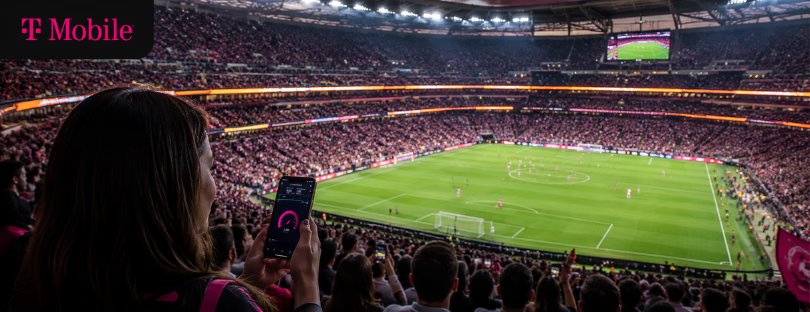
With 150,000 people predicted to travel to Miami for Super Bowl LIV events, T-Mobile focused network enhancements where the biggest crowds will be, including Hard Rock Stadium, Miami Beach Convention Center, Bayfront Park, Miami Beach, and Miami and Fort Lauderdale airports. And almost all the updates are permanent, so Miami residents and visitors can enjoy the improvements long after the Super Bowl is over.
T-Mobile has more than doubled LTE capacity at Hard Rock Stadium, so customers can stream, tweet, post and chat about every big moment from the game. To enhance indoor capacity at key venues throughout Miami, T-Mobile built new distributed antenna systems (DAS) and deployed small cells throughout the city to provide additional performance boosts in places that can be difficult for towers to reach.
Almost all of Miami is covered with T-Mobile’s far-reaching low-band 5G and fast LTE, so whether customers watch the game from the couch or the beach, they’ll be ready to share the action. In addition to launching broad 5G coverage last month, T-Mobile has newly deployed millimeter-wave 5G for customers with capable smartphones in parts of Miami, including nearly all of Bayfront Park and at Hard Rock Stadium in the lower bowl, parking lot and main entrances.
To ensure customers with compatible smartphones know where they can access 5G in Miami, T-Mobile has an interactive map of its nationwide low-band 5G to show where coverage is available down to the neighborhood level and created new millimeter wave maps for the city.
Only T-Mobile has a nationwide 5G network that works for more people in more places. The Un-carrier’s 5G network covers more than 1 million square miles, with much of that in rural America. This foundational layer of 5G provides far reaching coverage that can travel into buildings and work indoors and out. And now, the Un-carrier has millimeter wave 5G deployed in parts of seven cities for speedy, hotspot-like coverage outdoors in dense urban areas.
If T-Mobile’s merger with Sprint closes, the new T-Mobile will have the ability to build on this foundation by adding critical mid-band spectrum for far-reaching coverage and performance as well as additional millimeter wave spectrum for blazing fast speeds in dense urban areas. Only this combination of low, mid, and high spectrum will deliver a 5G network with both coverage breadth and depth of performance. T-Mobile expects devices capable of tapping into the low, mid, and high band spectrum to become available this year and expects to launch more than 15 new 5G smartphones in 2020 with a variety of price points and features.