T-Mobile eSIM: A Smarter Way to Connect in the U.S.
T-Mobile’s eSIM story is not really about the technology anymore. That part is becoming normal. The more interesting story is how quickly eSIM has moved from a “nice digital option” into the default way many people expect mobile service to work, especially in the United States.
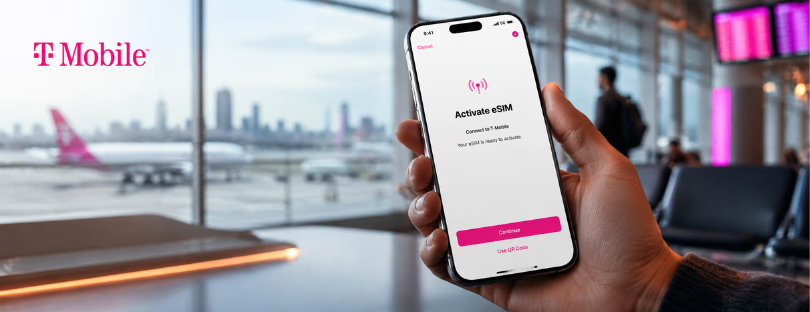
For travelers, temporary residents, students, remote workers, and anyone landing in the U.S. with an unlocked compatible phone, T-Mobile’s prepaid eSIM offer is a practical example of where the market is heading. No plastic SIM. No shop visit. No waiting for a card. You download the T-Mobile Prepaid eSIM app, check compatibility, pick a prepaid service, and activate directly on the device.
That sounds simple, and in many cases it is. But as always with eSIM, the small print matters more than the slogan.
Built for quick U.S. connectivity
T-Mobile’s prepaid eSIM page is clearly aimed at people who need U.S. mobile service without friction. The company positions it especially for international visitors and travelers, with 30 days of unlimited talk, text, and data starting from $50, plus taxes and fees. It also points users toward the T-Mobile Prepaid eSIM app as the starting point.
This is a smart move. Visitors to the U.S. are often caught between expensive roaming from their home operator, airport SIM kiosks, and travel eSIM apps that may offer data only. T-Mobile’s version has one obvious advantage: it is not just a travel eSIM profile riding on wholesale access. It is a prepaid service from a major U.S. network operator.
READ MORE: T-Mobile Launches U.S. Travel eSIM for Visitors
That matters for people who need more than casual browsing. A traveler attending a trade show in Las Vegas, a student arriving for a semester, or a business visitor spending a month between New York and Miami may prefer the reassurance of a local operator connection, especially if talk and text are part of the package.
At the same time, this is not necessarily the cheapest option for every visitor. Someone who only needs 3GB for maps, WhatsApp, Uber, and email could find a lighter travel eSIM plan for less. T-Mobile’s offer makes more sense when the trip is longer, usage is heavier, or having a local-style mobile setup is worth paying for.
The compatibility catch
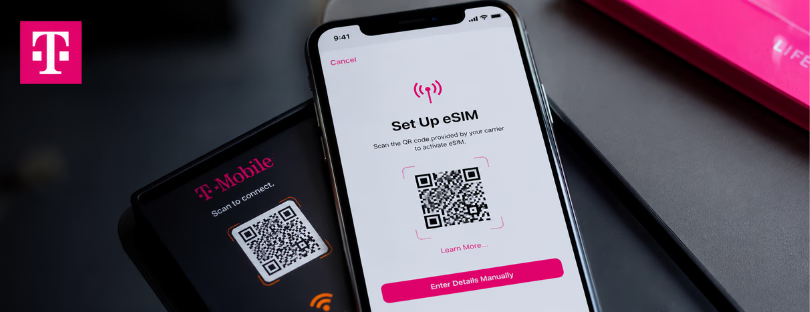
The part many users still underestimate is compatibility. T-Mobile’s support pages make it clear that eSIM depends on the device, the activation path, and whether the phone is eligible to connect to the network. If you bring your own phone, T-Mobile also advises checking network compatibility and making sure the device is unlocked.
This is where eSIM still has a slightly awkward reality. The industry talks about digital activation as if every phone is ready. In practice, not every phone supports eSIM, not every eSIM phone supports every network band well, and not every device bought through another carrier is unlocked.
For iPhone users in the U.S., eSIM is already familiar because recent U.S. iPhone models pushed the market hard in that direction. Android users are also increasingly well served, but the experience can vary by model, software version, and region. That is not T-Mobile’s problem alone. It is an industry problem. eSIM is simple when everything lines up. When it does not, users still need proper support.
Why T-Mobile’s approach matters
T-Mobile has an advantage that many travel eSIM brands do not: it owns the customer relationship and the network experience. Travel eSIM providers usually compete on price, destination coverage, app design, and flexibility. T-Mobile competes differently. Its prepaid eSIM is more about becoming the first local connection a visitor activates when arriving in the U.S.
That is a stronger position than it may look at first. The U.S. has become one of the world’s most advanced consumer eSIM markets, helped by device availability and operator support. GSMA Intelligence has noted that global smartphone eSIM adoption has been slower than early forecasts, but the U.S. is a clear exception, with much stronger adoption after eSIM-only iPhones entered the market.
READ MORE: Best USA eSIM 2026: Congestion & Latency Tested
This creates a useful signal for the rest of the world. eSIM adoption does not grow just because the technology exists. It grows when devices, operators, apps, customer support, and user habits finally meet in the same place.
Not the only smart route
For U.S. connectivity, T-Mobile is not alone. Verizon and AT&T also support eSIM and have their own prepaid or activation paths. Travel eSIM brands such as Airalo, Holafly, Ubigi, Nomad eSIM, Saily, and GigSky offer an alternative angle: faster comparison, multi-country plans, and usually a more travel-native buying experience.
The difference is intent. If the traveler wants a U.S. operator plan with talk, text, and heavier data, T-Mobile’s prepaid eSIM is a serious option. If the traveler wants the cheapest possible data for a short visit, a travel eSIM marketplace may be easier to compare. If the user needs one eSIM across several countries, T-Mobile’s U.S.-focused prepaid approach may feel too narrow.
That is not a weakness exactly. It is a positioning choice. T-Mobile is not trying to be a global travel eSIM aggregator. It is offering fast entry into its own U.S. network.
What could be smoother?
The biggest improvement opportunity is clarity. Operators still tend to explain eSIM from their own system perspective, while users think in practical questions: Will this work on my exact phone? Can I activate before I travel? Do I need Wi-Fi? What happens if activation fails? Can I move the eSIM to another device? Is hotspot included on this plan?
T-Mobile answers some of this across its support ecosystem, but the user journey would be stronger if the prepaid eSIM path felt more like a traveler checklist than a carrier support flow. Travel eSIM apps have trained customers to expect quick comparisons and simple plan logic. Operators now need to match that level of clarity, not just the technology.
Conclusion
T-Mobile’s eSIM offer shows where mobile connectivity is going: less plastic, less waiting, and more direct activation. But it also shows the split forming in the market. Traditional operators are good at trusted local service, voice, text, and network ownership. Travel eSIM providers are good at speed, comparison, and cross-border convenience.
For Alertify readers, the best choice depends on the trip. T-Mobile prepaid eSIM is a strong fit for people spending meaningful time in the U.S. who want a recognizable network experience and do not want to gamble with roaming bills. It is less compelling for ultra-light users, multi-country trips, or travelers who only need a small data bundle for a few days.
The bigger trend is clear: eSIM is no longer a feature. It is becoming the front door to mobile service. The winners will not simply be the companies that support eSIM. They will be the ones that make activation feel obvious, pricing feel honest, and connectivity feel dependable when the traveler is tired, jet-lagged, and standing at arrivals with one bar of roaming left.