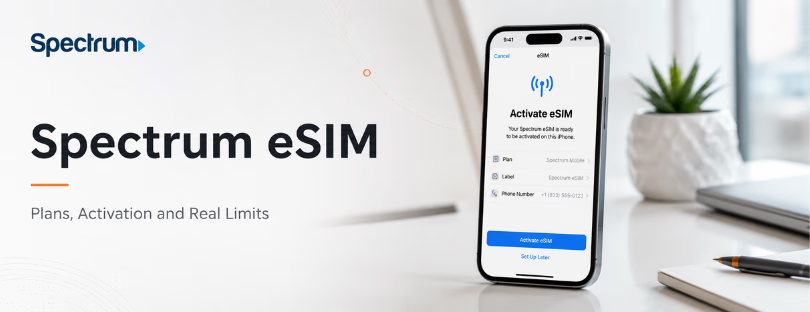
Spectrum eSIM: Plans, Activation and Real Limits
Spectrum Mobile’s eSIM offer is not trying to be the flashiest mobile story in the U.S. market. That is probably its strongest point.
In a market full of trade-in conditions and confusing promotional math, Spectrum is selling something simple: mobile service for existing Spectrum Internet customers, activated digitally on supported devices, without waiting for a plastic SIM card. Spectrum’s own eSIM page frames it that way, with online activation, compatible unlocked devices, and all Spectrum Mobile plans supporting eSIM.
That does not make Spectrum eSIM a travel eSIM in the Airalo or Holafly sense. It is a domestic plan first. The eSIM is just the delivery method. But for the right user, especially someone already tied into Spectrum’s broadband ecosystem, that can be enough.
What Spectrum is really offering
Spectrum Mobile operates as an MVNO, with service running on Verizon’s network. That matters because the value proposition is not only about cheap mobile data. It is about getting a mainstream U.S. mobile line with broad network access, but through a cable operator bundle rather than a traditional carrier relationship.
The plan structure is easy to understand. Spectrum lists By the Gig at $20 per month for the first GB, with additional data charged per GB. Unlimited is positioned at $30 per month, with unlimited talk, text and data, reduced speeds after 30 GB, and hotspot speeds reduced after 5 GB. Unlimited Plus sits at $40 per month, with reduced speeds after 50 GB and hotspot speeds reduced after 10 GB. Spectrum also says roaming in Mexico and Canada is included on Unlimited Plus.
READ MORE: Spectrum Mobile Turns Dual eSIM Into a Second Line
The important detail is that Spectrum Mobile requires Spectrum Internet. That makes the offer less universal than a pure prepaid carrier or travel eSIM app. It is not really built for someone landing in New York for five days and wanting instant data. It is built for households that already buy Spectrum internet and want mobile inside the same ecosystem.
The activation story
The eSIM experience is where Spectrum starts to feel more modern. Instead of waiting for a physical SIM, users can activate eligible devices online or through Spectrum’s support flow. Spectrum describes a three-step process: select a compatible device, choose a plan, then activate through the online portal or in-store.
That sounds clean, and in many cases it should be. Still, the “compatible device” part deserves attention. Spectrum says eSIM support applies to selected iPhones, iPads and Samsung models, while Holafly’s review also notes that device support is not universal across all eSIM-capable phones. That is not unusual for U.S. MVNOs, but it can irritate users who assume “my phone supports eSIM” automatically means “my carrier will support eSIM on this phone.”
This is where Spectrum could improve the experience: clearer compatibility messaging before checkout. eSIM should reduce friction, not move it to a different screen.
Good for locals, weaker for visitors
For U.S. residents already using Spectrum Internet, Spectrum eSIM can be a neat option. The pricing is competitive, the plan names are simple, and the Verizon network relationship gives it credibility. A family may find the By the Gig model useful for light users, while heavier users will naturally look at Unlimited or Unlimited Plus.
But for international travelers visiting the U.S., Spectrum is less convincing. The internet requirement alone narrows the audience. A visitor cannot treat it like a normal travel eSIM, install it before departure, and use it immediately after landing. For that use case, travel-first providers such as Holafly, Airalo, Ubigi, Nomad eSIM, Yesim or GigSky are usually more practical because they are built around short-term access, app-based purchase and fast installation without a domestic broadband relationship.
Spectrum’s plans are mobile service plans, not lightweight travel data passes. That is good if you need a real U.S. line and a monthly arrangement. It is less attractive if you only need data for a conference, road trip or temporary stay.
The market signal
Spectrum’s eSIM push shows how cable operators are becoming more serious mobile players. Xfinity Mobile follows a similar logic: use home broadband as the anchor, then add mobile service as a retention and value layer. In that model, eSIM is not a standalone product. It is a tool that makes onboarding faster and reduces operational friction.
eSIM started as a convenience feature for high-end phones and travelers. Now it is becoming a default activation layer for operators, MVNOs and cable brands. The winners will not be the companies that simply say “we support eSIM.” The winners will be the ones that make the whole journey feel obvious: compatibility, pricing, activation, transfer and support.
Conclusion about Spectrum eSIM
Spectrum eSIM is best understood as a strong domestic add-on, not a global travel connectivity solution. Compared with Verizon, AT&T or T-Mobile, Spectrum’s advantage is price simplicity for existing internet customers. Compared with travel eSIM providers, its weakness is obvious: it is not built for tourists, digital nomads or people who want connectivity without a U.S. service relationship.
That does not make it a bad offer. It makes it specific. Spectrum serves the home-connected customer who wants mobile to be cheaper, cleaner and easier to activate. Carriers and cable MVNOs are making eSIM part of everyday mobile service, while travel eSIM brands are turning it into a borderless connectivity product. Spectrum sits firmly in the first camp.