Why Travel eSIMs Aren’t the Real Threat to Roaming Revenues — Silent Roamers Are
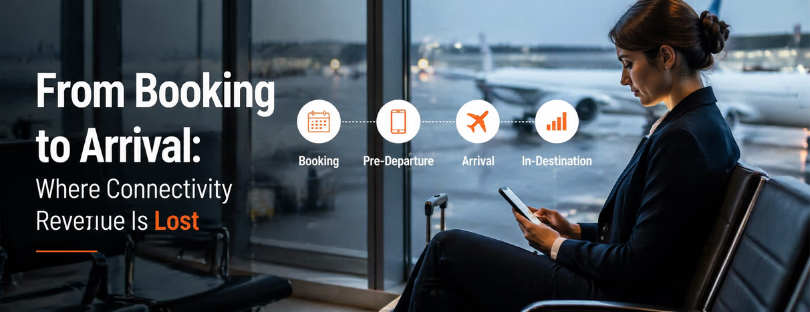
Kaleido’s newest research has landed at a very interesting moment for the roaming industry. According to its latest Roaming Data Hub, there is a $1.5 billion “silent roamer” opportunity sitting largely untapped. These are travellers who still rely on their home operator abroad but dramatically limit usage due to fear of costs, unclear pricing, or poor performance. In a world flooded with travel eSIM ads and price-led offers, that group may well decide the future of retail roaming growth. silent roamer market
This is not just another market forecast. It is a warning shot and a roadmap rolled into one.
A travel economy pulled in two directions
The 2026 travel landscape is shaped by a clear tension. On one side, a cautious global economy is still recovering from inflation shocks. On the other hand, a traveller who expects everything to be digital, flexible, and instant.
People are travelling again in large numbers, but they are far less willing to overpay for convenience. Connectivity has moved from an afterthought to a deliberate decision made before boarding a flight. That shift alone explains why traditional roaming revenues are under pressure and why travel eSIM churn keeps rising.
Bill shock, once a reliable revenue lever, has become a reputational liability. Consumers have learned, and many have moved on.
Global mobility is back, but it looks different
International tourism has proven far more resilient than many expected. Building on the rebound of 2024 and 2025, global mobility continues to grow, led by regions that combine economic momentum with rising outbound travel.
South Asia and Southeast Asia are standout performers. India is projected to grow by 6.6 percent, while Vietnam has emerged as the fastest-growing economy in the Asia Pacific. These markets are not just producing more travellers. They are producing more digitally savvy travellers.
Motivation matters too. Kaleido’s research highlights the rise of “whycations”, trips driven by personal meaning rather than status. There is also “hushpitality”, a move toward quiet destinations, secondary cities, and lower stimulus travel in response to overtourism.
For travellers heading off the beaten path, reliable connectivity is not optional. It is navigation, safety, payments, work, and access rolled into one. That makes cost-effective and predictable mobile data even more critical.

The eSIM tipping point is already behind us
eSIM is no longer a feature. It is infrastructure.
By 2025, 60 percent of all smartphones sold globally will be eSIM compatible. Today, more than 3 billion connections rely on eSIM technology. In markets like China and India, 27 percent and 22 percent of travellers respectively have already switched to digital-first roaming alternatives.
That is not a trend. That is a structural shift.
For mobile network operators, this creates an uncomfortable reality. The traditional roaming model is losing relevance exactly where outbound growth is strongest. Meanwhile, specialist travel eSIM brands are winning on simplicity, transparency, and app based experiences.
MVNOs, on the other hand, are finding opportunities. eSIM allows them to cut distribution costs, move faster, and experiment with new pricing models without legacy constraints. What started as a niche differentiator has become a core strategic asset.
IoT roaming quietly changes the game
While consumer roaming grabs headlines, Kaleido’s data shows that the real scale story is happening in cellular IoT.
By the end of 2025, the cellular IoT market reached 4.1 billion connections, adding one billion connections in just two years. Growth is averaging 15 percent annually, with forecasts pointing toward nearly seven billion connections by 2030.
More than half of newly provisioned IoT connections by the end of the decade will use eSIM. The GSMA’s SGP.32 specification plays a crucial role here, offering long-term flexibility against regulatory and commercial risk.
Despite the technical ability to localise connectivity via eSIM, roaming will continue to underpin a significant share of IoT deployments. In many cases, existing mobile infrastructure already meets performance, latency, and data sovereignty requirements without the complexity of frequent profile switching.
Satellite connectivity adds another layer. Once dismissed as too expensive, satellite is now the second most favoured wide area IoT technology. Over half of industry leaders now see it as a viable mainstream solution. In practical terms, this means fewer dead zones and truly global coverage.
For enterprises, the impact is tangible. Zero-touch provisioning for NB IoT and LTE M becomes possible at scale. Devices can be deployed anywhere and managed remotely, reducing operational overhead and total cost of ownership.


Retail roaming can no longer hide behind margins
The message for mobile operators is blunt. The high-margin, high-friction roaming model is finished.
Consumers have alternatives, and they are using them. Competing purely on legacy pricing structures is no longer viable, especially when travel eSIM providers have reset expectations around ease of use and transparency.
To stay relevant, operators need to rethink what retail roaming actually offers.
Own the digital experience
The operator app must evolve into a true travel companion, or operators must partner intelligently with eSIM platforms and super apps that already own the user journey. Control of the interface means control of trust.
Monetise performance, not fear
Tiered bundles built around streaming, gaming, video calls, and work applications allow operators to charge for quality of service rather than raw data volume. 5G Standalone makes this technically possible, but only if it is packaged in a way consumers understand.
Make pricing boring again
The biggest deterrent to roaming remains uncertainty. Clear, predictable pricing competes directly with travel eSIM offers and removes the psychological barrier that keeps silent roamers silent.
The opportunity is not theoretical. Kaleido estimates that a digital-first roaming strategy could unlock at least $1.5 billion in incremental revenue from silent roamers alone.
Where this leaves the market
Compared with pure travel eSIM players like Airalo, Nomad, or Yesim, traditional operators still hold powerful advantages. Network ownership, existing customer relationships, and billing integration are not small assets. But those advantages only matter if they are activated through better digital experiences.
We are also seeing convergence. Some operators are launching app-based travel passes that closely resemble eSIM offers. At the same time, eSIM providers are adding enterprise features, multi-device management, and even limited voice services.
The gap is narrowing from both sides.
Reliable sources like GSMA, Kaleido Intelligence, and industry data from Ericsson Mobility Reports all point in the same direction. Connectivity is becoming platform-driven, experience-led, and performance-priced.
Conclusion about the silent roamer market
The roaming industry in 2026 is not facing disruption. It is facing a choice.
Operators can continue defending a shrinking legacy model while travel eSIM brands absorb the next generation of travellers. Or they can redefine retail roaming as a digital service that competes on clarity, performance, and trust.
The silent roamer is not silent because they do not need data. They are silent because the industry trained them to be cautious. Whoever solves that trust gap first, whether an operator, MVNO, or eSIM native player, will define the next phase of global roaming.
And this time, the growth is not hidden. It is waiting to be unlocked.