Samsung Pay App Moves Beyond Mobile Payments
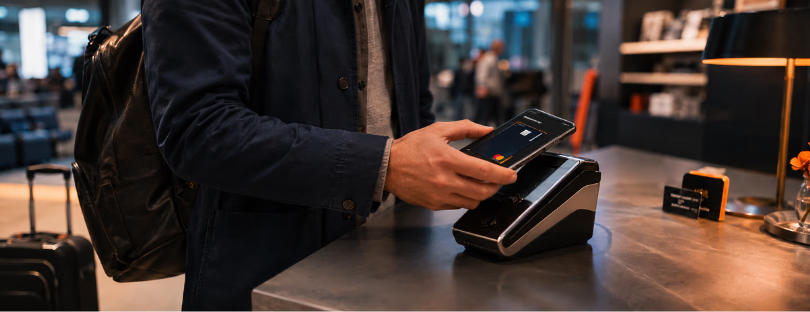
Samsung Pay used to be easy to explain. Add your card, tap your phone, pay at the terminal, and leave your wallet in your bag.
That story is now too small.
Samsung has folded Samsung Pay into Samsung Wallet, and that shift says a lot about where mobile payments are heading. The payment app is no longer just a faster way to use a bank card. It is becoming a control point for identity, travel documents, loyalty, keys, boarding passes, and everyday access. Samsung describes Wallet as a place to store credit cards, ID cards, keys, boarding passes and more, while Samsung’s support page still keeps the Samsung Pay name alive for users looking for help with payments.
For travellers, this matters more than it sounds. The phone is already the boarding pass, hotel key, navigation tool, translator, camera, eSIM manager and emergency contact device. Payments are just one part of that stack. Samsung is trying to make Wallet the place where the practical parts of travel sit together.
From card replacement to travel layer
The real value of Samsung Pay is not that it replaces a plastic card. Contactless cards already do that job very well. The value is that the payment function sits inside a device that knows where you are, what apps you use, what trip you are on, and which services you need next.
Samsung Wallet can store payment cards, loyalty cards, boarding passes and digital keys, depending on country, device and partner support. Samsung also says users can pay in person, online or in apps once cards are added.
That makes the app more interesting in a travel context. Think about the first hour after landing. You need transport, coffee, a train ticket, maybe a hotel check-in, maybe a local SIM or eSIM top-up. The wallet is not just a payment tool anymore. It becomes part of the arrival experience.
This is why mobile wallet strategy now overlaps with travel technology. The winner is not simply the app with the cleanest payment animation. The winner is the platform that sits closest to the traveller’s real moments of need.
Samsung’s advantage is hardware intimacy
Samsung’s biggest advantage is obvious but often underestimated: it owns the device experience for millions of Galaxy users.
That gives Samsung a natural route into payments, watches, biometrics, secure storage and quick access gestures. Samsung says Wallet can be launched with Quick Access, and the app combines Samsung Pay features with Samsung Pass, keys and other digital items.
This is not just convenience. It is distribution.
Apple has Apple Wallet deeply integrated into iPhone and Apple Watch. Google has Google Wallet across Android. Samsung sits in a slightly different position because it operates inside Android, but with its own Galaxy ecosystem layered on top. That creates both opportunity and friction.
The opportunity is loyalty. Galaxy users who already trust Samsung for phones, watches and wearables may accept Samsung Wallet as the natural default.
The friction is duplication. Many Android users already have Google Wallet. Banks also push their own apps. Airlines push their own apps. Hotels push their own apps. Fintechs push their own apps. The modern traveller is not short of wallets. They are short of patience.

Apple Pay and Google Wallet set the benchmark
Samsung is not competing in a quiet category.
Apple Pay has become almost invisible in the best possible way. In many cities, Apple Wallet works for transit with tap-and-go convenience, and Apple highlights that users can ride without unlocking the device in supported systems.
Google Wallet is also trying to become the Android layer for cards, passes, IDs, tickets and transit. For many users, especially outside Samsung’s most loyal Galaxy base, Google has the advantage of being the default Android service.
Samsung’s challenge is therefore not whether Samsung Pay works. It does. The bigger challenge is whether users see enough reason to choose Samsung Wallet over Google Wallet on the same phone.
That is a subtle but important distinction. Payment apps are not judged only by features. They are judged by habit. Once someone has a default wallet, changing it requires a strong reason.
Security is the trust engine
No wallet can win without trust.
Mobile payments rely heavily on tokenisation, biometrics and secure device-level authentication. EMVCo explains that payment tokenisation replaces the primary account number with a unique token that can be limited to a specific device, merchant or payment scenario. That is one reason wallet payments can be safer than handing around raw card credentials.
This is where Samsung’s device-level story matters. If the wallet is protected by biometrics, secure hardware and tokenised payments, it becomes more than a convenient app. It becomes a trusted access layer.
But trust is fragile. Wallet fraud does not always happen because the tap-to-pay technology is broken. It can happen during card provisioning, phishing, weak bank verification or social engineering. That means Samsung, Apple and Google all depend on banks, card networks and issuers doing their part properly.
For travellers, the practical advice is simple: use biometrics, avoid sharing one-time codes, keep the device updated, and make sure card alerts are switched on before travelling.
Why this matters for Alertify readers
The Samsung Pay app story is really a bigger story about where consumer technology is moving.
Payments are merging with identity. Wallets are merging with travel documents. Phones are becoming the control panel for mobility, connectivity and access. And this is exactly where travel tech, fintech and telecom start to overlap.
A traveller no longer thinks in separate categories: payment app, airline app, hotel app, eSIM app, banking app. They think: “Can I land, move, pay, connect and check in without friction?”
That is the new benchmark.
Worldpay’s recent payments reporting shows digital wallets continuing to dominate global payment growth, accounting for a major share of both e-commerce and point-of-sale value in 2025. That trend explains why Samsung, Apple and Google are not treating wallets as small utility apps. They are treating them as front doors.
The real conclusion
Samsung Pay is still useful as a payment product, but Samsung Wallet is the more important story.
Apple has the strongest closed ecosystem. Google has the broadest Android logic. Samsung has something slightly different: a premium hardware base, Galaxy loyalty, wearables, and a chance to make Wallet feel native to the everyday Samsung user.
The problem is that “works well” is no longer enough. Every serious wallet works well. The next battle is about context: who owns the airport moment, the hotel check-in moment, the transit gate, the loyalty card, the identity credential, and eventually the connectivity offer.
For travel brands, banks, eSIM providers and hospitality platforms, this is worth watching closely. Samsung Wallet is not just another payment app sitting on a phone. It is part of a broader shift where the mobile wallet becomes the traveller’s operating layer.
And once the wallet becomes the operating layer, everyone else has to ask a harder question: are you part of that moment, or are you just another app waiting to be opened?