Roamless Flexible Travel Internet: Why It Matters
Travel eSIMs used to be sold like small digital SIM cards: pick a country, choose 3GB or 5GB, activate, hope you bought enough, and repeat the same thing on the next trip. Roamless is pushing a slightly different idea. Instead of treating every journey as a separate purchase, it wants travelers to think of mobile data as a flexible balance that follows them around.
That sounds simple, but it is a meaningful shift.
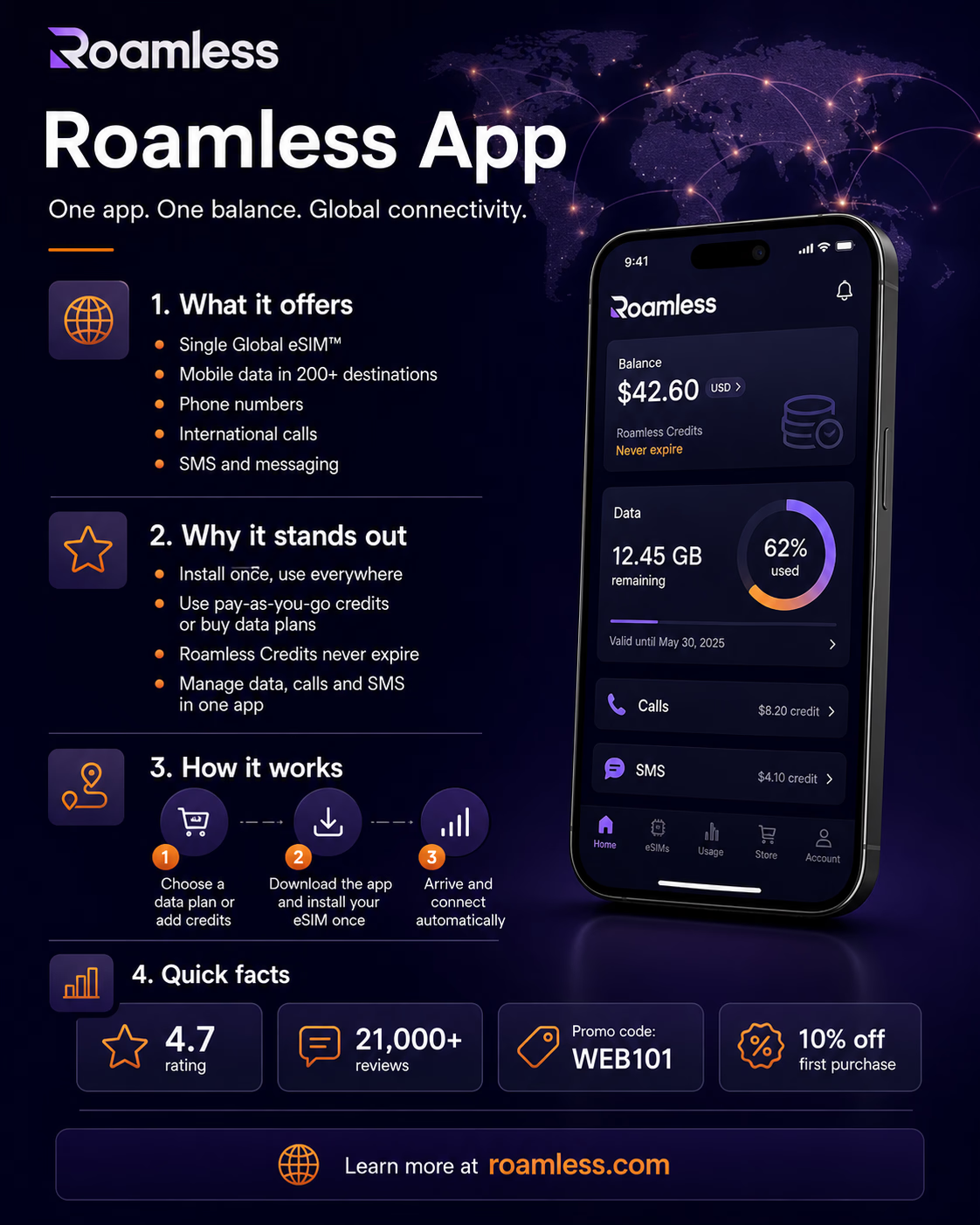
Roamless positions itself around a “Single Global eSIM” that works in 200+ destinations, with one app and one balance for data, calls and SMS. Users can either buy prepaid data plans or use Roamless Credits for pay-as-you-go usage, and the company says those credits do not expire. For travelers who move between countries often, that changes the mental model. You are not buying “Italy eSIM”, then “Turkey eSIM”, then “UAE eSIM”. You are keeping a travel connectivity wallet ready for wherever you land next.
That is where the phrase “flexible travel internet” actually makes sense. Not as marketing fluff, but as a product category that sits between old-school roaming and the fixed bundle model used by many travel eSIM providers.
Why flexibility matters now
The most annoying part of travel internet is not always the price. Sometimes it is the friction.
You land late. The airport Wi-Fi is weak. Your hotel address is in WhatsApp. The taxi app wants mobile data. Your bank sends a verification code. And suddenly, the “I’ll sort it out when I arrive” plan looks very optimistic.
Fixed eSIM packages solved part of this problem. Providers like Airalo, Nomad eSIM, Ubigi, Holafly and many others made it easier to buy data before departure. But fixed packages still ask travelers to predict their usage. Will 3GB be enough? Is unlimited really unlimited? What happens if the trip changes? What if you cross into another country for two days?
READ MORE: Roamless Pay-As-You-Go eSIM: Flexible Travel Data
Roamless is interesting because its pay-as-you-go structure is better matched to messy, real travel behavior. The app listings describe pay-as-you-go data starting from $2.45/GB and plans from $1.25/GB, with tethering allowed and setup through one-time activation of the Single GIobal eSIM. That combination gives Roamless two lanes: casual flexible use through balance, and lower per-GB pricing when a traveler knows they need a proper plan.
This is especially useful for people who do not travel in neat seven-day blocks. Think consultants, airline staff, conference visitors, digital nomads, cruise passengers, startup founders, journalists, or anyone who keeps bouncing between cities. Their problem is not just “cheap data”. It is continuity.
The wallet model
The clever part of Roamless is the balance.
A non-expiring balance reduces the pressure to use data before a package disappears. That matters because many travel eSIM plans still come with validity windows. You buy 10GB for 30 days, use 3GB, and the rest quietly dies. For a two-week holiday, that may be fine. For irregular travelers, it feels wasteful.
Roamless Credits can be used for pay-as-you-go data, calls or SMS, according to the company’s own description. That makes the app feel less like a one-off travel add-on and more like a lightweight connectivity account. It is closer to how people already think about Revolut, Wise or ride-hailing apps: add balance, use when needed, keep it ready.
READ MORE: Roamless Adds Calls, SMS and Phone Numbers — Is This the All-in-One Travel eSIM?
There is another subtle advantage here. A single globaI eSIM installed once removes repeated installation anxiety. Anyone who writes about eSIMs knows this pain point is underrated. Many travelers are still nervous about QR codes, activation timing, deleting profiles, switching lines and losing access to their normal number. Reducing that process to “install once and reuse” is not glamorous, but it is exactly the kind of simplification that helps mainstream adoption.
Where Roamless fits
Roamless is not the only player trying to escape the old country-plan model.
Yesim has pushed a similar “always-ready” logic with Pay & Fly, where users keep one eSIM and pay from a balance across many countries. Ubigi, backed by Transatel, has strong credibility in connected cars, laptops and recurring connectivity use cases. Airalo remains powerful because of its marketplace scale and brand awareness. Holafly has built a simple consumer proposition around unlimited-style travel data, especially for vacationers who do not want to calculate gigabytes. Nomad is strong for straightforward destination and regional plans.
READ MORE: Roamless Price: Is Pay-As-You-Go eSIM Worth It?
Roamless sits somewhere between the marketplace eSIM and the persistent connectivity wallet. Its strength is not necessarily that it is always the cheapest option for every country. It is that it reduces decision fatigue. For users who value flexibility over hunting the lowest possible local rate every time, that can be a strong proposition.
The market is clearly moving in this direction. TechRadar, citing Juniper Research, reported that travel eSIM revenue was projected to reach $1.8 billion by the end of 2025, up 85% from 2024, with smaller digital providers challenging traditional operators. Another TechRadar report, citing CCS Insight, projected travel eSIMs rising from 70 million in 2024 to 280 million by 2030, with market value exceeding $4.4 billion.
In other words, this is no longer a niche product for tech-savvy backpackers. It is becoming a mainstream travel layer.
 The catch
Flexible does not automatically mean perfect.
Pay-as-you-go is great for unpredictable use, but heavy users still need to compare country rates carefully. A traveler streaming video, hotspotting a laptop and uploading content daily may be better off with a larger fixed plan or an unlimited-style offer, depending on the destination and fair usage rules. Roamless does offer both credits and plans, which helps, but the user still needs to understand the difference.
READ MORE: Roamless In-App Calling: A Smarter Way to Call Abroad
There is also the broader issue of network performance. Two eSIMs can use the same local network and still perform differently because of routing, roaming agreements, latency and traffic management. That is the part most consumers never see. Travel eSIM brands increasingly compete not only on coverage maps, but on how well the connectivity is orchestrated behind the scenes.
This is where the next phase of competition will happen. Not just “200+ countries”. Everyone says that now. The real questions are: how stable is the route, how transparent is pricing, how easy is recovery when something fails, how quickly can users get help, and does the product fit repeat travel rather than one trip?
Conclusion
Roamless is worth watching because it reflects where travel connectivity is heading: away from disposable trip bundles and toward persistent, flexible internet accounts.
That does not make fixed eSIM plans obsolete. Airalo, Nomad and Ubigi will still be very attractive for travelers who know exactly where they are going and how much data they need. Holafly will still appeal to people who hate counting gigabytes. Yesim’s Pay & Fly is a strong comparison point because it also treats connectivity as an ongoing balance rather than a single destination purchase.
But Roamless understands something important: many travelers do not want to become telecom experts before every flight. They want a working connection, a reusable setup, and enough flexibility when plans change. In a market crowded with “best eSIM for X country” offers, that may be the more durable idea. The future of travel internet is not just cheaper data. It is data that behaves more like a travel utility, ready before the traveler even needs to think about it.