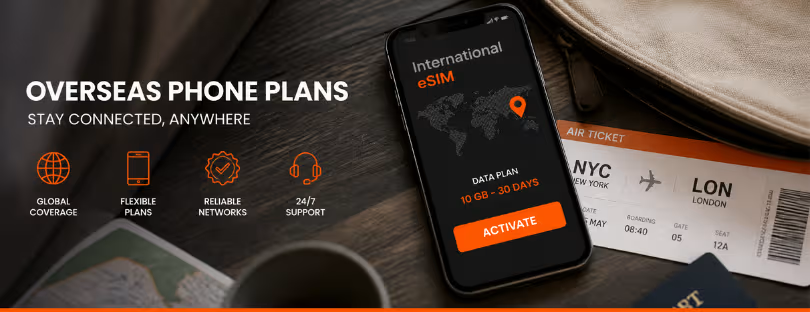
For years, overseas phone plans were simple. You landed, your phone connected, and your home operator billed you later. That’s still how traditionalroaming works.
But the problem hasn’t gone away. It’s just been repackaged.
A large share of travelers still don’t fully understand roaming charges, and many get hit with unexpected bills. If you skip a roaming package entirely, it can get extreme very quickly, especially for heavy data usage.
That’s why behavior hasn’t really changed. People still turn off mobile data, hunt for Wi-Fi, and limit usage abroad. The core experience is still built on caution rather than confidence.
Carrier international plans: predictable, but expensive
To fix that, operators introduced daily passes and travel bundles.
You’ve seen them. €5 to €15 per day, unlimited data claims with fair use limits, and the promise that you can keep your number.
They solve one thing well: predictability.
But they come at a cost. A two-week trip on a €10 daily plan quickly adds up to €140, which is often more than the flight itself.
Structurally, these plans are designed to protect operator revenue, not optimize your usage. That’s why they rarely compete aggressively on price, even as alternatives become cheaper.
So yes, these plans are safe. But they are rarely the smartest option.
Overseas plans are becoming products, not add-ons
This is where things start to shift.
Overseas connectivity is no longer tied to your home operator. It is becoming something you choose separately, just like booking a hotel or buying insurance.
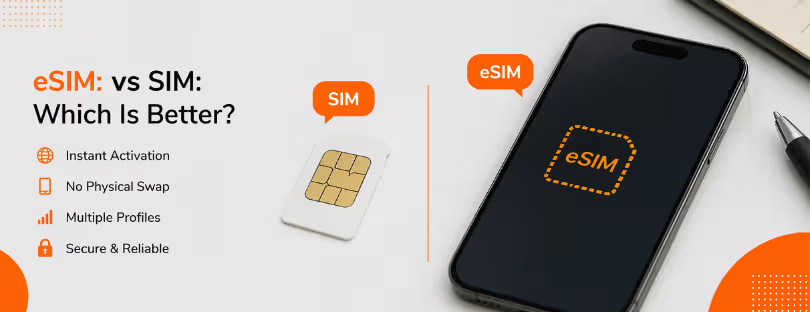
Instead of roaming being an extension of your plan, it is now a standalone purchase. You activate it instantly, control it through an app, and switch between providers without friction.
And the economics are completely different. Travel eSIMs are significantly cheaper than traditional roaming or daily passes, often by a wide margin.
This is not a small improvement. It is a structural change in how connectivity is sold.
Data vs real phone numbers
Most travel eSIMs solved the data problem. But voice and phone numbers are still where things get more interesting.
Some providers are starting to bridge that gap.
Yesim offers global data with options for voice and virtual numbers, making it more relevant for business travelers and longer trips.
Airhub operates more on the infrastructure side, but also supports plans that include number functionality depending on the setup.
Numero eSIM is one of the clearest examples of where this is going. It focuses on giving users local numbers in multiple countries, which is critical for verification, banking, and business use cases.
Nomad eSIM is mostly data-first, but is starting to move toward more complete offerings through partnerships and regional support.
aloSIM sits somewhere in between, combining data with international calling credits, which feels closer to a traditional telecom experience.
This is the key shift. Overseas phone plans are splitting into two categories. Data-first solutions that are cheaper and flexible, and full telecom solutions that combine data, voice, and identity.
The second category is still developing, but it is where the market is clearly heading.
Why is this market growing so fast?
This is no longer a niche category.
Growth is being driven by a combination of factors. Devices now support eSIM by default. Remote work has changed how people travel. Travelers expect to be connected all the time, not occasionally.
There is also a behavioral shift. People who used to avoid mobile data abroad are starting to use it again because the risk has been reduced.
And underneath all of this, telecom is slowly turning into software. That changes everything about how these products are built and sold.
What travelers are actually choosing
If you strip away the marketing, most travelers today fall into three groups.
Casual travelers still prioritize simplicity. They use carrier day passes or basic prepaid eSIM packages because they do not want to think about connectivity.
Frequent travelers optimize more aggressively. They use regional or global eSIMs, multi-country plans, and flexible models that match their movement.
Power users like digital nomads or business travelers need reliability and identity. They are more likely to choose eSIMs with phone numbers, multi-network access, and subscription-style connectivity.
This last group is where the biggest gap still exists.
Where overseas phone plans are going next
The real competition is no longer roaming versus eSIM.
It is telecom versus software.
The most interesting players are not selling plans anymore. They are building connectivity layers.
We are seeing global eSIMs that work across multiple countries without switching. Plans that activate only when you go online. Phone numbers are becoming part of a broader identity layer rather than just a calling feature.
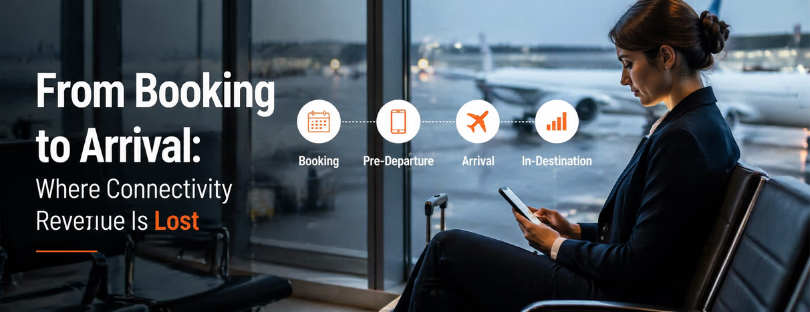
Even more importantly, connectivity is starting to be embedded into other products. Airlines, banks, and travel platforms are beginning to explore how eSIM can be part of their core experience, not just an add-on.
That is a much bigger shift than pricing.
Conclusion
The term overseas phone plans is starting to feel outdated.
What used to be a telecom feature is becoming its own product category.
Traditional roaming still exists, but it is increasingly a fallback option. Carrier travel plans offer predictability, but at a premium that is hard to justify.
The real momentum is with eSIM providers like Yesim, Airhub, Numero, Nomad, and aloSIM. Not just because they are cheaper, but because they rethink how connectivity works.
The most important change is this. Connectivity is no longer tied to your operator. It is something you choose, manage, and integrate into your travel experience.
And once that happens, telecom stops being invisible infrastructure.
Driven by wanderlust and a passion for tech, Sandra is the creative force behind Alertify. Love for exploration and discovery is what sparked the idea for Alertify, a product that likely combines Sandra’s technological expertise with the desire to simplify or enhance travel experiences in some way.