ORoaming: OnePlus and Oppo’s Built-In Travel Data
For most travelers, mobile data abroad still starts with one familiar moment of friction. You land, turn off airplane mode, and then the choice appears: risk expensive roaming, search for airport Wi-Fi, buy a local SIM, or install a travel eSIM before the trip.
Oppo and OnePlus have been testing a different answer: put the travel data shop inside the phone itself.
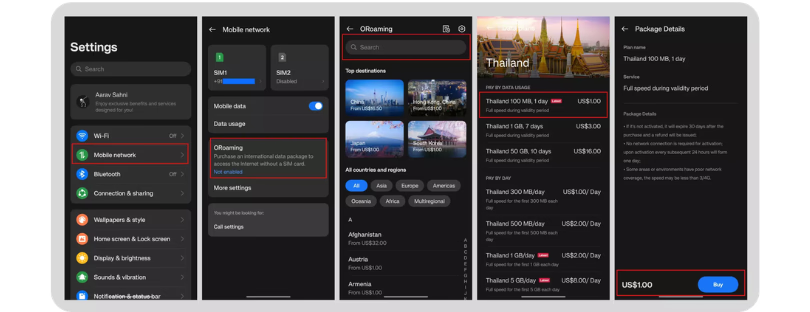
Through ORoaming and Redtea Mobile’s device-maker partnerships, selected Oppo and OnePlus users can buy and activate destination data plans directly from their phone settings, without hunting for a local SIM card or relying on a separate third-party eSIM app. OnePlus users have described ORoaming as a feature that removes the need to buy a physical SIM or third-party eSIM, while Oppo’s travel guidance points users to Settings > Mobile Network > ORoaming where available.
What ORoaming actually does
Instead of treating travel connectivity as something outside the device, ORoaming brings the purchase flow into the operating system experience. A traveler chooses a country or region, buys a data package, activates it, and uses mobile data abroad without swapping a SIM card.
Redtea Mobile describes its Android device-maker offer as “International Roaming Services now In-Built in Android Devices,” with a built-in Digital SIM designed to provide global network service. The company says the service has been deployed in China since 2015 across smartphone brands, and expanded from 2017 into markets including Thailand, Malaysia, Indonesia, India, the Philippines, plus American and European markets with OnePlus, OPPO and vivo devices.
This changes where the customer relationship begins. Traditional roaming starts with the mobile operator. Travel eSIMs usually start with an app or marketplace. ORoaming starts with the handset.
Redtea’s role behind the scenes
Redtea Mobile is not new to this space. The company positions itself as an eSIM service and device connectivity provider, offering remote SIM provisioning, global cellular data coverage and eSIM-based applications. In one statement, Redtea said its platform allows users to “buy pay-as-you-go local connectivity and switch among multiple cellular data plans,” while Redtea Roaming was described separately as creating a virtual local SIM card based on the user’s location.
READ MORE: Oppo Find X9 Ultra: eSIM & Camera Flagship Lands in Europe
That phrase — virtual local SIM card — is important. ORoaming may feel like an eSIM to the user, but it should not always be confused with a standard consumer eSIM profile installed through the normal GSMA eUICC flow. GSMA defines eSIM as a global specification enabling remote SIM provisioning, with multiple operator profiles stored on a device and switched remotely. ORoaming is closer to a device-integrated travel data layer, powered by Redtea’s connectivity platform.
Why phone makers like this model
For Oppo and OnePlus, built-in travel connectivity is a useful premium-device feature. It gives the phone one more service layer after purchase, and turns global travel into part of the device experience.
For Redtea Mobile, the model creates distribution at the hardware level. Instead of acquiring every traveler through app stores, ads or search, Redtea can sit inside the phone’s settings menu. That is powerful real estate.
READ MORE: OnePlus Open’s latest update expands eSIM support
For operators, the story is more complicated. Built-in roaming alternatives can reduce dependence on home-operator roaming bundles, especially for price-sensitive travelers. But they can also create wholesale demand for local data access and new partnership routes with OEMs and connectivity platforms. The smarter operators will see this as proof that connectivity retail is moving closer to software.
The experience still needs transparency
This model is not perfect.
Travelers still need to check availability by region and device model. Oppo notes ORoaming is available across APAC and select countries, so it is not universal on every Oppo phone. OnePlus availability can also vary by model, region and software build.
Users also need clear information on validity, speed policy, hotspot support, refund rules, network partner, and whether the plan is data-only. A built-in feature can feel more trustworthy because it lives inside the phone, but that raises the standard for transparency. If usage tracking is unclear or support is hard to reach, travelers will blame the phone brand too.
For heavy data users, business travelers needing expense control, or anyone who wants one eSIM across multiple trips, a dedicated travel eSIM provider may still be the better fit. RedteaGO, Airalo, Nomad, Ubigi, Yesim and Holafly all approach the market differently, with app-based account management, plan comparison and clearer cross-device portability.
Conclusion
ORoaming is not just another roaming button. It is a sign of where travel connectivity is heading.
Apple normalized eSIM as part of the smartphone experience, while Motorola has now introduced Global Connect, a native travel connectivity app powered by Gigs and available for eSIM-compatible Motorola devices in selected markets. Oppo and OnePlus, through Redtea Mobile, show another path: make international data a native handset feature and let the traveler buy connectivity where they manage mobile networks.
That will not replace travel eSIM marketplaces overnight. It is too device-dependent, too region-specific, and still needs better education around what kind of “SIM” is actually being used. But it points to a bigger trend: the SIM card is no longer just plastic or a QR code. It is becoming a software layer, a retail channel, and increasingly, a device feature.
For travelers, that is good news. The fewer airport SIM queues, the better. For telecom players, it is a warning: if operators do not make roaming simple, phone makers and software connectivity platforms will keep doing it for them.